Uttaradhyayana Sutra · Chapter 23

Dialogue of Kesi and Gautama (केसीगोयमिज्जं)

Chapter 23 — The Historic Dialogue between the Traditions of Lord Parshva and Lord Mahavira

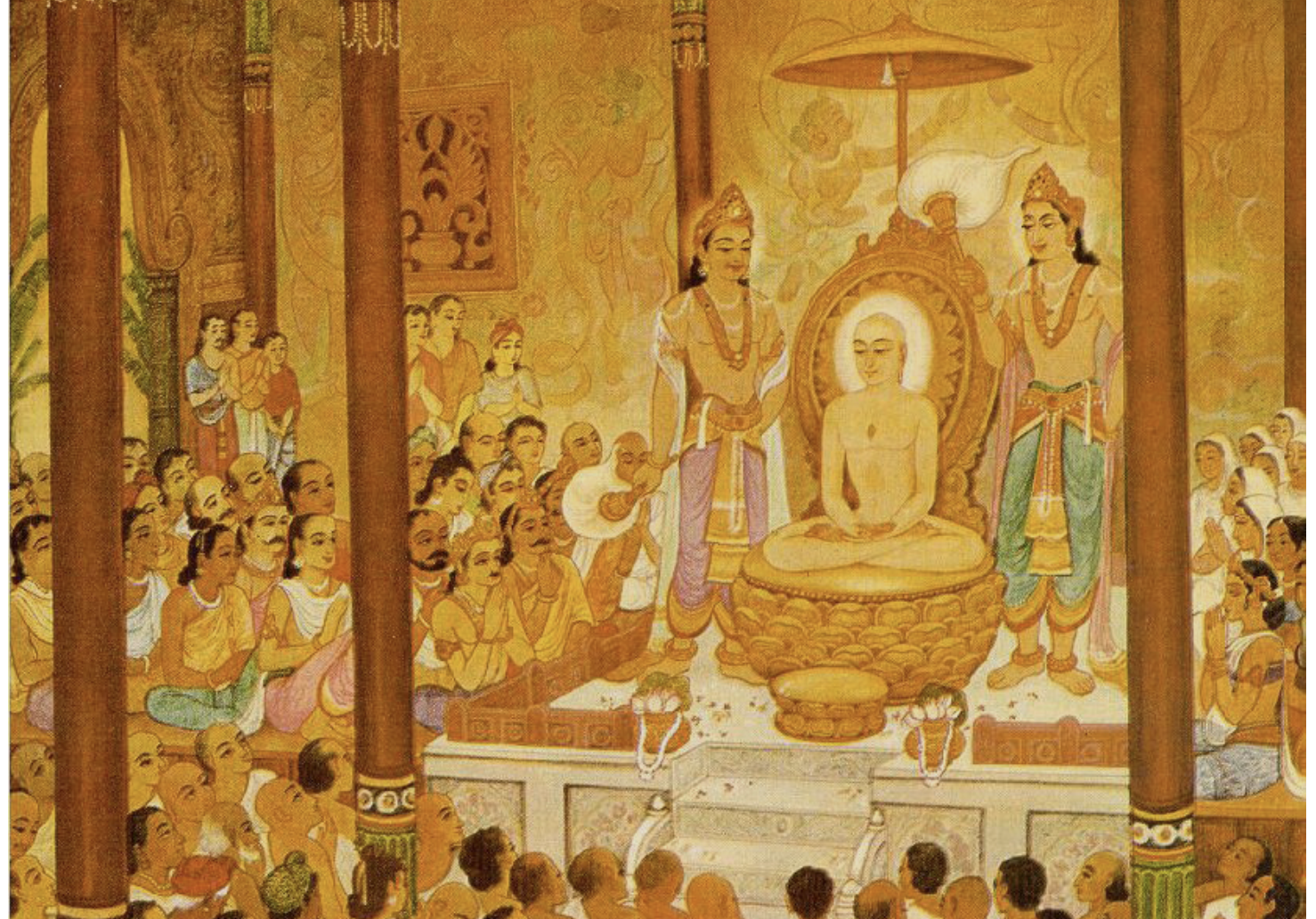
Kesi and Gautama dialogue

केसीकुमार समणे, गोयमे य महायसे । उभओ णिसण्णा सोहंति, चंद-सूर-समप्पभा

“Keśī Kumāra the ascetic and the great-souled Gautama, both seated, shone like the sun and moon together.”

About This Chapter

The Dialogue of Kesi and Gautama

Kesi-Gautamiya — the twenty-third chapter — records one of the most significant intellectual and spiritual encounters in the Jain Aagamas. It bridges the transition between the tradition of Lord Parshvanatha (the 23rd Tirthankara) and Lord Mahavira (the 24th Tirthankara).

The chapter is structured as a series of twelve questions posed by Kesi and answered by Gautama. They address the apparent differences in their traditions—the four vows versus five, and the wearing of clothes versus nakedness—resolving them through the principle that while the outer form of the Dharma adapts to the capacity of the age, the inner essence remains the same.

Chapter Structure

I The Meeting of Lineages (1–9)
II Disciples' Doubts (10–18)
III Twelve Questions & Answers (19–81)
IV Resolution & Conversion (82–89)
89 Sutras
Kesi & Gautama Participants
12 Q&A Cycles
Adhyayana 23

The 89 Sutras

Each sutra is presented with the original Prakrit, English translation, and a simplified commentary.

Introduction — The Meeting of Lineages
23.1

जिणे पासे ति णामेणं, अरहा लोगपूइओ । संबुद्धप्पा य सव्वण्णू, धम्म तित्थयरे जिणे ॥२३.१॥

The Jina named Pārśva, the worthy one honored by the world, was self-enlightened, omniscient, and the ford-maker of the Dharma.

The chapter opens by establishing the lineage of Keśī through his master Pārśvanātha, the twenty-third Tīrthaṅkara. Pārśvanātha is described with four epithets: Jina (conqueror of passions), Arhant (worthy of veneration), Saṃbuddha (self-awakened), and Sarvajña (omniscient). The word "Tīrthaṅkara" means one who creates the ford — a crossing point over the ocean of saṃsāra — making the path of liberation accessible to all souls.

The simple version: This verse introduces Lord Pārśva, a great spiritual teacher who had conquered all inner enemies and could see all of reality, and who showed others the path to freedom.

23.2

तस्स लोगपईवस्स, आसी सीसे महायसे । केसीकुमार समणे, विज्जाचरण पारगे ॥२३.२॥

That world-illuminating lord had a great and renowned disciple — Keśī Kumāra the ascetic, who had reached the far shore of knowledge and conduct.

Keśī Kumāra is introduced as the foremost disciple of Pārśvanātha. The compound vijjācaraṇa-pārage means he had mastered both theoretical knowledge (vijjā) and practical conduct (caraṇa) — he was not merely learned but fully lived what he knew. This dual mastery is the hallmark of true spiritual attainment in Jain tradition.

The simple version: Lord Pārśva's greatest student was Keśī, a monk who had completely mastered both spiritual knowledge and the disciplined life that goes with it.

23.3

ओहिणाणसुए बुद्धे, सीससंघसमाउले । गामाणुगाम रीयते, सावत्थिं पुरिमागए ॥२३.३॥

Possessed of clairvoyant knowledge and scriptural learning, wise, surrounded by his assembly of disciples, wandering village to village, he arrived at the city of Śrāvastī.

Keśī is described as possessing avadhi-jñāna (clairvoyant perception) in addition to scriptural learning — a supernatural faculty that allowed him to perceive beyond ordinary sensory range. The wandering ascetic life (caryā) from village to village was the prescribed mode of existence for Jain monks, preventing attachment to any fixed place. Śrāvastī was one of the great cities of ancient India, a major center of religious life.

The simple version: Keśī, gifted with special inner sight and surrounded by his monk-students, traveled from town to town and eventually arrived at a great city called Śrāvastī.

23.4

तिंदुयं णाम उज्जाणं, तम्मि णगरमंडले । फासुए सिज्जसंथारे, तत्थ वासमुवागए ॥२३.४॥

In the district of that city there was a garden called Tinduka, and there, on a pure and permissible bed and mat, he took up residence.

The Tinduka garden (named after the tinduka/tendu tree) was in the outskirts of Śrāvastī. The term phāsua (prāsuka) indicates that the resting place was checked to ensure no living beings were harmed — a fundamental Jain principle of ahiṃsā even in the most mundane acts. Jain monks cannot stay in any place without first ensuring it is free of harm to living beings.

The simple version: Keśī settled in a garden outside the city, making sure his resting place didn't cause harm to any living creature — as Jain monks always do.

23.5

अह तेणेव कालेणं, धम्मतित्थयरे जिणे । भगवं वद्धमाणित्ति, सव्वलोगम्मि विस्सुए ॥२३.५॥

And at that very same time, the Jina who was the ford-maker of the Dharma — the Blessed One named Vardhamāna — was renowned throughout the entire world.

The sutra introduces Mahāvīra (Vardhamāna) as a parallel figure at the very same moment in history — a masterly narrative technique establishing the two traditions as contemporaneous. Mahāvīra is called the twenty-fourth Tīrthaṅkara, the ford-maker of Dharma, paralleling Pārśvanātha in sutra 1. This symmetry prepares for the profound dialogue to follow.

The simple version: At the same time Keśī arrived in Śrāvastī, the great teacher Mahāvīra — also known as Vardhamāna — was famous throughout the world.

23.6

तस्स लोगपईवस्स, आसी सीसे महायसे । भगवं गोयमे णामं, विज्जाचरणपारगे ॥२३.६॥

That world-illuminating lord had a great and renowned disciple — the Blessed Gautama by name — who had reached the far shore of knowledge and conduct.

This sutra is deliberately constructed as a mirror of sutra 2, using identical language to describe Gautama that was used for Keśī. This parallel structure is a literary device showing that both disciples are equals in attainment — only the masters differ. Gautama (Indrabhūti Gautama) was Mahāvīra's foremost disciple and chief questioner in many dialogues of the Āgamas.

The simple version: Just as Keśī was Pārśva's greatest student, Gautama was Mahāvīra's greatest student — equally accomplished in both learning and practice.

23.7

बारसंगविऊ बुद्धे, सीससंघसमाउले । गामाणुगाम रीयते, से वि सावत्थिमागए ॥२३.७॥

A knower of the twelve Aṅgas, wise, surrounded by his assembly of disciples, wandering village to village, he too arrived at Śrāvastī.

Gautama is described as bārasa-aṅga-viu — master of all twelve Aṅgas of the Jain canon. This mirrors Keśī's description as possessing avadhi-jñāna in sutra 3, but with a different emphasis: Keśī has supernatural perception while Gautama has comprehensive scriptural mastery. Together, the two disciples represent the fullness of spiritual achievement in their respective traditions.

The simple version: Gautama, who knew all twelve sacred Jain scriptures by heart, was also wandering with his students and arrived at the same city of Śrāvastī.

23.8

कोट्टगं णाम उज्जाणं, तम्मि णगरमंडले । फासुए सिज्जसंथारे, तत्थ वासमुवागए ॥२३.८॥

In the district of that city there was a garden called Koṭṭaka, and there, on a pure and permissible bed and mat, he took up residence.

Just as Keśī stayed in the Tinduka garden (sutra 4), Gautama stayed in the nearby Koṭṭaka garden. The two great teachers were now residing in the same city but in different gardens — a divinely arranged proximity that would enable the historic dialogue. The identical phrasing once again underscores the structural parallelism of the two traditions.

The simple version: Gautama settled in a different garden in the same city as Keśī — the two greatest disciples of two great teachers were now living very close to each other.

23.9

केसीकुमार समणे, गोयमे य महायसे । उभओ वि तत्थ विहरिंसु, अल्लीणा सुसमाहिया ॥२३.९॥

Both Keśī Kumāra the ascetic and the great-souled Gautama dwelled there, absorbed and well-composed in deep equanimity.

Jain PrincipleSamata · Equanimity

Equal-mindedness in pleasure and pain reveals the soul's true nature.

The word allīṇā (absorbed, inward) and susamāhiyā (well-established in samādhi) describe both monks as deeply settled in their practice — not restless or competitive, but inwardly peaceful. Great souls, even when representing different traditions, share this quality of inner stability. The stage is set: two masters of equanimity are about to meet.

The simple version: Both Keśī and Gautama were living near each other in a state of deep inner peace and spiritual focus — two great meditating monks in the same city.

Disciples' Concerns and the Meeting
23.10

उभओ सीससंचाणं, संजयाणं तवस्सिणं । तत्थ चिंता समुप्पण्णा, गुणवंताण ताइणं ॥२३.१०॥

Among the disciples of both — the self-restrained and ascetic ones, virtuous and protecting — a concern arose.

The impetus for the great dialogue did not come from the masters themselves, but from their disciples — a detail of great narrative significance. The disciples' sincere concern about doctrinal differences reflects genuine spiritual inquiry, not rivalry or hostility. The text carefully describes these disciples as self-restrained (saṃjaya), ascetic (tapassī), virtuous (guṇavanta), and compassionate protectors of life (tāin) — establishing their motivation as pure.

The simple version: The students of both Keśī and Gautama began to wonder and worry about the differences between their teachers' traditions — not out of rivalry, but out of genuine curiosity.

23.11

केरिसो वा इमो धम्मो, इमो धम्मो वा केरिसो । आयार-धम्मपणिही, इमा वा सा व केरिसी ॥२३.११॥

What is the nature of this Dharma? And what is the nature of that Dharma? What is the conduct-discipline of this one, and what is the conduct-discipline of that one?

Jain PrincipleVinaya · Discipline

Self-imposed order of thought, word, and deed transforms the soul.

The disciples' inquiry is expressed through this beautifully balanced verse — alternating "this" and "that" without declaring either superior. Their question is not polemical but philosophical: what are the essential natures of these two paths? The word āyāra-dhammapaṇihī is significant — it asks not just about doctrine but about the actual lived conduct-discipline (āyāra) that each tradition prescribes.

The simple version: The students were asking: "What exactly is our teacher's path and what is the other teacher's path? What rules of conduct do they each follow, and why are they different?"

23.12

चाउज्जामो य जो धम्मो, जो इमो पंचसिक्खओ । देसिओ वद्धमाणेण, पासेण य महामुणी ॥२३.१२॥

The four-fold restraint that is one Dharma, and the five-fold discipline that is this Dharma — both were taught by great sages: Vardhamāna and Pārśva.

Jain PrincipleAhimsa · Non-Violence

Harmlessness toward all beings is the foundation of all virtues.

This sutra names the core doctrinal difference precisely. Pārśvanātha taught cāturyāma — four great restraints (non-violence, truth, non-stealing, non-possession). Mahāvīra taught pañca-mahāvrata — five great vows, adding brahmacarya (celibacy) as the fifth. Both are described equally as "taught by great sages," neither being dismissed. The disciples' concern was genuine: if both teachers are great sages, why do the vow-counts differ?

The simple version: One teacher (Pārśva) taught four main vows for monks, and the other teacher (Mahāvīra) taught five — and the students wanted to understand why two great teachers gave different rules.

23.13

अचेलगो य जो धम्मो, जो इमो संतरुत्तरो । एगकज्ज-पवण्णाणं, विसेसे किण्णु कारणं ॥२३.१३॥

The Dharma of nakedness and the Dharma with upper and lower garments — for those who have entered the same goal, what is the reason for this difference?

A second difference is identified: Mahāvīra's monks went completely naked (digambara practice in its root form), while Pārśvanātha's monks wore two pieces of cloth. The disciples' question is incisive — if both paths lead to the same liberation, why the difference in dress? This question cuts to the heart of the relationship between external form and inner realization.

The simple version: One tradition's monks wore no clothes at all, and the other wore simple robes — students were asking why monks going for the same goal should look different.

23.14

अह ते तत्थ सीसाणं, विण्णाय पवित्तिकयं । समागमे कयमई, उभओ केसि-गोयमा ॥२३.१४॥

Then, having perceived the conduct and activity of their disciples there, both Keśī and Gautama resolved to meet.

This is a pivotal moment: both masters, being clairvoyant and deeply perceptive, independently became aware of their disciples' concerns without being told directly. Rather than ignoring the situation, both resolved to address it through dialogue. This demonstrates the ideal of a true teacher — responsive to the needs of students even before being asked. Both masters initiated the meeting, showing no hierarchy between them.

The simple version: Both Keśī and Gautama somehow sensed what their students were wondering about, and both decided on their own to meet each other and talk.

23.15

गोयमो पडिरूवण्णू, सीससंघसमाउले । जेट्ठुं कुलमवेक्खंतो, तिंदुयं वणमागओ ॥२३.१५॥

Gautama, knowledgeable about proper conduct, surrounded by his community of disciples, honoring the elder lineage, came to the Tinduka garden.

Gautama came to Keśī's garden — not Keśī to Gautama's. This is a significant detail: Gautama, despite being the disciple of the later and current Tīrthaṅkara Mahāvīra, showed deference to Keśī's seniority as a disciple of the earlier Tīrthaṅkara Pārśvanātha. The phrase jeṭṭhuṃ kulam (elder lineage) explicitly honors the anteriority of the Pārśvanātha tradition. This models the virtue of humility even across traditions.

The simple version: Gautama went to visit Keśī at Keśī's garden — showing respect for the fact that Pārśva's tradition was older.

23.16

केसीकुमारसमणे गोयमं दिस्समागयं । पडिरूवं पडिवत्ति, सम्मं संपिडवज्जइ ॥२३.१६॥

Seeing Gautama coming, Keśī the ascetic properly received him with appropriate conduct and offered fitting hospitality.

Keśī's welcome of Gautama is described with the words paḍirūva (fitting, appropriate) and sammaṃ (properly, correctly) — indicating that the reception followed the protocols of respectful greeting between senior ascetics. There is no competition or wariness, only proper and warm hospitality. The scene exemplifies how two streams of the same spiritual river can meet — with grace and mutual honor.

The simple version: When Keśī saw Gautama arriving, he greeted him warmly and properly — with the full respect one great teacher gives to another.

23.17

पलालं फासुयं तत्थ, पंचमं कुसतणाणि य । गोयमस्स णिसेज्जाए, खिप्पं संपणामए ॥२३.१७॥

He quickly arranged permissible straw, soft grass, and kuśa grass as a seat for Gautama.

Keśī personally arranged a simple seat of straw and grass for Gautama — not a throne or cushion, as befitting ascetic simplicity, but arranged with care and promptness (khippaṃ = quickly). Even the grass chosen was phāsua — checked to ensure no living beings were harmed. This small detail reveals the meticulous ahiṃsā embedded in every action of a Jain monk, even in welcoming a guest.

The simple version: Keśī quickly spread some clean grass on the ground as a simple seat for Gautama — even in this small act being careful not to harm any living creatures.

23.18

केसीकुमारसमणे, गोयमे य महायसे । उभओ णिसण्णा सोहंति, चंद-सूर-समप्पभा ॥२३.१८॥

Keśī Kumāra the ascetic and the great-souled Gautama, both seated, shone like the sun and moon together.

The image of the moon and sun together captures the beauty and complementarity of this meeting perfectly. The moon and sun are different — one rules the night, one the day — yet both illuminate the world. Similarly, Keśī and Gautama represent different but equally luminous traditions. The verse radiates the joy of this meeting: two stars of the spiritual world seated together in harmony.

The simple version: Seeing both Keśī and Gautama sitting together, people said they looked as radiant as the sun and moon side by side — two great lights in the world at the same time.

23.19

समागया बहु तत्थ, पासंडा कोउगा मिगा । गिहत्थाणं अणेगाओ, साहस्सीओ समागया ॥२३.१९॥

Many came there — ascetics of various sects, curious people, animals, and householders by the thousands.

Word of the meeting spread quickly, drawing an immense and diverse gathering. The text specifically includes migā (animals) among those who came — reflecting the Jain understanding that all beings, not only humans, are drawn toward the presence of great souls. Even animals are shown to have a natural affinity for virtue and light. The assembly represented all of creation gathering to witness this historic dialogue.

The simple version: Word spread fast, and thousands of people — monks of all traditions, regular folks, and even animals — came to the Tinduka garden to witness this meeting.

23.20

देव-दाणव-गंधव्वा, जक्ख-रक्खस-किण्णरा । अदिस्साणं च भूयाणं, आसी तत्थ समागमो ॥२३.२०॥

Gods, demons, gandharvas, yakshas, rākshasas, kinnāras, and invisible beings — all were assembled there.

The gathering extended beyond the human and animal world to include divine and semi-divine beings — gods, demigods, and invisible spirits. In Jain cosmology, such gatherings (samavasaraṇa) occur naturally around events of great spiritual significance, as beings from all realms of existence are attracted by the presence of advanced souls. This cosmic assembly underscores the universal importance of the dialogue about to unfold.

The simple version: Even heavenly beings — gods, celestial musicians, spirits — gathered invisibly to witness this great spiritual conversation, because truth draws all beings.

23.21

पुच्छामि ते महाभाग, केसी गोयममब्बवी । तओ केसिं बुवंतं तु, गोयमो इणमब्बवी ॥२३.२१॥

"I wish to ask you something, O Mahābhāga," said Keśī to Gautama. Then, as Keśī spoke thus, Gautama replied to him:

Keśī initiates the dialogue, addressing Gautama as mahābhāga — "O great-fortuned one" or "O blessed one" — a term of deep respect. The dialogue is structured through the sutra as a formal exchange: Keśī speaks, Gautama responds. What follows is twelve cycles of Keśī asking and Gautama answering, with Keśī expressing satisfaction and raising the next doubt. The form itself models gracious spiritual inquiry.

The simple version: Keśī opened the conversation respectfully, telling Gautama he had some questions to ask, and Gautama invited him to go ahead.

23.22

पुच्छ भंते जिहिच्छं ते, केसिं गोयममब्बवी । तओ केसि अणुण्णाए, गोयमं इणमब्बवी ॥२३.२२॥

"Please ask, Venerable One, whatever you wish," said Gautama to Keśī. Then, with Keśī's permission, Gautama said to him:

Gautama responds with equal grace, addressing Keśī as bhaṃte (Venerable One) and giving him complete freedom to ask whatever he wishes. Notably, the sutra also says Gautama waited for Keśī's formal permission (aṇuṇṇāe) before speaking — a detail that shows the extraordinary mutual respect and protocol of this exchange. Neither master asserts precedence; the dialogue is a co-creation of genuine seeking.

The simple version: Gautama invited Keśī to ask whatever he wanted, and then — after Keśī's permission — began to answer, each of them showing the utmost respect for the other.

Question 1 — Four Vows vs. Five Vows
23.23

चाउज्जामो य जो धम्मो, जो इमो पंचसिक्खओ । देसिओ वद्धमाणेण, पासेण य महामुणी ॥२३.२३॥

The four-fold restraint that is one Dharma, and the five-fold discipline that is this other Dharma — both were taught by great sages, Vardhamāna and Pārśva.

Jain PrincipleVinaya · Discipline

Self-imposed order of thought, word, and deed transforms the soul.

Keśī now formally poses the first question, repeating verbatim the concern expressed in sutra 12. The repetition is deliberate — it signals that this is no longer background narrative but formal philosophical inquiry. The question is precisely framed: the same liberation-goal, two different forms of vow. The four vows of Pārśva were non-violence, truth, non-stealing, and non-possession. Mahāvīra's five added celibacy as explicit and separate.

The simple version: Keśī asked his first formal question: "Both Pārśva and Mahāvīra were great teachers, but one taught four vows and the other five — why?"

23.24

एगकज्ज-पवण्णाणं, विसेसे किण्णु कारणं ? । धम्मे दुविहे मेहावी, कहं विप्पच्चओ ण ते ॥२३.२४॥

For those who have entered the same goal, what is the reason for this difference? O wise one, how do you not see contradiction in this twofold Dharma?

Jain PrincipleMoksha · Liberation

Freedom from karma and rebirth is the soul's eternal home.

Keśī sharpens the question — if the goal is one (liberation), how can the path be two? This is a piercing philosophical challenge. He respectfully calls Gautama mehāvī (wise one) while pressing him: surely wisdom should see the contradiction? The question assumes that a truly unified truth cannot produce genuinely different prescriptions. Gautama's answer will challenge this very assumption.

The simple version: Keśī presses harder: "If both paths lead to the same destination of liberation, how can a truly wise person not see that having different rules for monks is a contradiction?"

23.25

तओ केसिं बुवंतं तु, गोयमो इणमब्बवी । पण्णा समिक्खए धम्मं, तत्तं तत्तविणिच्छियं ॥२३.२५॥

Then, as Keśī spoke thus, Gautama replied: "Wisdom examines the Dharma; reality is determined by examining reality."

Jain PrinciplePrajna · Wisdom

Direct insight into reality transcends mere intellectual knowledge.

Gautama's opening response is itself a complete teaching: the answer lies in paṇṇā (prajñā — discernment). Truth must be examined, not merely received. The differences in form are not contradictions for the wise; they are variations that wisdom can penetrate to see the single reality beneath. The word tattaviṇicchiya (determination of truth) implies that doctrinal resolution requires rigorous investigation, not mere preference or loyalty to tradition.

The simple version: Gautama answered: "True wisdom sees through the outer forms to the reality beneath them — examine the truth carefully and the apparent contradiction disappears."

23.26

पुरिमा उज्जुजडा उ, वंकजडा य पच्छिमा । मज्झिमा उज्जुपण्णा उ, तेण धम्मे दुहा कए ॥२३.२६॥

Earlier disciples were straightforwardly simple-minded; later ones were crookedly simple-minded; middle-period ones were straightforward and wise — therefore Dharma was made twofold.

Gautama gives a profound answer: the form of the vows was adapted to the spiritual capacity of the time. In Pārśvanātha's era, people were simpler and more direct — four vows sufficed because brahmacarya was naturally included within non-possession. In Mahāvīra's time, human minds had become more crooked and complex, requiring an explicit fifth vow. The Dharma in its essence is one; its form adapts to the need of the age and the capacity of practitioners. This is the principle of adhikāra — teachings calibrated to the recipient.

The simple version: Gautama explained: "People in Pārśva's time were simpler and more straightforward, so four vows were enough; by Mahāvīra's time, minds had become more complex, so five vows were needed — the teaching adapted to the people."

23.27

पुरिमाणं दुव्विसोज्झो उ, चरिमाणं दुरणुपालओ । कप्पो मज्झिमगाणं तु, सुविसोज्झो सुपालओ ॥२३.२७॥

For the earlier ones, the rule is hard to cleanse away; for the later ones, hard to follow. But for the middle-period ones, the code is easy to cleanse and easy to follow.

Gautama elaborates: earlier disciples were too simple-minded to purify subtle faults (duvvisojjho — hard to cleanse), while later ones (in a degenerate age) find the stricter rules too hard to maintain (duraṇupālao). The middle period — Mahāvīra's time — represents the optimal balance: the five-vow code (pañca-mahāvrata) is both achievable and effective. This is not relativism but pedagogical wisdom: the true Dharma is the one that actually produces liberation in the actual beings of a given age.

The simple version: The four vows worked for the simpler people of earlier times; later times were harder so people couldn't follow even those; Mahāvīra's five vows hit the right balance — clear enough to understand and achievable enough to actually follow.

23.28

साहु गोयम पण्णा ते, छिण्णो मे संसओ इमो । अण्णो वि संसओ मज्झं, तं मे कहसु गोयमा ॥२३.२८॥

"Well done, Gautama! Your wisdom is excellent. This doubt of mine has been cut away. But I have another doubt — please tell me that also, Gautama."

Jain PrinciplePrajna · Wisdom

Direct insight into reality transcends mere intellectual knowledge.

Keśī's response — sāhu! (Excellent! Well done!) — is a spontaneous and wholehearted acknowledgment of a satisfying answer. His doubt was genuinely dissolved, not merely papered over. The pattern "doubt raised → answer given → sāhu! → new doubt" repeats twelve times in this chapter, each cycle a model of sincere philosophical dialogue. Keśī is humble enough to admit when he is satisfied and honest enough to raise the next genuine concern.

The simple version: Keśī was genuinely satisfied with the answer — "That clears it up completely!" — but immediately raised his next honest question, showing both humility and sincere inquiry.

Question 2 — Nakedness vs. Clothed
23.29

अचेलगो य जो धम्मो, जो इमो संतरुत्तरो । देसिओ वद्धमाणेण, पासेण य महाजसा ॥२३.२९॥

The Dharma of nakedness and the Dharma of wearing upper and lower garments — both were taught by greatly renowned sages, Vardhamāna and Pārśva.

Jain PrincipleTyaga · Renunciation

Voluntarily releasing worldly attachments leads to spiritual freedom.

The second question addresses the visible difference in dress between the two traditions. Mahāvīra's monks practiced complete nudity (acela) — total renunciation including of clothing. Pārśvanātha's monks wore two simple garments (saṃtara and uttara — lower and upper cloth). To the outside observer, this is perhaps the most visible doctrinal difference. Keśī asks how two great, equally renowned teachers can prescribe such different physical disciplines.

The simple version: Keśī's second question was about clothes: "Mahāvīra's monks wear nothing at all, and Pārśva's monks wear simple robes — why would two great teachers disagree on something so basic?"

23.30

एगकज्जपवण्णाणं, विसेसे किण्णु कारणं ? । लिंगे दुविहे मेहावि, कहं विप्पच्चओ ण ते ॥२३.३०॥

For those who have entered the same goal, what is the reason for this difference? O wise one, how do you not see contradiction in this twofold sign (of dress)?

Keśī uses the word liṃga (sign, mark, identifier) for dress — recognizing that clothing in ascetic life is not merely practical but symbolic, a visible embodiment of one's vows. His question sharpens the philosophical edge: if sign and truth must correspond, two different signs suggest two different truths. How can wisdom tolerate this? Gautama's answer will address whether the sign (liṃga) or the substance (bhāva) is primary in liberation.

The simple version: Keśī sharpened the question: "The way a monk dresses is a sign of what he believes — how can the same truth produce two different signs?"

23.31

केसिमेवं बुवाणं तु, गोयमो इणमब्बवी । विण्णाणेण समागम्म, धम्म साहणमिच्छियं ॥२३.३१॥

As Keśī spoke thus, Gautama replied: "With discernment, having considered carefully, what is desired is the accomplishment of Dharma."

Gautama again places discernment (viṇṇāṇa = vijñāna) at the center of the answer. The point of any religious sign or dress is the sāhaṇa (accomplishment) of Dharma — i.e., the actual attainment of inner purity and liberation. The sign (liṃga) is instrumental, not essential. Where the inner purpose is served, the sign has done its work. This sets up the full answer in the following sutras.

The simple version: Gautama responded: "What matters is whether the practice actually achieves its purpose — inner transformation — not which specific external form it takes."

23.32

पच्चयत्थं च लोगस्स, णाणाविह विगप्पणं । जत्तत्थं गहणत्थं च, लोगे लिंगपओयणं ॥२३.३२॥

For the purpose of conviction for the world, for diverse configurations of understanding, for the purpose of endeavor and for the purpose of reception — these are the functions of the sign in the world.

CautionSamsara · Worldly Existence

Involvement in worldly activities generates binding karma.

Gautama gives a sophisticated analysis of why religious signs (dress, marks) exist and what purposes they serve. Signs help worldly people recognize and develop faith in spiritual practitioners (paccayatthaṃ — conviction). They also serve the monk's own endeavor (jattatthaṃ) and his ability to receive alms or instruction (gahaṇatthaṃ). Given these purposes, the form of the sign can legitimately vary according to the capacity and culture of the people. The sign is pragmatic, not absolute.

The simple version: Gautama explained that religious dress and symbols exist for practical reasons — to help people recognize monks, to support the monks' practice, and to facilitate their interaction with society — so the form can vary without contradicting the truth.

23.33

अह भवे पइण्णा उ, मोक्ख सभूयसाहणा । णाणं च दंसणं चेव, चारित्तं चेव णिच्चए ॥२३.३३॥

And in reality, the agreed-upon means of liberation, which are their essential instruments, are knowledge, vision, and conduct — this is what is determined.

Jain PrincipleMoksha · Liberation

Freedom from karma and rebirth is the soul's eternal home.

CautionLobha · Greed

Craving for possessions generates binding karma without ceasing.

Gautama now gives the definitive answer: the true substance of liberation in both traditions is the same — ratna-traya (the three jewels): samyak-jñāna (right knowledge), samyak-darśana (right vision/faith), and samyak-cāritra (right conduct). These are the real instruments (sāhaṇā) of liberation, not the number of vows or the style of dress. The form (four vows, five vows; clothed, unclothed) is the instrument of the instrument — a means to achieving the three jewels, which are the means to liberation.

The simple version: Gautama reveals the common ground: both paths agree that the real tools of liberation are the same three things — right knowledge, right vision, and right living — and the vows are just ways to achieve these.

23.34

साहु गोयम पण्णा ते, छिण्णो मे संसओ इमो । अण्णो वि संसओ मज्झं, तं मे कहसु गोयमा ॥२३.३४॥

"Well done, Gautama! Your wisdom is excellent. This doubt of mine has been cut away. But I have another doubt — please tell me that also, Gautama."

Jain PrinciplePrajna · Wisdom

Direct insight into reality transcends mere intellectual knowledge.

The refrain sāhu goyama paṇṇā te is repeated verbatim at the end of each successful exchange — a liturgical repetition that gives the dialogue its rhythmic quality. Keśī's consistent openness to being satisfied, and his transparent acknowledgment of remaining doubts, is itself a teaching on the quality of mind needed for genuine inquiry. There is no ego protecting prior positions — just honest seeking.

The simple version: Again Keśī was fully satisfied and acknowledged it openly — then raised his next genuine question, modeling the spirit of humble, honest seeking.

Question 3 — The Inner Enemy
23.35

अणेगाणं सहस्साणं, मज्झे चिट्ठसि गोयमा । ते य ते अहिगच्छंति, कहं ते णिज्जिया तुमे ॥२३.३५॥

"Gautama, you stand in the midst of thousands of enemies, and they come upon you — how have you conquered them?"

Keśī's third question shifts from doctrinal to experiential — a question about personal practice and inner conquest. He observes that Gautama lives surrounded by "thousands of enemies" — the whole world of sense objects, passions, and distractions — that constantly assail the practitioner. How has Gautama conquered them? The question moves the dialogue from intellectual comparison of traditions to the living reality of spiritual practice.

The simple version: Keśī posed a more personal question: "You live surrounded by countless things that could pull you away from your path — how have you actually conquered all of them?"

23.36

एगे जिए जिया पंच, पंच जिए जिया दस । दसहा उ जिणित्ताणं, सव्वसतू जिणामहं ॥२३.३६॥

"By conquering one, five are conquered; by conquering five, ten are conquered; having conquered ten in this way, I conquer all enemies."

Gautama's answer is a master-key: the structure of inner conquest is cascading. One → five → ten → all. The "one" is the ātmā (the self); conquering the self means conquering the five senses; conquering the senses means conquering the ten directions (all external objects); conquering all external pulls means total inner victory. Liberation is not a battle fought on thousands of fronts simultaneously — it is won through one fundamental conquest: the conquest of the self's own craving and aversion.

The simple version: Gautama answered with a beautiful chain: "Conquer yourself, and you've conquered your five senses; conquer the five senses, and you've conquered all ten directions — meaning you've conquered everything."

23.37

सत्तू य इइ के वुत्ते ? केसी गोयममब्बवी । तओ केसिं बुवंत तु, गोयमो इणमब्बवी ॥२३.३७॥

"And who are said to be the enemies?" asked Keśī of Gautama. Then, as Keśī spoke thus, Gautama replied:

Keśī presses Gautama for specificity — a mark of genuine philosophical inquiry. The abstract answer ("conquer one, conquer all") is not enough; Keśī wants to know: what exactly are these enemies? This is the kind of follow-up question that separates sincere inquiry from passive listening. Keśī's questioning throughout this dialogue models the ideal of the student who seeks complete understanding, not just satisfying-sounding words.

The simple version: Keśī pushed for clarity: "But who exactly are these 'enemies' you're talking about conquering?"

23.38

एगप्पा अजिए सतू, कसाया इंदियाणि य । ते जिणितु जहाणायं, विहरामि अहं मुणी ॥२३.३८॥

"The one unconquered enemy is the self; the enemies are the passions (kaṣāyas) and the senses. Having conquered them as prescribed, I wander as a monk."

CautionLobha · Greed

Craving for possessions generates binding karma without ceasing.

Gautama names the enemies: the self (ātmā) insofar as it remains unconquered (ajia — not-yet-Jina), the four kaṣāyas (anger, pride, deceit, greed), and the five senses. This is the comprehensive Jain map of the inner battlefield. The conquering of these is the literal meaning of "Jina" — one who has conquered. Every Tīrthaṅkara is a Jina precisely because they have achieved this inner victory. Gautama presents his own life as the living enactment of this conquest.

The simple version: Gautama named the real enemies: the unconquered self — your own anger, pride, deception, greed, and untamed senses. Having genuinely conquered these, he lives freely as a monk.

23.39

साहु गोयम पण्णा ते, छिण्णो मे संसओ इमो । अण्णो वि संसओ मज्झं, तं मे कहसु गोयमा ॥२३.३९॥

"Well done, Gautama! Your wisdom is excellent. This doubt of mine has been cut away. But I have another doubt — please tell me that also, Gautama."

Jain PrinciplePrajna · Wisdom

Direct insight into reality transcends mere intellectual knowledge.

The refrain returns, marking the completion of the third exchange. The pattern — question, precise answer, satisfaction, new question — has the quality of a musical composition moving through its movements. Keśī's repeated sāhu is not formulaic praise; in context it carries genuine relief — one more layer of doubt dissolved, one more step toward complete understanding.

The simple version: Third doubt cleared. Keśī acknowledged it fully and immediately moved to his next genuine question.

Question 4 — The Bonds
23.40

दीसंति बहवे लोए, पासबद्धा सरीरिणो । मुक्कपासो लहुभूओ, कहं तं विहरिस मुणी ॥२३.४०॥

"In the world, many embodied beings are seen bound by fetters. O Muni, how do you, freed from fetters and having become light, wander thus?"

CautionSanga · Attachment

Emotional bonds to people and things perpetuate suffering.

The fourth question uses the image of pāsa (fetters, snares, bonds) — all beings in the world appear bound, their movements constrained by invisible chains of attachment and karma. Gautama, in contrast, appears mukkha-pāsa (freed from all fetters) and lahuabhūa (light as a feather — spiritually buoyant). The question asks: how is this freedom achieved in actual practice, not just in principle?

The simple version: Keśī observed that most people seem bound and heavy with attachments, while Gautama moves freely and lightly — and asked how Gautama achieved that freedom.

23.41

ते पासे सव्वसो छित्ता, णिहंतूण उवायओ । मुक्कपासो लहुभूओ, विहरामि अहं मुणी ॥२३.४१॥

"Having completely cut through those fetters and destroyed them by the proper method, freed from fetters and having become light, I wander as a monk."

Gautama's answer is clean and direct: complete cutting (savvaso chittā) through the proper method (uvāyao). Not partial cutting, not suppression, not avoidance — but complete, methodical elimination. The phrase uvāyao (by the right means) is significant: there is a method, a proper way (the path of right knowledge, vision, and conduct), and this method when applied completely produces total freedom. This is not an accidental liberation but an achieved one.

The simple version: Gautama answered: "I cut through every single bond completely and methodically — that is how I became free and light."

23.42

पासा य इइ के वुत्ता, केसी गोयममब्बवी । केसिमेवं बुवंतं तु, गोयमो इणमब्बवी ॥२३.४२॥

"And what are said to be the fetters?" asked Keśī of Gautama. Then, as Keśī spoke thus, Gautama replied:

Again Keśī demands specificity — what precisely are the pāsā (fetters)? The abstract answer about cutting them is not sufficient; the practitioner needs to know the names and nature of what is being cut. This method of pressing for concrete identification, rather than accepting poetic metaphor, is a hallmark of the Jain analytical tradition. Identifying the enemy precisely is the first step in defeating it.

The simple version: Again Keśī pressed for specifics: "What exactly are these 'fetters' you're talking about?"

23.43

रागदोसादाओ तिव्वा, णेहपासा भयंकरा । ते छिदित्तु जहाणायं, विहरामि जहक्कमं ॥२३.४३॥

"The intense fetters of attachment and aversion arising from desire, terrible cords of affection — having cut through them as prescribed, I wander in proper order."

CautionSanga · Attachment

Emotional bonds to people and things perpetuate suffering.

The fetters are named: rāga (attachment, desire) and dosa (aversion, hatred), and their manifestation as ṇeha-pāsa (cords of affection-attachment). The word ṇeha is particularly significant — ṇeha means love or oiliness (sneha) — the binding quality of emotional attachment that makes things stick to the soul. These are described as bhayaṃkarā (terrifying) because they are the root cause of all suffering and rebirth. Cutting them "in proper sequence" (jaha-kkma) implies that the path of liberation has a systematic order.

The simple version: Gautama named the real fetters: intense attachment and hatred — especially the sticky bonds of emotional clinging — and said he cut through them systematically, following the proper method.

23.44

साहु गोयम पण्णा ते, छिण्णो मे संसओ इमो । अण्णो वि संसओ मज्झं, तं मे कहसु गोयमा ॥२३.४४॥

"Well done, Gautama! Your wisdom is excellent. This doubt of mine has been cut away. But I have another doubt — please tell me that also, Gautama."

Jain PrinciplePrajna · Wisdom

Direct insight into reality transcends mere intellectual knowledge.

Fourth exchange completed. Keśī's pattern of inquiry continues — genuine satisfaction followed by honest continuation. The rhythm of this dialogue mirrors the rhythm of genuine spiritual practice: each level of understanding naturally reveals the next level of depth. Understanding the fetters leads naturally to the question about the creeper (next cycle) — a progressively deeper examination of what binds the soul.

The simple version: Fourth doubt resolved. Keśī acknowledged it with genuine appreciation and moved to his next question.

Question 5 — The Creeper of Craving
23.45

अंतो हिययसंभूया, लया चिट्टुइ गोयमा । फलेइ विसभक्खीणि, सा उ उद्धरिया कहं ॥२३.४५॥

"Gautama, a creeper growing from within the heart stands there, bearing fruits that are poison to eat — how have you uprooted it?"

The fifth question uses the metaphor of a poisonous creeper growing from within the heart — a vivid image for desire (tṛṣṇā). Unlike external enemies, this creeper grows from inside: it is nourished by the very substance of the self, rooted in the depths of the heart, and bears fruit that looks attractive but is poison. Uprooting it is more difficult than cutting outer bonds — the roots go to the very center of one's being.

The simple version: Keśī asked: "There is a poisonous vine growing from inside your own heart — the vine of craving — how did you pull it out by the roots?"

23.46

तं लयं सव्वसो छित्ता, उद्धरित्ता समूलियं । विहरामि जहाणायं, मुक्कोमि विसभक्खणं ॥२३.४६॥

"Having completely cut through that creeper and uprooted it with its roots, I wander as prescribed — I am freed from eating its poison."

Gautama's answer emphasizes samūliya — root-and-all uprooting. Not trimming the creeper (suppression), not poisoning the fruit (avoidance), but pulling out the entire root system. This is the Jain understanding of nirjarā (shedding of karma) — complete elimination, not management. The result is total freedom from the poisonous fruit of desire: mukkomi visabakkhaṇaṃ — I am free from eating that poison.

The simple version: Gautama answered: "I pulled that creeper out completely, roots and all — that's why I am free from its poison and can walk lightly."

23.47

लया य इइ का वुत्ता, केसी गोयममब्बवी । केसिमेवं बुवंतं तु, गोयमो इणमब्बवी ॥२३.४७॥

"And what is said to be the creeper?" asked Keśī of Gautama. Then, as Keśī spoke thus, Gautama replied:

Keśī again insists on naming what is to be conquered — the creeper (layā) is a metaphor, and he wants the literal reality behind it. This consistent demand for specificity in Keśī's questioning is one of the most instructive aspects of this dialogue. Abstract teachings become actionable only when the object of practice is identified with precision. Gautama's answer will name the creeper directly.

The simple version: Keśī asked: "What exactly is this 'creeper' you are talking about uprooting?"

23.48

भवतण्हा लया वुत्ता, भीमा भीमफलोदया । तमुद्धितु जहाणायं, विहरामि महामुणी ॥२३.४८॥

"The creeper is called the craving for existence — terrifying, bearing terrifying fruit. Having uprooted it as prescribed, I wander as a great sage."

The creeper is named: bhava-taṇhā — the craving for existence (bhava = existence/becoming; taṇhā = thirst). This is the deepest root in Buddhist and Jain soteriology alike: the fundamental will-to-be, the desire to continue existing, to be reborn, to persist. It is called bhīmā (terrifying) twice — terrifying in itself and terrifying in its fruits — because it is the engine of all saṃsāra. Uprooting this is not suppressing it but genuinely eliminating the very impulse toward continued existence in conditioned form.

The simple version: Gautama named the creeper as "the craving for continued existence" — the deep, terrifying desire to keep being reborn. He uprooted that desire completely through his practice.

23.49

साहु गोयम पण्णा ते, छिण्णो मे संसओ इमो । अण्णो वि संसओ मज्झं, तं मे कहसु गोयमा ॥२३.४९॥

"Well done, Gautama! Your wisdom is excellent. This doubt of mine has been cut away. But I have another doubt — please tell me that also, Gautama."

Jain PrinciplePrajna · Wisdom

Direct insight into reality transcends mere intellectual knowledge.

Fifth exchange completed. The craving-for-existence answer strikes at the very root of saṃsāra, and Keśī's satisfaction is immediate and complete. The dialogue is progressively moving inward — from external forms (vows, dress), to inner enemies, to bonds, to the deepest root of all existence. The next questions will use further metaphors (fire, horse, path, island, boat, sun, abode) to explore the nature of practice and liberation from different angles.

The simple version: Fifth doubt resolved — the deepest one yet. Keśī acknowledged the profound answer and pressed on to the next question.

Question 6 — The Inner Fire
23.50

संपज्जलिया घोरा, अग्गी चिट्टुइ गोयमा । जे डहंति सरीरत्था, कहं विज्झाइया तुमे ॥२३.५०॥

"Gautama, terrible blazing fires stand within, burning those who dwell in the body — how have you extinguished them?"

The sixth metaphor is fire (aggi) — the terrible inner fires of passion that blaze within embodied beings and burn them from within. These are the kaṣāyas (passions) again, but now pictured as consuming flames rather than enemies or fetters. The image of internal fire speaks to the visceral experience of uncontrolled passion: anger literally burns, lust consumes, greed scorches — these are not metaphors but descriptions of lived inner states.

The simple version: Keśī asked: "Terrible fires of passion burn inside every person — how did you manage to put those fires out within yourself?"

23.51

महामेहप्पसूयाओ, गिज्झ वारि जलुत्तमं । सिंचामि सययं तेउं, सित्ता णो व डहंति मे ॥२३.५१॥

"Drawing the finest water produced by the great cloud, I constantly sprinkle the fire — when sprinkled, they do not burn me."

Gautama uses the image of rain from a great cloud extinguishing fire — a vivid natural image. The "great cloud" is the cloud of spiritual knowledge and practice; the "finest water" it produces is the water of śruta (scriptural learning), śīla (conduct), and tapas (austerity). This water must be applied constantly (sayaṃ — always, ceaselessly) to keep the inner fires in check. This is the Jain teaching on the continuous nature of spiritual vigilance.

The simple version: Gautama answered with a beautiful image: "I draw water from the great cloud of spiritual practice and constantly sprinkle it on the fires — that is how I keep them from burning me."

23.52

अग्गी य इइ के वुत्ता, केसी गोयममब्बवी । केसिमेवं बुवंतं तु, गोयमो इणमब्बवी ॥२३.५२॥

"And what are said to be the fires?" asked Keśī of Gautama. Then, as Keśī spoke thus, Gautama replied:

Predictably, Keśī asks: what exactly are these inner fires? His methodical questioning ensures that each metaphor is decoded — the poetic image is traced back to its concrete referent. This is the pattern of the entire dialogue: image → acknowledgment → naming. The named reality is what can be worked with in actual practice.

The simple version: Keśī asked: "What exactly are these 'fires' you're putting out?"

23.53

कसाया अग्गिणो वुत्ता, सुयसीलतवो जलं । सुयधाराभिहया संता, भिण्णा हु ण डहंति मे ॥२३.५३॥

"The passions (kaṣāyas) are called the fires; scriptural learning, moral conduct, and austerity are the water. Struck by the stream of scriptural learning and becoming pacified, they are extinguished and do not burn me."

CautionLobha · Greed

Craving for possessions generates binding karma without ceasing.

Gautama identifies the fires as the kaṣāyas (anger, pride, deceit, greed) — the four passions that are the root cause of karmic bondage. The water that extinguishes them is threefold: śruta (scriptural learning/wisdom), śīla (moral conduct), and tapas (austerity). Notably, the stream of śruta (suyyadhārā) is specifically named as the instrument that strikes and pacifies the flames first — wisdom leads the transformation that conduct and austerity then complete.

The simple version: Gautama named the fires as the four passions (anger, pride, deceit, greed), and the water as the combination of spiritual learning, moral conduct, and self-discipline — these three together put out the inner flames.

23.54

साहु गोयम पण्णा ते, छिण्णो मे संसओ इमो । अण्णो वि संसओ मज्झं, तं मे कहसु गोयमा ॥२३.५४॥

"Well done, Gautama! Your wisdom is excellent. This doubt of mine has been cut away. But I have another doubt — please tell me that also, Gautama."

Jain PrinciplePrajna · Wisdom

Direct insight into reality transcends mere intellectual knowledge.

Sixth exchange complete. The pattern of genuine inquiry is now deeply established. The dialogue is revealing a systematic phenomenology of the inner life: enemies, bonds, creepers, fires — each metaphor illuminating a different facet of the same problem. The next metaphor — the runaway horse — will speak to the problem of the uncontrolled mind.

The simple version: Sixth doubt cleared. Keśī moved directly to the next.

Question 7 — The Runaway Horse
23.55

अयं साहस्सिओ भीमो, दुट्टुस्सो परिधावइ । जंसि गोयम आरूढो, कह तेण ण हीरिस ॥२३.५५॥

"This terrifying, vicious horse of a thousand runs wild in all directions. Gautama, you are mounted on it — how are you not carried away by it?"

The seventh metaphor is the runaway horse (duṭṭha-asso — the vicious, wild horse) — a classic image for the uncontrolled mind. The horse runs terrifyingly fast in every direction (sāhassio — as swift as a thousand), pulling the rider wherever it will. The rider (the practitioner) is mounted on this beast — there is no escaping the fact of having a mind. The question is not how to dismount, but how to master the horse without being thrown.

The simple version: Keśī used the image of a terrifying runaway horse: "The mind is like a wild, powerful horse that gallops in every direction — you're riding it, Gautama — how do you keep it from carrying you away?"

23.56

पधावंतं णिगिण्हामि, सुयरस्सीसमाहियं । ण मे गच्छइ उम्मग्गं, मग्गं च पडिवज्जइ ॥२३.५६॥

"As it runs, I rein it in with the cord of scriptural learning, composed in equanimity. It does not go off the wrong path for me — it takes to the right path."

Jain PrincipleSamata · Equanimity

Equal-mindedness in pleasure and pain reveals the soul's true nature.

The rein is suyarassī — the cord of śruta (scriptural wisdom). The mind is not killed, not suppressed, not dismounted — it is disciplined through the steady application of wisdom. The image is subtle and important: the horse is allowed to run (it has energy) but is guided by the rein onto the right path. In Jain practice, the mind's natural energy is not destroyed but redirected through the discipline of learning and meditation.

The simple version: Gautama answered: "I rein in the runaway mind with the cord of spiritual wisdom and calm discipline — and then it doesn't go the wrong way, it goes the right way."

23.57

आसे य इइ के वुत्ते, केसी गोयममब्बवी । केसिमेवं बुवंतं तु, गोयमो इणमब्बवी ॥२३.५७॥

"And what is said to be the horse?" asked Keśī of Gautama. Then, as Keśī spoke thus, Gautama replied:

The familiar pattern: name the metaphor. Keśī's consistency here is itself instructive — he never accepts a brilliant metaphor at face value but always presses for the literal referent. Spiritual teaching that cannot be cashed out in concrete, specific, actionable terms remains merely poetic. Gautama's answers throughout have never evaded this demand.

The simple version: Keśī asked: "What exactly is this 'horse' you're talking about taming?"

23.58

मणो साहस्सिओ भीमो, दुट्टुस्सो परिधावइ । तं सम्मं तु णिगिणहामि, धम्मसिक्खाए कंथगं ॥२३.५८॥

"The mind is the terrifying horse of a thousand, running wild — I rein it in properly with the bridle of Dharma-discipline."

Jain PrincipleVinaya · Discipline

Self-imposed order of thought, word, and deed transforms the soul.

The horse is named: maṇo — the mind. The mind is the wild horse of a thousand — inexhaustibly energetic, naturally prone to wander in every direction, terrifying when uncontrolled. The bridle is dhamma-sikkhā — the discipline of the Dharma, systematic spiritual training. This is among the most direct and profound teachings of the entire dialogue: the mind is the horse, and spiritual discipline is its bridle. All liberation ultimately depends on taming this horse.

The simple version: Gautama revealed the answer: "The horse is the mind — wild, powerful, running in every direction. I rein it in with the bridle of Dharma-discipline."

23.59

साहु गोयम पण्णा ते, छिण्णो मे संसओ इमो । अण्णो वि संसओ मज्झं, तं मे कहसु गोयमा ॥२३.५९॥

"Well done, Gautama! Your wisdom is excellent. This doubt of mine has been cut away. But I have another doubt — please tell me that also, Gautama."

Jain PrinciplePrajna · Wisdom

Direct insight into reality transcends mere intellectual knowledge.

Seventh exchange complete. The mind-horse metaphor is one of the most resonant in this dialogue. Keśī's acknowledgment rings particularly warm here — this answer touches something universally recognizable in any practitioner's experience. The next question will pivot from internal dynamics to the question of right path — with particular urgency in a world full of wrong paths.

The simple version: Seventh doubt resolved. The mind-as-horse teaching was clearly satisfying to Keśī, and he pressed on to the next doubt.

Question 8 — The Right Path
23.60

कुप्पहा बहवे लोए, जेहिं णासंति जंतवो । अद्धाणे कहं वट्टतो, तं ण णासिस गोयमा ॥२३.६०॥

"In the world there are many wrong paths, by which beings are lost. How, while traveling the path, do you not get lost on it, Gautama?"

The eighth question addresses the practical problem of orientation in a world full of misleading paths. The word kuppahā (wrong paths, crooked paths) evokes the complexity of the spiritual landscape — countless traditions, philosophies, teachers, and practices, many of which lead away from liberation rather than toward it. Beings get lost (ṇāsaṃti) on these paths despite sincerely walking them. How does Gautama navigate without going astray?

The simple version: Keśī asked: "There are so many wrong paths in the world that lead people astray — how do you walk without getting lost?"

23.61

जे य मग्गेण गच्छंति, जे य उम्मग्ग पट्टिया । ते सव्वे वेइया मज्झं, तो ण णस्सामहं मुणी ॥२३.६१॥

"Those who travel by the right path and those who take the wrong path — I know all of them. Therefore I do not get lost, O Muni."

Gautama's answer reveals the faculty of discernment: he knows both the right path and the wrong paths — and this comprehensive knowing is the basis of his navigation. One who has studied and penetrated both the authentic path of liberation and the many deviant paths is uniquely equipped to navigate. Ignorance of the wrong paths makes one vulnerable to them. Wisdom here is not just knowledge of the good but a comprehensive understanding that includes knowledge of what leads astray.

The simple version: Gautama answered: "I know all the paths — both right and wrong ones — and because I know them all completely, I don't get lost."

23.62

मग्गे य इइ के वुत्ते, केसी गोयममब्बवी । केसिमेवं बुवंतं तु, गोयमो इणमब्बवी ॥२३.६२॥

"And what is said to be the path?" asked Keśī of Gautama. Then, as Keśī spoke thus, Gautama replied:

Keśī's question is deceptively simple but philosophically central: what is "the path"? The answer will determine everything. Without a precise definition of the right path (sammaga), all other answers are unanchored. The entire Jain tradition's claim to authenticity rests on how this question is answered. Gautama's reply will define the path in terms accessible to both traditions.

The simple version: Keśī asked the most important question: "What exactly is the right path?"

23.63

कुप्पवयण पासंडी, सव्वे उम्मग्ग पट्टिया । सम्मगं तु जिणकखायं, एस मग्गे हि उत्तमे ॥२३.६३॥

"Those who follow wrong teachings — all sectarians — are on the wrong path. But the right path, proclaimed by the Jina, this indeed is the supreme path."

Gautama's answer is clear and direct: the right path is the path proclaimed by the Jina (jiṇa-kkhāyaṃ — declared/revealed by the conqueror). Those who follow wrong teachings (kuppayaṇa — corrupt teachings, false doctrines) are on wrong paths. The Jain tradition, firmly rooted in the Jina's revelation, is the sammaga (right path). This is not polemical arrogance but a statement of the Jain understanding: the path revealed by one who has achieved complete omniscience through total self-conquest is inherently the most reliable guide.

The simple version: Gautama answered clearly: "All those following distorted or false teachings are on wrong paths. The right and supreme path is the one directly proclaimed by the Jina — the fully enlightened conqueror."

23.64

साहु गोयम पण्णा ते, छिण्णो मे संसओ इमो । अण्णो वि संसओ मज्झं, तं मे कहसु गोयमा ॥२३.६४॥

"Well done, Gautama! Your wisdom is excellent. This doubt of mine has been cut away. But I have another doubt — please tell me that also, Gautama."

Jain PrinciplePrajna · Wisdom

Direct insight into reality transcends mere intellectual knowledge.

Eighth exchange complete. The question of the right path has been answered at the level of tradition and source — the Jina's proclamation defines the sammaga. The next question will move to a more compassionate dimension: what about all the beings who are drowning in the ocean of saṃsāra? What refuge, what island, what goal exists for them?

The simple version: Eighth doubt resolved. Keśī moved forward with his next question, now turning to the question of refuge and destination.

Question 9 — The Island of Refuge
23.65

महा उदगवेगेण, वुज्झमाणाण पाणीणं । सरण गई पड्डा य, दीवं कं मण्णसि मुणी ॥२३.६५॥

"For beings swept away by the great current of water, for those seeking shelter and a goal, what do you consider to be the island, O Muni?"

The ninth metaphor is the most lyrical and compassionate: beings swept away in a great current, desperately seeking an island of refuge. The image of saṃsāra as an ocean and its currents (of birth, aging, death) as a great flood is among the most ancient and universal in Indian spirituality. What island can shelter these drowning souls? The three qualities asked about — saraṇa (shelter), gaī (goal/direction), paḍḍā (foundation/resting place) — map the three functions of spiritual refuge.

The simple version: Keśī posed a deeply compassionate question: "For all the souls drowning in the great current of birth and death, seeking safety and direction — what do you consider to be the island of refuge?"

23.66

अत्थि एगो महादीवो, वारिमज्झे महालओ । महाउदगवेगस्स, गई तत्थ ण विज्जइ ॥२३.६६॥

"There exists one great island in the midst of the waters — a great refuge. The great current of water cannot reach there."

Gautama affirms the existence of the island: one great island (mahādīvo) stands in the midst of the waters, and the great current cannot reach it. The word mahālao (great abode/refuge) conveys both its vastness and its stability. This is not a metaphor of escape to somewhere else — it is a description of what the Dharma provides: a ground so stable that the currents of saṃsāra cannot touch it. The one island is the path itself when fully entered.

The simple version: Gautama confirmed: "Yes, there is one great island in the middle of the ocean — a vast refuge where the great flood cannot reach."

23.67

दीवे य इइ के वुत्ते, केसी गोयममब्बवी । केसिमेवं बुवंतं तु, गोयमो इणमब्बवी ॥२३.६७॥

"And what is said to be the island?" asked Keśī of Gautama. Then, as Keśī spoke thus, Gautama replied:

The inevitable follow-up: name the island. Keśī's questioning is by now entirely predictable in its structure — and this predictability is itself a teaching on the nature of systematic inquiry. The beautiful metaphor of the island must be decoded into its literal referent, which will be the Dharma itself.

The simple version: Keśī asked: "What exactly is this island?"

23.68

जरामरणवेगेण, वुज्झमाणाण पाणिणं । धम्मो दीवो पड्डा य, गई सरणमुत्तमं ॥२३.६८॥

"For beings swept along by the current of aging and death, the Dharma is the island, the resting place, the goal — the supreme refuge."

CautionImpermanence and Death

All worldly things are temporary—clinging to them brings suffering.

The island is named: dhammo — the Dharma, the śruta-cāritra-rupa (knowledge and conduct) path taught by the Jina. For all beings swept along by the currents of jarā (aging) and maraṇa (death) — the two most fundamental currents of saṃsāra — the Dharma is simultaneously island (dīva), foundation (paḍḍā), goal (gaī), and supreme refuge (saraṇa uttama). This fourfold description of the Dharma as island covers its every function: it shelters, grounds, directs, and receives.

The simple version: Gautama revealed: "The island is the Dharma — the path of right living. For all beings swept along by aging and death, the Dharma is the island, the ground, the destination, and the supreme refuge."

23.69

साहु गोयम पण्णा ते, छिण्णो मे संसओ इमो । अण्णो वि संसओ मज्झं, तं मे कहसु गोयमा ॥२३.६९॥

"Well done, Gautama! Your wisdom is excellent. This doubt of mine has been cut away. But I have another doubt — please tell me that also, Gautama."

Jain PrinciplePrajna · Wisdom

Direct insight into reality transcends mere intellectual knowledge.

Ninth exchange complete. The Dharma-as-island answer is one of the most complete in the dialogue — naming all four functions of spiritual refuge simultaneously. The next cycle will use the metaphor of the boat to probe the instrument of crossing, rather than the destination.

The simple version: Ninth doubt resolved. The Dharma as island clearly satisfied Keśī, who moved to the next question about the boat that crosses the ocean.

Question 10 — The Boat
23.70

अण्णवंसि महोहंसि, णावा विपरिधावइ । जंसि गोयम आरूढो, कहं पारं गमिस्ससि ॥२३.७०॥

"In the great ocean, the boat runs in the opposite direction. You are mounted on it, Gautama — how will you reach the far shore?"

The tenth question uses the boat metaphor to probe the problem of spiritual means (upāya). The ocean of saṃsāra runs in the wrong direction — toward bondage and rebirth. The boat (body, the vehicle of practice) seems to be heading the wrong way. How does one reach the far shore of liberation when the very vessel one travels in seems to be caught in the current going the other way?

The simple version: Keśī asked: "The ocean of existence is running the wrong way, and your boat is caught in it — how will you make it to the far shore of liberation?"

23.71

जा उ अस्साविणी णावा, ण सा पारस्स गामिणी । जा णिरस्साविणी णावा, सा उ पारस्स गामिणी ॥२३.७१॥

"A boat that is leaking cannot reach the far shore. A boat that is not leaking — that one can reach the far shore."

Gautama's answer is structurally beautiful — two parallel lines, one negative and one positive, differing only in a single prefix (a-/nir-). The leaking boat (assāviṇī) fills with water and sinks; it cannot reach the far shore. The intact boat (nirassāviṇī) crosses safely. In the context of spiritual practice, the leaking boat is a body-vehicle (or practice) with moral flaws (dosa — leaks), through which karmic water seeps in. The intact boat is the one whose moral discipline is whole and airtight.

The simple version: Gautama answered with a perfect image: "A leaking boat can never reach the far shore; a boat without leaks can. The key is keeping the vessel watertight."

23.72

णावा य इइ का वुत्ता, केसी गोयममब्बवी । केसिमेवं बुवंतं तु, गोयमो इणमब्बवी ॥२३.७२॥

"And what is said to be the boat?" asked Keśī of Gautama. Then, as Keśī spoke thus, Gautama replied:

The familiar inquiry: name the boat. Each time Keśī demands the name of the metaphor's referent, he demonstrates that genuine understanding requires moving from poetry to reality. The boat has been established as the instrument of crossing; now its identity must be disclosed. Gautama's answer will connect body, soul, and the practice of discipline.

The simple version: Keśī asked: "What exactly is the 'boat' you're describing?"

23.73

सरीरमाहु णावत्ति, जीवो वुच्चइ णाविओ । संसारो अण्णवो वुत्तो, जं तरंति महेसिणो ॥२३.७३॥

"The body is called the boat; the soul (jīva) is said to be the boatman. The ocean is called saṃsāra — which the great sages cross."

This is among the most profound declarations of the entire chapter. The body (sarīra) is the boat; the soul (jīva) is the boatman (ṇāvia); saṃsāra is the ocean. The great sages (mahesiṇo) are those who have successfully piloted the body-boat across the ocean by the skill of the soul-boatman. The leaking boat is a body with violated moral discipline — sins (dosa) are the leaks. The intact boat is a body governed by pure discipline. Liberation is reaching the far shore with the soul as skilled navigator.

The simple version: Gautama revealed the complete metaphor: "The body is the boat, the soul is the boatman, and the ocean of rebirth is the ocean to be crossed — and the great sages are those who successfully cross it."

23.74

साहु गोयम पण्णा ते, छिण्णो मे संसओ इमो । अण्णो वि संसओ मज्झं, तं मे कहसु गोयमा ॥२३.७४॥

"Well done, Gautama! Your wisdom is excellent. This doubt of mine has been cut away. But I have another doubt — please tell me that also, Gautama."

Jain PrinciplePrajna · Wisdom

Direct insight into reality transcends mere intellectual knowledge.

Tenth exchange complete. The boat-body-soul triad is one of the most elegant syntheses in the dialogue. The next metaphor moves from water to light — from navigating the ocean to dispelling the darkness of ignorance. The dialogue is approaching its final movements.

The simple version: Tenth doubt resolved. The body-boat metaphor clearly resonated, and Keśī immediately turned to his next question — now about light in the darkness.

Question 11 — The Sun of Wisdom
23.75

अंधयारे तमे घोरे, चिट्टुंति पाणिणो बहु । को किरस्सइ उज्जोयं, सव्वलोयम्मि पाणिणं ॥२३.७५॥

"In the terrible, profound darkness, many beings dwell. Who will provide light for the beings of all the world?"

CautionAvijja · Ignorance

Lack of spiritual vision perpetuates the cycle of rebirth.

The eleventh question uses the metaphor of cosmic darkness — the ghora tamas (terrible deep darkness) of ignorance — in which countless beings dwell, unable to see reality. This is ajñāna (ignorance) as the fundamental condition of saṃsāra. The question "who will illuminate all the world's beings?" is at once cosmological and urgently personal. What or who can light the darkness of fundamental spiritual unknowing?

The simple version: Keśī asked: "In the terrible darkness of ignorance, countless beings live without seeing the truth — who can possibly light up the whole world for all of them?"

23.76

उग्गओ विमलो भाणू, सव्वलोयपभंकरो । सो किरस्सइ उज्जोयं, सव्वलोयम्मि पाणिणं ॥२३.७६॥

"The pure sun has arisen, illuminating all the world — it will provide light for the beings of all the world."

Gautama's answer is simple and radiant: the pure sun (vimalo bhāṇū) has arisen and illuminates all the world. This is at once a literal reference to the physical sun and a metaphor for the Tīrthaṅkara's teaching — both the physical and spiritual suns illuminate all beings without distinction. The sun of wisdom, once risen, sends its light everywhere equally, regardless of whether individual beings receive it. The teaching exists; the question is only whether beings turn toward it.

The simple version: Gautama answered: "The pure sun has risen, and it illuminates the entire world — it provides light for all beings everywhere."

23.77

भाणू य इइ के वुत्ते, केसी गोयममब्बवी । केसिमेवं बुवंतं तु, गोयमो इणमब्बवी ॥२३.७७॥

"And what is said to be the sun?" asked Keśī of Gautama. Then, as Keśī spoke thus, Gautama replied:

CautionAvijja · Ignorance

Lack of spiritual vision perpetuates the cycle of rebirth.

Keśī asks: what is the sun? The physical sun is the provisional answer; the true answer — the sun that dispels the darkness of spiritual ignorance — must now be named. Gautama's answer will identify the Jina as the sun of wisdom that rises for all the world.

The simple version: Keśī asked: "What exactly is this 'sun' that illuminates all beings?"

23.78

उग्गओ खीणसंसारो, सव्वण्णू जिणभक्खरो । सो किरस्सइ उज्जोयं, सव्वलोयम्मि पाणिणं ॥२३.७८॥

"The one whose saṃsāra is exhausted has arisen — omniscient, the Jina who is the sun — he will provide light for the beings of all the world."

The sun is named: the Jina, the omniscient one (savvaṇṇū) whose saṃsāra is completely exhausted (khīṇa-saṃsāra — all karmic fuel burned). Such a being — Jina-bhakkaro, the Jina-who-is-the-sun — illuminates all the world with the light of knowledge. After Pārśvanātha, Mahāvīra arose as exactly this: the exhausted-saṃsāra sun, providing the light of omniscience to all beings. Both teachers in this dialogue are suns of the same order.

The simple version: Gautama revealed: "The sun is the Jina — the fully enlightened one who has exhausted all karmic existence and whose omniscience illuminates all beings everywhere."

23.79

साहु गोयम पण्णा ते, छिण्णो मे संसओ इमो । अण्णो वि संसओ मज्झं, तं मे कहसु गोयमा ॥२३.७९॥

"Well done, Gautama! Your wisdom is excellent. This doubt of mine has been cut away. But I have another doubt — please tell me that also, Gautama."

Jain PrinciplePrajna · Wisdom

Direct insight into reality transcends mere intellectual knowledge.

Eleventh exchange complete. The sun metaphor has revealed the Jina as the cosmic illuminator of all worlds. The twelfth and final question moves to the ultimate destination — the place of liberation itself. What is the final abode? What is the place where all suffering ends?

The simple version: Eleventh doubt resolved. Now Keśī prepared to ask the final and deepest question — about the ultimate destination.

Question 12 — The Eternal Abode
23.80

सारीरमाणसे दुक्खे, बज्झमाणाण पाणीणं । खेमं सिवमणाबाहं, ठाणं किं मण्णसि मुणी ॥२३.८०॥

"For beings bound by physical and mental suffering, what do you consider to be the auspicious, blissful, unobstructed place of well-being, O Muni?"

CautionDukha · Suffering

Suffering arises from identifying with the perishable body and desires.

The twelfth and final question is the most fundamental of all: for beings suffering on all levels (physical — sārīra and mental — māṇasa), what is the place of ultimate well-being? The three adjectives — khema (security/well-being), siva (auspicious, blissful), aṇābāha (unobstructed, without obstacles) — describe the three qualities of the final goal: complete security, positive bliss, and the absence of all obstruction. This is the question behind all the others.

The simple version: For his final and deepest question, Keśī asked: "For all beings suffering physically and mentally — what is the ultimate place of safety, peace, and unobstructed well-being?"

23.81

अत्थि एगं धुवं ठाणं, लोगग्गम्मि दुरारुहं । जत्थ णत्थि जरा मच्चू, वाहिणो वेयणा तहा ॥२३.८१॥

"There exists one permanent place at the summit of the universe — difficult to reach — where there is no aging, no death, no disease, no pain either."

CautionImpermanence and Death

All worldly things are temporary—clinging to them brings suffering.

Gautama confirms the existence of the final goal: one permanent place (dhuvam ṭhāṇam — the eternal state) at the summit of the universe (logaggam — the apex of the cosmic structure in Jain cosmology). This is the Siddha-śilā, the realm of liberated souls. It is durāruham (difficult to reach) — not impossible, but demanding the full measure of spiritual effort. And there, aging, death, disease, and pain simply do not exist — not because they are managed, but because their very cause (karma) is gone.

The simple version: Gautama confirmed: "Yes — there exists one permanent place at the very top of the universe where there is no aging, no death, no disease, and no pain. It's hard to reach, but it exists."

23.82

ठाणे य इइ के वुत्ते, केसी गोयममब्बवी । केसिमेवं बुवंतं तु, गोयमो इणमब्बवी ॥२३.८२॥

"And what is said to be the place?" asked Keśī of Gautama. Then, as Keśī spoke thus, Gautama replied:

The final "name the metaphor" question. For the twelfth time, Keśī insists on precision. Even at the level of the ultimate goal — the final abode — he will not accept a beautiful description without naming what it literally is. This is Keśī's most profound gift to the dialogue: his refusal to rest in the poetic has forced Gautama to reveal the concrete reality behind every metaphor. The answer will name the final abode.

The simple version: For the final time, Keśī asked: "What exactly is this place you are describing?"

23.83

णिव्वाणं ति अबाहं ति, सिद्धी लोगग्गमेव य । खेमं सिवं अणाबाहं, जं चरंति महेसिणो ॥२३.८३॥

"It is called Nirvāṇa, called the Unobstructed, the Siddhi at the very summit of the universe — the auspicious, blissful, unobstructed place where the great sages move."

Jain PrincipleMoksha · Liberation

Freedom from karma and rebirth is the soul's eternal home.

CautionDukha · Suffering

Suffering arises from identifying with the perishable body and desires.

The place is named with three designations: Nirvāṇa (complete cessation of suffering), Abāha (the Unobstructed), and Siddhi (perfection/liberation) at the summit of the universe (logaggam). These three names capture the same reality from different angles: Nirvāṇa names it by what it lacks (suffering), Abāha names it by its unobstructed quality, and Siddhi names it by what it is (the state of complete perfection). This is where mahesiṇo (great sages) dwell — those who have completed the crossing.

The simple version: Gautama named the final abode: "It is called Nirvāṇa — the place of liberation and perfection at the summit of the universe — the auspicious, unobstructed state where all liberated souls live."

23.84

तं ठाणं सासयं वासं, लोगग्गम्मि दुरारुहं । जं संपत्ता ण सोयंति, भवोहंतकरा मुणी ॥२३.८४॥

"That place — the eternal dwelling at the summit of the universe, difficult to reach — those sages who have arrived there and who end the flood of existence grieve no more."

This sutra seals the description of Nirvāṇa with its defining characteristic: those who reach it (saṃpattā) grieve no more (ṇa soyaṃti). They are bhavohantakarā — "enders of the flood of existence," those who have permanently ended the cycle of birth and death. The eternal dwelling (sāsayaṃ vāsaṃ) is permanent — not a temporary rest state but an irreversible arrival. This is the end of the dialogue's philosophical content: the complete map from here (suffering) to there (liberation) has been drawn.

The simple version: Gautama described the final state: "Those sages who arrive at that eternal place at the top of the universe — the ones who have ended the flood of existence — they grieve no more, ever."

23.85

साहु गोयम ! पण्णा ते, छिण्णो मे संसओ इमो । णमो ते संसयातीत ! सव्वसुत्तमहोयही ! ॥२३.८५॥

"Well done, Gautama! Your wisdom is excellent. This doubt of mine has been cut away. I bow to you, O one who has gone beyond doubt! O great ocean of all scriptures!"

Jain PrinciplePrajna · Wisdom

Direct insight into reality transcends mere intellectual knowledge.

The twelfth and final exchange concludes with a moment of profound transformation. The familiar refrain changes: instead of "another doubt remains," Keśī adds two extraordinary epithets for Gautama: saṃsayātīta (one who has transcended all doubt — literally "beyond-doubt") and savvasutta-mahoyahī (the great ocean of all scriptures). And crucially, Keśī bows to Gautama — ṇamo te — a gesture of genuine veneration from one great soul to another. All twelve doubts are dissolved.

The simple version: After the twelfth question was answered, Keśī's response changed completely — instead of raising another doubt, he bowed to Gautama: "I bow to you, O one beyond all doubt, O great ocean of all scriptures!"

Resolution — Keśī Accepts the Five Vows
23.86

एवं तु संसए छिण्णे, केसी घोरपरक्कमे । अभिवंदित्ता सिरसा, गोयमं तु महायसं ॥२३.८६॥

Thus, with the doubt cut away, Keśī of tremendous valor, bowing his head in reverence to the great-souled Gautama —

The narrative describes Keśī's gesture of bowing to Gautama with his head (sirasā — the most complete form of obeisance in Indian tradition, the head touching the ground). Keśī is described as ghoraparakkame — of tremendous valor and strength of character. That such a powerful, accomplished master would bow to another is not weakness but the highest expression of the wisdom he has just received. The doubt is cut; the gesture of reverence follows naturally from genuine insight.

The simple version: With all his doubts truly dissolved, the great and powerful Keśī bowed his head all the way to the ground in genuine reverence before Gautama.

23.87

पंचमहव्वयधम्मं, पडिवज्जइ भावओ । पुरिमस्स पच्छिमम्मि मग्गे, तत्थ सुहावहे ॥२३.८७॥

He accepted the five great vows of the Dharma with full inner sincerity — leaving behind the former path and entering the latter path, which is joy-bearing.

This is the culminating act of the entire chapter: Keśī formally accepts the five great vows (pañca-mahāvrata) of Mahāvīra's tradition, releasing the four-vow framework of Pārśvanātha's tradition. The acceptance is bhāvao — heartfelt, sincere, coming from within, not merely formal. The word purimassa ("of the former") applied to Pārśvanātha's path carries no disrespect — it was the right path for its time. Now the suhāvahe (joy-bearing) path of the twenty-fourth Tīrthaṅkara becomes Keśī's path.

The simple version: Keśī formally and wholeheartedly accepted Mahāvīra's five great vows — not reluctantly but with genuine joy — leaving the four-vow tradition and entering the five-vow path.

23.88

केसीगोयमओ णिच्चं, तम्मि आसिस समागमे । सुय-सील-समुक्कसो, महत्थत्थ-विणिच्छओ ॥२३.८८॥

In that meeting, the continuous dialogue of Keśī and Gautama was such that it uplifted scripture and moral conduct, and settled matters of great meaning.

The sutra describes the nature and fruit of the Keśī-Gautama dialogue: it uplifted both śruta (scripture) and śīla (conduct) and settled great matters (mahatthattha-viṇiccha — determination of great meaning). The meeting was not merely personal but had vast implications for both sanghas (communities). By resolving the doctrinal questions, both traditions were enriched and the great questions of practice and liberation were definitively settled for their respective disciples.

The simple version: The dialogue of Keśī and Gautama uplifted the understanding of scripture and moral conduct for everyone present, and settled the great questions about liberation once and for all.

23.89

तोसिया परिसा सब्वा, सम्मगं समुवट्टिया । संथुया ते पसीयंतु, भयवं केसीगोयमे ॥ ति बेमि ॥२३.८९॥

All the assembly was pleased and established in the right path. Praised, may those Blessed Ones — Keśī and Gautama — be gracious. Thus I say.

The final sutra is the benediction of the chapter. The entire assembly — gods, humans, animals, and invisible beings who gathered — was satisfied (tosiyā) and established in the right path (sammagaṃ). The text ends with a prayer of praise: may those two Blessed Ones, Keśī and Gautama, be gracious. The formula iti bemi ("thus I say") — the standard Āgamic closing — affirms the authenticity and completeness of the transmission. The Twenty-Third Chapter is complete.

The simple version: The entire vast assembly was satisfied and turned toward the right path. The chapter ends with a prayer: "May the blessed Keśī and Gautama be gracious — I have faithfully transmitted their dialogue."

॥ अध्ययन-२३ सम्पूर्ण ॥

End of Chapter 23 — The Dialogue of Kesi and Gautama

← Ch 22 Ch 24 →