Uttaradhyayana Sutra · Chapter 10

Fallen Leaf (दुमपत्रक)

Chapter 10 — On Impermanence, the Rarity of Human Birth, and the Urgency to Awaken

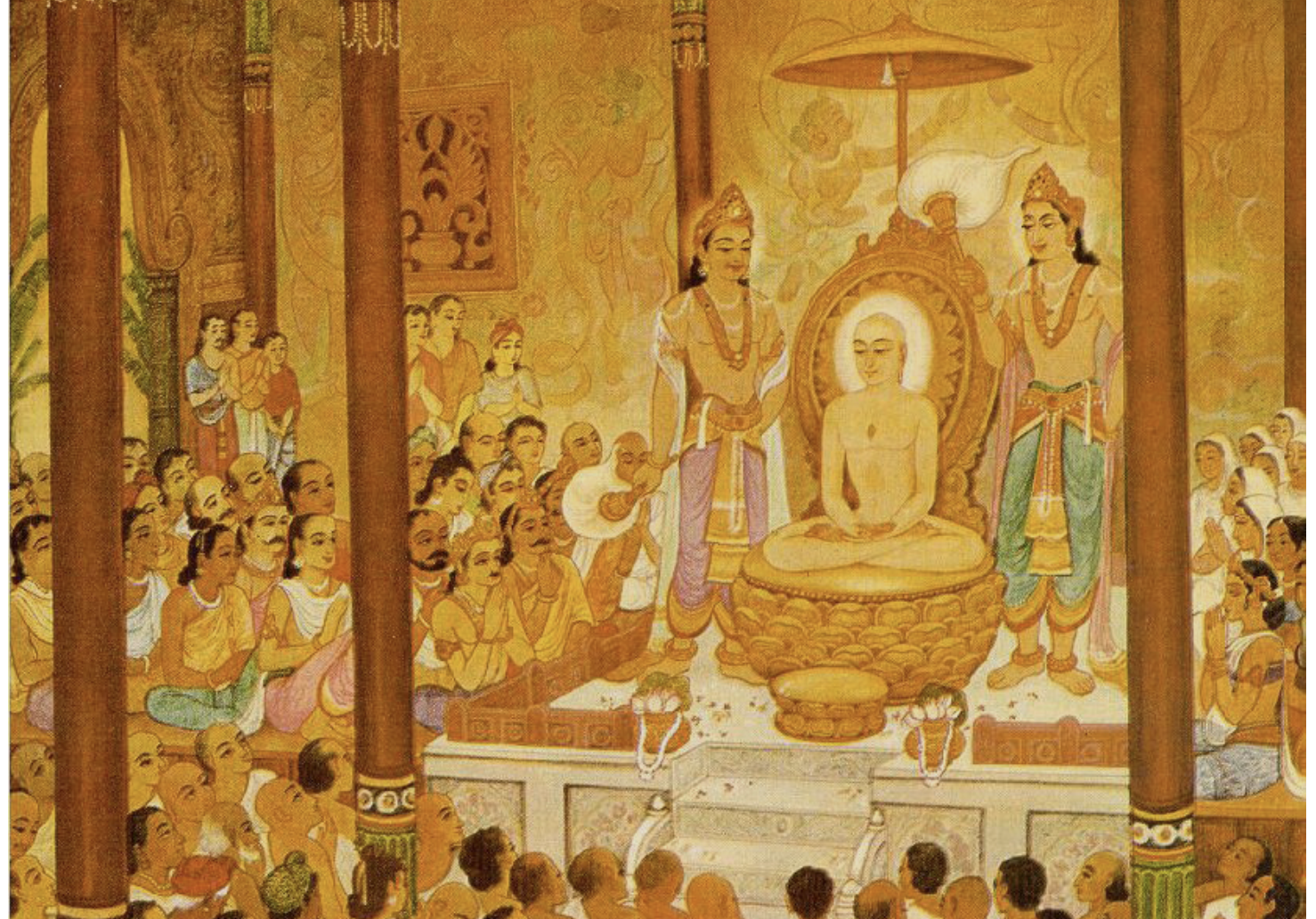
Lord Mahavira teaching Gautama

दुमपत्ते पंडुयए जहा,
णिवडइ राइगणाण अच्चए

“As a pale, yellowed leaf falls from the tree when the days and nights have passed — so is human life. O Gautam, do not be negligent for even a moment.”

About This Chapter

The Fallen Leaf

Dumapatraka — the tenth chapter — is named after its opening image: a pale, yellowed leaf falling from the tree as the days and nights pass. This is Lord Mahavira's intimate and urgent address to his chief disciple Gautama. The refrain “O Gautam, do not be negligent for even a moment” runs through the chapter like a meditation bell.

The chapter traces the soul's vast wandering through all six elemental forms of life — earth, water, fire, air, plants, and moving beings — and maps the incalculable rarity of human birth and the gifts it carries. It ends with the command to cut every last thread of attachment before it is too late, and the record of Gautama's own liberation as its living proof.

37 Sutras
Gautama Addressed To
6 Sections
Adhyayana 10

The 37 Sutras

Each sutra is presented with the original Prakrit, English translation, and a simplified commentary.

Part I — The Leaf and the Dewdrop: Life Is Brief
10.1

दुमपत्ते पंडुयए जहा, णिवडइ राइगणाण अच्चए। एवं मणुयाण जीवियं, समयं गोयम मा पमायए ॥१०.१॥

As a pale, yellowed leaf falls from the tree when the days and nights have passed — so is human life. O Gautam, do not be negligent for even a moment.

The image is exact: a leaf turns yellow slowly, unseen, and then one day it simply falls. Human life is the same. We do not feel it ending — but day by day, the vitality drains away. The scripture opens with this image to jolt the practitioner awake. The address "O Gautam" is intimate and urgent; it speaks to the chief disciple but is meant for every seeker who reads it.

The simple version: Your life is like a dying leaf on a tree. It looks fine until suddenly it falls. Don't assume you have time — use this moment.

ImpermanenceUrgencyNon-negligence
10.2

कुसग्गे जह ओसबिंदुए, थोवं चिट्टुइ लंबमाणए। एवं मणुयाण जीवियं, समयं गोयम मा पमायए ॥१०.२॥

As a dewdrop on a blade of grass hangs trembling and then falls after a brief moment — so is human life. O Gautam, do not be negligent for even a moment.

The second image is even more fragile: a dewdrop. It does not even have the rootedness of a leaf — it clings to the grass blade by the thinnest surface tension and is gone the instant the sun or the wind arrives. This is the second quality of human life: not only is it brief, it is also entirely without guarantee. There is no fixed time for it to end.

The simple version: A dewdrop on grass is here for a few minutes, then gone. Human life is exactly that uncertain. There is no "I'll do it later."

ImpermanenceUncertaintyVigilance
10.3

इइ इत्तरियम्मि आउए, जीवियए बहुपच्चवायए। विहुणाहि रयं पुरेकडं, समयं गोयम मा पमायए ॥१०.३॥

In this short, obstacle-filled life, shake off the karmic dust accumulated from the past. O Gautam, do not be negligent for even a moment.

Life is not only brief — it is also full of obstacles (disease, grief, loss, distraction) that impede spiritual effort. And all the while, old karma from past lives continues to bind the soul. The instruction is precise: shake it off (vihunaahi). Karma is described as "dust" — something that accumulates passively, that clings unless actively removed. The spiritual path is that removal.

The simple version: Your life is short and full of interruptions. On top of that you carry old karmic weight from past lives. The instruction: shake it off now — don't wait.

Karmic BondagePurificationPast Lives
Part II — The Soul's Long Wandering in All Forms of Life
10.4

दुल्लहे खलु माणुसे भवे, चिरकालेण वि सव्वपाणिणं। गाढा य विवाग कम्मुणो, समयं गोयम मा पमायए ॥१०.४॥

Human birth is truly rare for all living beings even across vast stretches of time, and the ripening of karma runs extremely deep. O Gautam, do not be negligent for even a moment.

This sutra grounds the urgency: human birth is not just precious — it is statistically vanishingly rare across all of time and all beings. The reason is stated immediately: karma ripens deeply (gaadha vivagakammuno). The karma a soul has accumulated forces it into forms of life far removed from human birth. The next eleven sutras demonstrate precisely where the soul wanders instead.

The simple version: Getting a human life is extremely rare across all of time. The reason: heavy karma keeps pulling souls into other forms. That's why this birth must not be wasted.

Rarity of Human BirthKarmaRebirth
10.5

पुढवीकाय-मइगओ, उक्कोसं जीवो उ संवसे। कालं संखाईयं, समयं गोयम मा पमायए ॥१०.५॥

A soul born into earth-bodies dwells there, cycling birth and death, for an incalculable span of time. O Gautam, do not be negligent for even a moment.

CautionImpermanence and Death

All worldly things are temporary—clinging to them brings suffering.

The Jain cosmology recognizes six classes of one-sensed beings. The soul that enters earth-bodies (soil, rock, clay) cycles there through innumerable births and deaths for a period beyond calculation — incalculable (asankhyata). It has only the sense of touch, no awareness of a path out. This is one of the destinations karma leads to instead of the rare human form.

The simple version: Souls trapped in earth-bodies (rocks, soil) live and die there for an unimaginably long time. That could be where you were — or where karma leads next.

Earth-BodiesCycle of ExistenceOne-Sensed Life
10.6

आउक्काय-मइगओ, उक्कोसं जीवो उ संवसे। कालं संखाईयं, समयं गोयम मा पमायए ॥१०.६॥

A soul born into water-bodies dwells there, cycling birth and death, for an incalculable span of time. O Gautam, do not be negligent for even a moment.

CautionImpermanence and Death

All worldly things are temporary—clinging to them brings suffering.

Water too is a life-form in Jain cosmology — a one-sensed being existing in every drop and current. A soul drawn into water-bodies by its karma remains there cycling through births and deaths across an incalculable duration. The same pattern as earth, the same warning: O Gautam, do not be negligent.

The simple version: Water has life in it. Souls trapped there cycle for ages. Use your human life — you have something those beings cannot: the capacity for liberation.

Water-BodiesCycle of ExistenceOne-Sensed Life
10.7

तेउक्काय-मइगओ, उक्कोसं जीवो उ संवसे। कालं संखाईयं, समयं गोयम मा पमायए ॥१०.७॥

A soul born into fire-bodies dwells there, cycling birth and death, for an incalculable span of time. O Gautam, do not be negligent for even a moment.

CautionImpermanence and Death

All worldly things are temporary—clinging to them brings suffering.

Fire-bodies — living souls existing in flames and heat — are another destination for the wandering soul. The repetition of the same verse structure across sutras 5–9 is deliberate: it creates a chant-like rhythm of growing dread, listing the vast prisons of karma one after another. Each verse ends identically: do not be negligent.

The simple version: Fire has living souls within it. They too are trapped in an incalculable loop. The human birth you have now is the exception, not the rule.

Fire-BodiesCycle of ExistenceOne-Sensed Life
10.8

वाउक्काय-मइगओ, उक्कोसं जीवो उ संवसे। कालं संखाईयं, समयं गोयम मा पमायए ॥१०.८॥

A soul born into air-bodies dwells there, cycling birth and death, for an incalculable span of time. O Gautam, do not be negligent for even a moment.

CautionImpermanence and Death

All worldly things are temporary—clinging to them brings suffering.

Air — the breath in the atmosphere, the wind — also contains living beings according to Jain cosmology. The soul dragged into air-bodies by its karma cycles there with only the sense of touch, for vast stretches of time. No capacity for wisdom, no hearing, no sight of the path. The warning deepens.

The simple version: Even the wind carries living beings. They wander in it for ages, unable to seek liberation. The human form you hold right now is uniquely precious.

Air-BodiesCycle of ExistenceOne-Sensed Life
10.9

वणस्सइकाय-मइगओ, उक्कोसं जीवो उ संवसे। कालमणंत दुरंतयं, समयं गोयम मा पमायए ॥१०.९॥

A soul born into plant-bodies dwells there, cycling birth and death, for an infinite and sorrowful span of time. O Gautam, do not be negligent for even a moment.

CautionImpermanence and Death

All worldly things are temporary—clinging to them brings suffering.

Plant-bodies are the deepest rut among one-sensed beings — here the time is not merely "incalculable" (asankhyata) but infinite (ananta) and sorrowful (durantam). Souls in plant-bodies can cycle there literally forever without any mechanism to exit, unless some rare accumulation of merit carries them upward. This is the longest imprisonment karma offers among elemental bodies.

The simple version: Plants are alive too. Souls trapped there can remain for literally infinite time — no awareness, no path out. This is what karma leads to without spiritual effort.

Plant-BodiesInfinite WanderingOne-Sensed Life
10.10

बेइंदियकाय-मइगओ, उक्कोसं जीवो उ संवसे। कालं संखिज्ज सिणियं, समयं गोयम मा पमायए ॥१०.१०॥

A soul born into two-sensed bodies dwells there, cycling birth and death, for a finite but still immense span of time. O Gautam, do not be negligent for even a moment.

CautionImpermanence and Death

All worldly things are temporary—clinging to them brings suffering.

Two-sensed beings (worms, leeches, shellfish) possess touch and taste. The period of wandering here is finite (sankhyata — countable), but still vast. Compared to the infinite trap of plant-bodies, this is a step up — but still an enormous waste of the soul's potential. The soul gains a second sense but still has no capacity to hear truth, see a teacher, or reason toward liberation.

The simple version: Worms and shellfish have two senses. Souls there are stuck for a huge but finite time. Still no access to the path of liberation.

Two-Sensed BeingsCycle of ExistenceGradual Ascent
10.11

तेइंदियकाय-मइगओ, उक्कोसं जीवो उ संवसे। कालं संखिज्ज सिणियं, समयं गोयम मा पमायए ॥१०.११॥

A soul born into three-sensed bodies dwells there, cycling birth and death, for a finite but still immense span of time. O Gautam, do not be negligent for even a moment.

CautionImpermanence and Death

All worldly things are temporary—clinging to them brings suffering.

Three-sensed beings (ants, lice, bedbugs) possess touch, taste, and smell. Again, the period is sankhyata — vast but finite. Each step up the ladder of senses represents a little more awareness, a little closer to the human form — but still enormously far from the capacity to practice self-discipline and walk toward liberation.

The simple version: Ants and lice have three senses. Better than before, but still trapped for an immense time, still unable to hear the teaching. Don't take your five senses for granted.

Three-Sensed BeingsCycle of ExistenceGradual Ascent
10.12

चउरिंदियकाय-मइगओ, उक्कोसं जीवो उ संवसे। कालं संखिज्जसिणियं, समयं गोयम मा पमायए ॥१०.१२॥

A soul born into four-sensed bodies dwells there, cycling birth and death, for a finite but still immense span of time. O Gautam, do not be negligent for even a moment.

CautionImpermanence and Death

All worldly things are temporary—clinging to them brings suffering.

Four-sensed beings (flies, mosquitoes, butterflies) have touch, taste, smell, and sight. They can see the world but still cannot hear teachings, reason philosophically, or consciously choose renunciation. They too cycle for a vast but finite time. This is the last step before the five-sensed beings — the threshold at which liberation becomes possible.

The simple version: Flies and butterflies can see the world but still cannot hear truth or choose a path. They cycle for ages. You can hear truth right now — that is extraordinary.

Four-Sensed BeingsCycle of ExistenceGradual Ascent
10.13

पंचिंदियकाय मइगओ, उक्कोसं जीवो उ संवसे। सत्तटु भवग्गहणे, समयं गोयम मा पमायए ॥१०.१३॥

A soul born into five-sensed bodies (animals and humans) dwells there for at most seven or eight consecutive births. O Gautam, do not be negligent for even a moment.

Jain PrincipleMoksha · Liberation

Freedom from karma and rebirth is the soul's eternal home.

Five-sensed beings — including both animals and humans — have all five senses. This is where liberation becomes accessible. The text specifies that such a being can take at most seven or eight consecutive births in this tier (with a brief divine or infernal birth possible between them). Unlike the vast stretches of one-sensed existence, five-sensed existence has a natural ceiling — which means the window for liberation can close.

The simple version: As a five-sensed being, you have at most seven or eight more births in this form. The window to reach liberation is real but limited. Start now.

Five-Sensed BeingsWindow for LiberationUrgency
10.14

देवे णेरइए य अइगओ, उक्कोसं जीवो उ संवसे। इक्केकक भवग्गहणे, समयं गोयम मा पमायए ॥१०.१४॥

A soul that enters divine or infernal realms stays there for only one birth at a time in each state. O Gautam, do not be negligent for even a moment.

Divine beings (devas) and infernal beings (narakis) are bound to a single birth in their respective realm — they cannot be reborn as divine or infernal again immediately. Though they may dwell there for enormous spans of time, it is a single birth. Neither realm offers liberation: divine beings are sunk in pleasure and negligence; infernal beings in suffering. Both states must end before spiritual progress can resume.

The simple version: Even heaven and hell are one-birth traps. Gods can't practice discipline; beings in hell can't either. Human birth is the only form where liberation is actually possible.

Divine RealmsInfernal RealmsLiberation Requires Human Birth
10.15

एवं भव संसारे, संसरइ सुहासुहेहिं कम्मेहिं। जीवो पमाय बहुलो, समयं गोयम मा पमायए ॥१०.१५॥

In this way, the negligent soul — full of negligence — wanders through the cycle of existence (samsara), driven by wholesome and unwholesome karmas alike. O Gautam, do not be negligent for even a moment.

CautionPamada · Negligence

Indifference to spiritual practice wastes the precious human birth.

This verse draws the entire preceding sequence together. The soul wanders through all those forms — earth, water, fire, air, plants, two-sensed through five-sensed, divine, infernal — driven by both wholesome and unwholesome karma. Even "good" karma (that leads to heavenly birth) keeps the soul in the cycle. Only the karma that burns through itself with disciplined practice ends the wandering entirely. The cause is named plainly: negligence (pamaya).

The simple version: The soul wanders through all those realms because of negligence — failing to practice. Even good karma just keeps the cycle going. Only decisive spiritual effort breaks it.

SamsaraKarmaNegligence as Root Cause
Part III — Five Rare Gifts: The Ladder to Liberation
10.16

लद्धूण वि माणुसत्तणं, आरियत्तं पुणरवि दुल्लहं। बहवे दसुया मिलक्खुया, समयं गोयम मा पमायए ॥१०.१६॥

Even after obtaining human birth, obtaining a spiritually cultivated birth (Aryan culture) is again rare — for many are born as thieves, bandits, or among those without moral discernment. O Gautam, do not be negligent for even a moment.

Human birth is rare. But within human birth, being born in a culture where dharma (right conduct) is understood and practiced is rarer still. "Aryan" here does not mean an ethnic group — it means one who is noble, who has been taught the distinction between what is right and what is harmful, between what leads toward liberation and what leads away from it. Many humans are born into environments of moral chaos, violence, or ignorance of the teaching entirely.

The simple version: Getting a human birth is hard. But being born in a culture that knows dharma — that's even harder. Many humans are born into environments of theft, cruelty, or no teaching at all.

Noble CultureDharmic EnvironmentSpiritual Inheritance
10.17

लद्धूण वि आरियत्तणं, अहीण पंचिंदिया हु दुल्लहा। विगलिंदिया हु दीसइ, समयं गोयम मा पमायए ॥१०.१७॥

Even after obtaining a spiritually cultivated birth, having all five senses complete and fully functioning is extremely rare — for many are seen with defective or impaired senses. O Gautam, do not be negligent for even a moment.

This sutra acknowledges what anyone who looks clearly at the world can see: many people are born blind, deaf, with impaired faculties. These limitations — whatever their cause in previous karma — restrict one's capacity for the full range of spiritual practice: studying the scripture (requires hearing or sight), practicing ritual purification (requires mobility), discerning subtle right conduct. All five senses complete and functioning is not a given even within a noble human birth.

The simple version: Born human and in a dharmic culture — and then also with all five senses intact? That's a third rare gift. Many people don't have it. If you do, use it.

Complete SensesPhysical CapacitySpiritual Prerequisites
10.18

अहीणपंचिंदियत्तं पि से लहे, उत्तमधम्मसुई हु दुल्लहा। कुतित्थिय णिसेवए जणे, समयं गोयम मा पमायए ॥१०.१८॥

Even having all five senses complete, hearing the highest teaching (the true path of liberation) is very rare — for many follow false teachers and wrong paths. O Gautam, do not be negligent for even a moment.

Jain PrincipleMoksha · Liberation

Freedom from karma and rebirth is the soul's eternal home.

Even if one has human birth, a dharmic environment, and all five senses — encountering the actual highest teaching (uttama dharma shruti) is rare. Most people with intact senses fill their hearing with whatever is around them — and most of what is around them is not the clear path to liberation. Many follow teachers who claim to offer liberation but whose doctrines lead practitioners away from it. The fourth gift: actually encountering true teaching.

The simple version: Lots of people can hear, but most don't hear the right thing. Many follow teachers whose path doesn't actually lead to liberation. The fourth rare gift: encountering the true teaching.

Hearing True TeachingRight GuidanceFalse Paths
10.19

लद्धूण वि उत्तमं सुइं, सद्दहणा पुणरावि दुल्लहा। मिच्छत्त णिसेवए जणे, समयं गोयम मा पमायए ॥१०.१९॥

Even after hearing the highest teaching, developing genuine faith in it is again rare — for many continue following wrong views. O Gautam, do not be negligent for even a moment.

Hearing is not enough. The soul carries the weight of beginningless wrong-view (micchattva) — a habitual misdirection of the mind, accumulated across countless births. Even when a person hears the true teaching, their prior conditioning may prevent genuine conviction. They may hear and dismiss, hear and doubt, hear and distort what they heard. Faith (shraddha) — the settled, clear recognition that "this is the truth, this is the path" — is a fifth distinct gift, not automatic even after hearing.

The simple version: You could hear the highest teaching and still not believe it. Wrong-view runs deep. Genuine, settled faith in the path is the fifth rare gift — and most people don't develop it even after hearing.

Right FaithWrong ViewConviction
10.20

धम्मं पि हु सद्दहंतया, दुल्लहया काएण फासया। इह कामगुणेहिं मुच्छिया, समयं गोयम मा पमायए ॥१०.२०॥

Even after developing faith in the teaching, actually practicing it with body, speech, and mind is very rare — for people here are intoxicated by the pleasures of the senses. O Gautam, do not be negligent for even a moment.

The fifth and final rare gift is practice — actually living the teaching. The diagnosis is clear: even people who sincerely believe in the path are found in a state of intoxication by sensory pleasure (kamagunehi mucchiya). The mind acknowledges the truth, but the body, the habits, and the craving for pleasure pull in the opposite direction. This verse closes the ladder: the rare human birth, the rare dharmic environment, the rare complete senses, the rare hearing, the rare faith, the rarest of all — sustained practice.

The simple version: People can believe the path is right and still not actually walk it — because sensory pleasure keeps pulling them away. Practice is the rarest gift of all. And you have it in front of you right now.

PracticeSensory PleasureFive Rarenesses
Part IV — The Body Decays: Do Not Wait for a Better Time
10.21

परिजूरइ ते सरीरयं, केसा पंडुरया हवंति ते। से सोयबले य हायइ, समयं गोयम मा पमायए ॥१०.२१॥

O Gautam, your body is growing old and weakening; your hair is turning white; your power of hearing is failing. Do not be negligent for even a moment.

The argument shifts from the cosmic scale (the wandering soul across countless births) to the intimate and personal: your body, right now, is decaying. Lord Mahavira speaks directly and without softening. He names three signs in the first verse of this set: the body weakening (parijurai), the hair whitening (kesaa pandurayaa), and the hearing fading (soyabalam hayai). Hearing is listed first because it is through hearing that one receives the teaching — and that capacity is going.

The simple version: Your body is getting old. Your hair is going white. Your hearing is fading. The time to practice is not "after" — it is now, while you still can.

AgingHearingPhysical Decay
10.22

परिजूरइ ते सरीरयं, केसा पंडुरया हवंति ते। से चक्खुबले य हायइ, समयं गोयम मा पमायए ॥१०.२२॥

O Gautam, your body is growing old and weakening; your hair is turning white; your power of sight is failing. Do not be negligent for even a moment.

The second in this series: sight. What Sutras 21–26 do structurally is list each of the five senses one by one, showing that each is in the process of failing. The repetition of the first two lines creates a drumbeat of mounting urgency. The meditation teacher Mahavira is naming each capacity as it slips away, asking: are you going to wait until this one goes too?

The simple version: Your eyesight is going too. Every sutra in this set names one more thing that is failing in the aging body. The pattern says: stop waiting.

AgingSightPhysical Decay
10.23

परिजूरइ ते सरीरयं, केसा पंडुरया हवंति ते। से घाणबले य हायइ, समयं गोयम मा पमायए ॥१०.२३॥

O Gautam, your body is growing old and weakening; your hair is turning white; your power of smell is failing. Do not be negligent for even a moment.

The sense of smell (ghanabala) is next. In Jain ascetic life, the sense of smell relates to discernment — distinguishing the pure from the impure in food and environment, which is critical for the discipline of alms-gathering. As smell fades, even that capacity for discernment in practice weakens. Every sense named here is both a physical loss and a spiritual one.

The simple version: Your sense of smell is going. Each sutra adds another failing sense — the body's full capacity is already draining away.

AgingSmellPhysical Decay
10.24

परिजूरइ ते सरीरयं, केसा पंडुरया हवंति ते। से जिंभबले य हायइ, समयं गोयम मा पमायए ॥१०.२४॥

O Gautam, your body is growing old and weakening; your hair is turning white; your power of taste is failing. Do not be negligent for even a moment.

Taste (jimbhabala) fails next. The irony is noted in traditional commentary: the very sense that people so often indulge and protect — the pleasure of food — is precisely what declines with age. The senses one clings to most are the first to leave. With taste gone, even recitation and teaching become harder (the tongue and voice weaken together).

The simple version: Your sense of taste is fading. The pleasures people protect most carefully — food, flavor — are precisely what age takes first.

AgingTastePhysical Decay
10.25

परिजूरइ ते सरीरयं, केसा पंडुरया हवंति ते। से फास बले य हायइ, समयं गोयम मा पमायए ॥१०.२५॥

O Gautam, your body is growing old and weakening; your hair is turning white; your power of touch is failing. Do not be negligent for even a moment.

Touch (phasabala) is the most fundamental of the five senses — the only one shared by all living beings, from earth-bodies upward. As it fails, the practitioner loses the capacity for advanced austerities such as enduring the pairs of opposites (cold and heat, pain and pleasure). The text moves from the subtler senses to the most foundational — completing the survey of all five.

The simple version: Even your sense of touch is going. This is the most basic sense — the one every being has. When it fades, the body is close to its limit.

AgingTouchPhysical Decay
10.26

परिजूरइ ते सरीरयं, केसा पंडुरया हवंति ते। से सव्वबले य हायइ, समयं गोयम मा पमायए ॥१०.२६॥

O Gautam, your body is growing old and weakening; your hair is turning white; your entire strength — of mind, speech, and body — is failing. Do not be negligent for even a moment.

This verse is the summation of the six-verse set. Having named each sense individually, the text now names everything together: sarvabala — the totality of strength, including thought (manas), speech (vachana), and physical capacity (kaya). Nothing is excluded. Old age does not take one thing — it takes everything. This is not pessimism; it is radical honesty used as a spur to action.

The simple version: It's not just one thing — it's everything. Mind, voice, body — all of it is fading. The honest view of aging is meant to light a fire under you, not depress you.

Complete DeclineAgingMind Body Speech
10.27

अरई गंडं विसूइया, आयंका विविहा फुसंति ते। विहडइ विद्धंसइ ते सरीरयं, समयं गोयम मा पमायए ॥१०.२७॥

Boils, tumors, cholera, and various deadly diseases are attacking your body, weakening it and destroying it. O Gautam, do not be negligent for even a moment.

The final verse in this section shifts from the slow erosion of age to sudden attack by disease. Where aging is predictable and gradual, illness is unpredictable and violent. The diseases named — boils (arai), tumors (ganda), cholera (visuiya), and "various deadly afflictions" (vivihaa aayankaaa) — are added to the aging body as further sources of destruction. The body is not just fading; it is under siege. Do not wait for a healthy, convenient time — it may never come.

The simple version: On top of aging, illness can strike at any moment. The body is not just slowly fading — it is fragile. There is no guaranteed window of health ahead. Practice now.

DiseaseFragilityImpermanence
Part V — Cut Every Thread: Instructions for the Path
10.28

वुच्छिंद सिणेहमप्पणो, कुमुयं सारइयं व पाणियं। से सव्वसिणेह वज्जिए, समयं गोयम मा पमायए ॥१०.२८॥

Cut off all attachment from your soul — like the autumn lotus that grows in water yet remains unattached to it. Become free of every form of attachment. O Gautam, do not be negligent for even a moment.

CautionSanga · Attachment

Emotional bonds to people and things perpetuate suffering.

The image of the autumn lotus (kumuda) is one of the most beautiful in Jain literature. The lotus is born in water, lives submerged in water, yet its petals are never wet — water beads off without clinging. This is the precise instruction: do not remove yourself from the world like a stone, but be in it like the lotus — fully present, entirely unattached. The word "vucchinda" (cut off) is sharp — not loosen, not reduce, but sever.

The simple version: Be like the lotus — in the world but unattached to it. Water doesn't cling to the lotus petal. Let the world be what it is, but don't let it cling to you.

Non-attachmentLotus MetaphorRenunciation
10.29

चिच्चाणं धणं च भारियं, पव्वइओ हि सि अणगारियं। मा वंतं पुणो वि आविए, समयं गोयम मा पमायए ॥१०.२९॥

Having renounced wealth and wife (worldly life), you have accepted the homeless (monastic) path. Do not return to what you have already cast aside. O Gautam, do not be negligent for even a moment.

CautionSamsara · Worldly Existence

Involvement in worldly activities generates binding karma.

The teaching becomes explicit: Gautama has already renounced. He is already on the path. This verse is not an invitation to renounce — it is a warning not to regress. The Prakrit word "vantam" is striking — it means vomited. What has been vomited out is done; to take it back in is a violation both of the body and of the spirit. Worldly life that has already been renounced should not be sought again, even in imagination or desire.

The simple version: You already left that life behind. Don't go back to it — not in action, not in longing. What's vomited out is vomited out.

Monastic VowNo RegressionRenunciation
10.30

अवउज्झिय मित्तबंधवं, विउलं चेव धणोहसंचयं। मा तं बिइयं गवेसए, समयं गोयम मा पमायए ॥१०.३०॥

Having freely renounced your friends, relatives, and vast accumulated wealth — do not seek them again, do not yearn for them. O Gautam, do not be negligent for even a moment.

The full scope of what was renounced is named: friends (mitta), relatives (bandhava), and great wealth (viulam dhanohsanchayam). All were given up freely — not taken away by misfortune. To seek them back is to betray both the vow and the intelligence that made the renunciation in the first place. This verse addresses not just physical return but internal craving — "do not seek" means do not let the mind wander back toward them.

The simple version: You gave up friends, family, and wealth — by choice. Don't let your mind drift back and start yearning for them. That's where slippage begins.

Non-attachmentRenunciationMental Discipline
10.31

ण हु जिणे अज्ज दीसइ, बहुमए दीसइ मग्गदेसिए। संपइ णेयाउए पहे, समयं गोयम मा पमायए ॥१०.३१॥

Today no living Tirthankara is visible, and many self-proclaimed path-guides are seen — yet right now, the true path to liberation is available. O Gautam, do not be negligent for even a moment.

Jain PrincipleMoksha · Liberation

Freedom from karma and rebirth is the soul's eternal home.

This verse is strikingly honest. It acknowledges that in the current age (spoken from within the fifth era of time), no Tirthankara walks the earth. Many claim to show the way. And yet — the teaching is here, the path is available, and those who follow it with genuine understanding and discipline can still attain liberation. The absence of the Tirthankara in person is not an excuse for negligence.

The simple version: There's no living Tirthankara today, and many fake guides. But the path itself is still here, still valid. Walk it — don't use the difficulty of the time as an excuse.

TirthankaraCurrent AgePath Available
10.32

अवसोहिय कंटगापहं, ओइण्णो सि पहं महालयं। गच्छिस मग्गं विसोहिया, समयं गोयम मा पमायए ॥१०.३२॥

Having cleared the thorny path, you have entered the great royal highway of liberation. Walk this path with full and unwavering faith, clearing every obstacle ahead. O Gautam, do not be negligent for even a moment.

Jain PrincipleMoksha · Liberation

Freedom from karma and rebirth is the soul's eternal home.

CautionSanga · Attachment

Emotional bonds to people and things perpetuate suffering.

The metaphor shifts to a journey. The thorny path (kantakapaham) represents the ordinary life of attachment, distraction, and wrong-view — full of obstacles at every step. By renouncing and taking up practice, Gautama has cleared that thorn-path and entered the great highway (mahalayam patham) — the Jain path of right conduct, which the great ones (the liberated ones) have walked before. It is cleared, wide, and true. The instruction: stay on it, with full faith.

The simple version: You left the thorny path of worldly life and entered the clear, open highway to liberation. You're on the right road now. Don't wander off it.

Path of LiberationRight ConductSteadfastness
10.33

अबले जह भारवाहए, मा मग्गे विसमेऽवगाहिया। पच्छा पच्छाणुतावए, समयं गोयम मा पमायए ॥१०.३३॥

Like a weak porter who loses patience on a difficult road, abandons his precious load midway, and then bitterly regrets it at home — do not similarly abandon the self-discipline you have accepted. O Gautam, do not be negligent for even a moment.

Jain PrincipleVinaya · Discipline

Self-imposed order of thought, word, and deed transforms the soul.

The parable is vivid: a man is hired to carry a heavy load. He begins the journey. Midway, the road becomes rough — and he sets down his load and walks home empty-handed. When he arrives home and realizes he has no payment and must face poverty, he regrets it deeply. The load he abandoned was his wage and his livelihood. The parallel: the "load" of monastic discipline is heavy, but abandoning it midway is the real catastrophe — not carrying it.

The simple version: A weak porter drops his load halfway and goes home — then regrets it when he's poor. Don't drop your practice when it gets hard. The regret after is much worse than the difficulty during.

PerseveranceNo Mid-Path RetreatParable
10.34

तिण्णो हु सि अण्णवं महं, किं पुण चिट्टुसि तीरमागओ। अभितुर पारं गिमत्तए, समयं गोयम मा पमायए ॥१०.३४॥

You have crossed the great ocean of existence — why do you now stand still on the near shore? Swiftly reach the far shore (liberation). O Gautam, do not be negligent for even a moment.

Jain PrincipleMoksha · Liberation

Freedom from karma and rebirth is the soul's eternal home.

This is one of the most dramatic verses in the chapter. Gautama has done the immense work — he has renounced, taken vows, practiced. He has crossed the vast ocean of samsara. He stands on the near shore. And the teacher asks: why are you standing there? The far shore — liberation (moksha) — is right there. The verse is a loving provocation: you have done the hardest part. Finish it. Do not stop with liberation in sight.

The simple version: You've done the hard part — you crossed the ocean of samsara. Now you're standing on the near shore looking at liberation on the other side. Why are you just standing there? Cross it.

Near LiberationSamsara as OceanFinal Push
10.35

अकलेवर-सेणिमुसिया, सिद्धिं गोयम लोयं गच्छिसि। खेमं च सिवं अणुत्तरं, समयं गोयम मा पमायए ॥१०.३५॥

Climbing the liberation-ladder beyond the body, O Gautam, you will attain the realm of the liberated — free from trouble, auspicious, unsurpassed. Do not be negligent for even a moment.

Jain PrincipleMoksha · Liberation

Freedom from karma and rebirth is the soul's eternal home.

This verse offers the vision: the aklevara-shreni — the ladder of pure thought and practice that dissolves karma and leads the soul beyond all physical existence to the realm of the liberated (Siddha-loka). It is described as "khemam" (free from all harm and trouble), "shivam" (auspicious, wholesome), and "anuttaram" (unsurpassed — the highest state possible). This is what awaits on the far shore. The destination is named clearly: why wait?

The simple version: Beyond the body, beyond the cycle, beyond every form of suffering — there is the realm of the liberated. Peaceful, pure, unsurpassed. That is where you are headed. Keep going.

LiberationSiddha-LokaFinal Goal
10.36

बुद्धे परिणिभ्युडे चरे, गामगए णगरे व संजए। संतिमग्गं च वूहए, समयं गोयम मा पमायए ॥१०.३६॥

Having realized truth and extinguished the passions, practice self-restraint as you roam through villages and cities — cultivate and expand the path of peace. O Gautam, do not be negligent for even a moment.

Jain PrinciplePrajna · Wisdom

Direct insight into reality transcends mere intellectual knowledge.

This verse describes the active life of the enlightened monk: "budde" (having realized), "parinibhyude" (having quenched the passions fully), "charе" (moving through the world). Even with wisdom attained, the monk does not cease — he continues wandering, teaching, growing in the path of peace (shantimargam). The instruction is both inward (keep extinguishing) and outward (keep moving, keep teaching). Negligence has no place even for the advanced practitioner.

The simple version: Even after realizing truth and quenching the passions, keep moving. Wander through villages and towns. Cultivate the path of peace in yourself and expand it in the world.

Self-RestraintActive PracticePath of Peace
Part VI — Gautama Attains Liberation
10.37

बुद्धस्स णिसम्म भासियं, सुकिहयं-मट्टुपओवसोहियं। रागं दोसं च छिंदिया, सिद्धिगइं गए गोयमे ॥१०.३७॥
— ति बेमि ।

Having listened to the supremely beautiful and meaningful words of the Enlightened One (Lord Mahavira) — cutting away every thread of attachment and aversion — Gautama attained liberation. Thus I say.

Jain PrincipleMoksha · Liberation

Freedom from karma and rebirth is the soul's eternal home.

CautionSanga · Attachment

Emotional bonds to people and things perpetuate suffering.

The chapter closes with its most extraordinary moment: the teaching arrives, and the student attains what the teaching promises. Gautama — who was addressed throughout as "O Gautam, do not be negligent" — hears the full teaching to its end, cuts away attachment (raga) and aversion (dosha) completely, and attains liberation (siddhigatim). The word "siddhi-gatim gaye" means literally "gone to the state of perfection." The closing "iti bemi" (thus I say) is Lord Mahavira's seal on the teaching — the words are his own.

The simple version: Gautama heard everything the Enlightened One said. He cut away attachment and aversion completely. And he was liberated. That is what these teachings lead to — not just theory, but the end of the cycle.

LiberationGautama SwamiAttachment and AversionThus I Say
॥ अध्ययन-१० सम्पूर्ण ॥

End of Chapter 10 — The Fallen Leaf

Chapter 9 Chapter 11