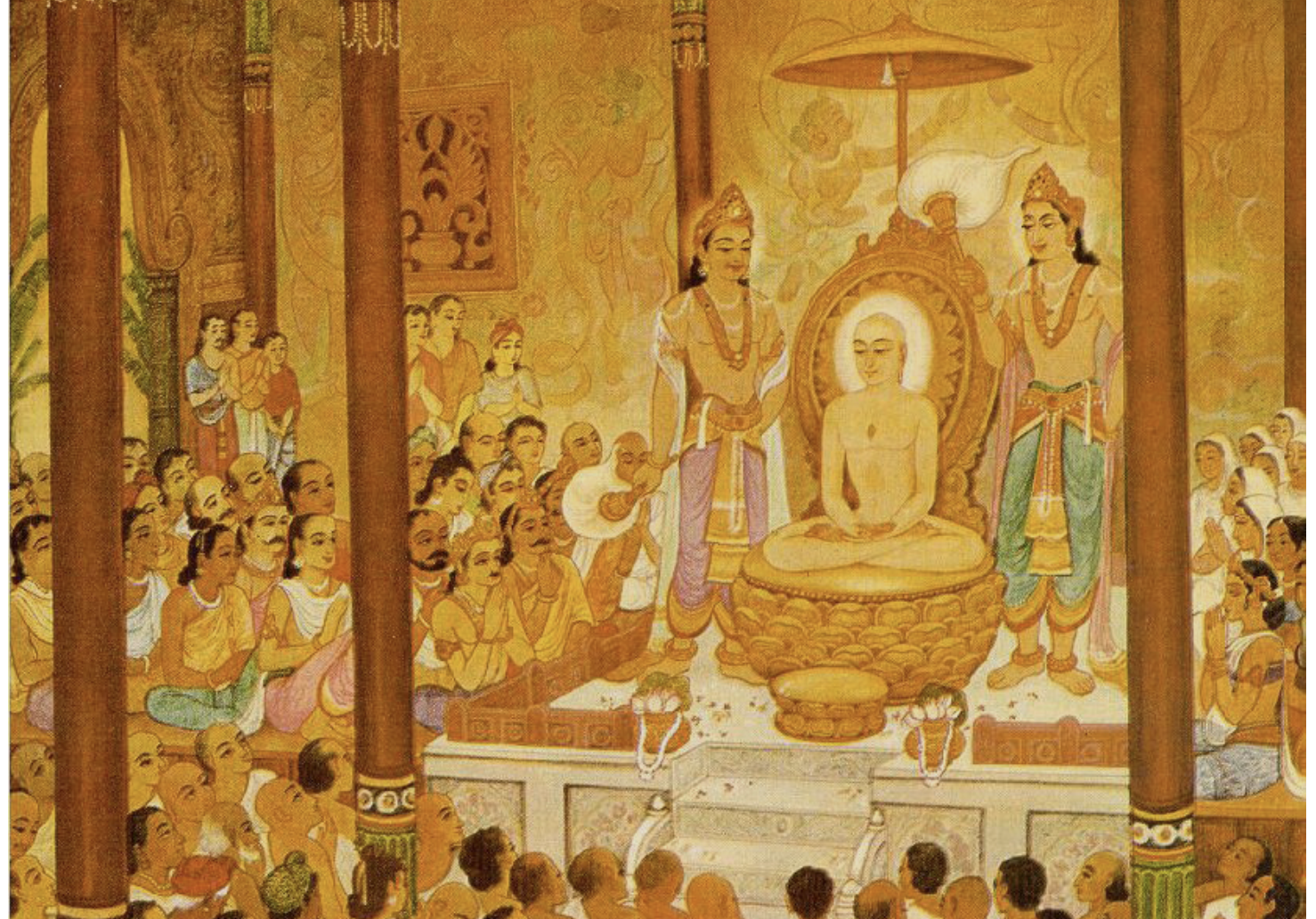
Adhyayana 9
The 62 Sutras
Each sutra is presented with the original Prakrit, English translation, and a simplified commentary.
Part I — Nami's Birth and Past-Life Memory
9.1
चइऊण देवलोगाओ, उववण्णो माणुसिम्मि लोगम्मि ।
उवसंत-मोहिणिज्जो, सरइ पोराणियं जाइं ॥९.१॥
Having descended from the divine realm and been born into the human world, Nami — whose delusion-producing karma was subsiding — recalled his former births.
False perception of reality keeps the soul bound in karma.
Nami's soul had been living in the Mahasuka heaven (the 7th divine realm). When his divine lifespan was complete, he was reborn as a human being. The phrase "mohaniya karma subsiding" is precise: it was not yet fully destroyed, but the loosening of its grip was enough to allow jati-smaran — the arising of past-life memory. This is one of the most significant spiritual events described in the Uttaradhyayana: a king who is simultaneously a Pratyekabuddha — one who attains self-enlightenment through inner awakening rather than through a teacher's direct guidance.
The simple version: Nami had lived in a high heaven. When reborn as a king in Mithila, his delusion began to loosen — and he spontaneously remembered all his past lives. This is the awakening that changes everything.
Past-Life MemoryJati-SmaranPratyekabuddhaMohaniya Karma
9.2
जाइं सरित्तु भयवं, सयसंबुद्धो अणुत्तरे धम्मे ।
पुत्तं ठविउ रज्जे, अभिणिक्खमइ णमीराया ॥९.२॥
Recalling his past births, the Lord Nami — self-enlightened in the supreme dharma — placed his son on the throne and went forth in renunciation.
Voluntarily releasing worldly attachments leads to spiritual freedom.
The sequence is illuminating: first comes the memory (sutra 1), then comes the self-enlightenment (saya-sambaddho — awakened through oneself alone, without an external teacher), and only then comes the action of renunciation. The enlightenment precedes the physical departure — the inner abandonment is complete before the outer one begins. Placing the son on the throne is not hesitation; it is the orderly fulfillment of worldly duty before departing from it entirely.
The simple version: Nami remembered his past lives, became self-enlightened in the supreme dharma — without a teacher, through his own inner clarity — placed his son on the throne, and went forth to renounce the world.
Self-EnlightenmentSaya-SambaddhoRenunciationSuccession
Part II — The Act of Going Forth
9.3
से देवलोग-सिरिसे, अंतेउर वरगओ वरे भोए ।
भुंजित्तु णमी राया, बुद्धो भोगे परिच्चयइ ॥९.३॥
Having enjoyed supreme pleasures in the inner palace equal to the splendors of the divine realm, King Nami became enlightened and abandoned all pleasures.
This sutra is crucial: Nami did not abandon pleasures because he lacked them. He had them in the fullest measure — pleasures comparable to heaven itself. He abandoned them after having enjoyed them, from the position of complete satiation and wisdom — not from deprivation. This is the Jain understanding of genuine vairagya (dispassion): not the frustration of one who could not obtain, but the clear seeing of one who saw through what they fully possessed.
The simple version: Nami had enjoyed pleasures equal to heavenly life — not the pleasures of a deprived man, but of one who had everything. And having fully lived that life, he became enlightened and let go. That is true renunciation.
VairagyaComplete RenunciationInner PalaceEnlightened Abandonment
9.4
मिहिलं सपुरजणवयं, बलमोरोहं च परियणं सव्वं ।
चिच्चा अभिणिक्खंतो, एगंतमिहिट्ठिओ भयवं ॥९.४॥
Lord Nami, having abandoned Mithila with all its people and townships, his fourfold army, his inner palace, and all his retinue — went forth and stood alone in solitude, established in oneness.
"Egantamihitthio" — established in solitary oneness — is not loneliness but its precise opposite: the discovery of the soul's completeness in itself. The list is deliberately comprehensive: the city, the people, the army (four divisions: infantry, cavalry, elephants, chariots), the inner palace, the retinue. Nothing is held back. And then: alone. The one who was at the center of all of this simply steps out of it — not fleeing, but completed.
The simple version: Nami left everything — city, army, palace, every person. And stood alone in solitude — not lost, but whole. This is the moment of going forth.
Total RenunciationSolitudeEkantvabhavaGoing Forth
9.5
कोलाहलग-भूयं आसी, मिहिलाए पव्वयंतम्मि ।
तइया रायिरिसिम्मि, णिमिम्मि अभिणिक्खमंतम्मि ॥९.५॥
When the royal sage Nami was going forth in renunciation, there arose a great commotion throughout Mithila.
Voluntarily releasing worldly attachments leads to spiritual freedom.
The city responds to what the sage has already internally completed. The commotion (kolahala) — crying, lamentation, panic — reveals how thoroughly ordinary life is organized around its central figures, and how completely disoriented it becomes when that figure dissolves the role. Nami is not affected. The inner solitude achieved in sutra 4 is already sealed. The city's noise is real — and it becomes the first of Indra's ten tests.
The simple version: The moment Nami left, all of Mithila broke into chaos — crying, lamentation, confusion. The city could not comprehend what had just happened. Nami's inner world was already still.
Commotion in MithilaWorldly AttachmentThe City's Response
Part III — Indra Arrives in Disguise · The Ten Questions
9.6
अभ्भुट्ठियं रायिरिसिं, पव्वज्जा ठाणमुत्तमं ।
सक्को माहणरूवेण, इमं वयणमब्बवी ॥९.६॥
To the royal sage Nami who had risen to the supreme state of renunciation, Shakra (Indra) — having taken the form of a Brahmin — spoke these words.
Voluntarily releasing worldly attachments leads to spiritual freedom.
When Indra in the heavens learned that King Nami — a Pratyekabuddha — was taking initiation, he descended to test whether the renunciation was genuine or a passing impulse. The disguise of a Brahmin is deliberate: the Brahmin represents the authority of worldly duty, social obligation, and conventional dharma. Indra would probe Nami not with spiritual questions but with the hardest practical arguments of ordinary life — the ten questions of a man who is not yet ready to let go.
The simple version: Indra heard that King Nami was renouncing and came to test him — disguised as a Brahmin, the symbol of worldly religious duty. He would ask ten questions. Each one was a challenge: "Why are you leaving now? Do this first. Finish that first."
Indra's TestBrahmin DisguiseWorldly ArgumentsShakra
Question 1 — The Commotion in Mithila
9.7
किण्णु भो अज्ज मिहिलाए, कोलाहलग-संकुला ।
सुव्वंति दारुणा सद्दा, पासाएसु गिहेसु य ॥९.७॥
O Nami! Why today in Mithila are such frightening sounds of lamentation and anguish heard — in every palace and in every home?
Suffering arises from identifying with the perishable body and desires.
Indra's first challenge is compassion-based: your people are suffering. How can you leave them? The implication is that a responsible king — especially a compassionate one — should first calm the commotion he has caused, then renounce. This is the argument that holds most householders back from the spiritual path: the claim that responsibility to others requires postponing responsibility to oneself.
Indra's challenge: Your city is in chaos because of you. People are crying in every home and palace. How can you leave now — in the middle of all this suffering that your departure caused?
Compassion ArgumentQ1 of 10Social Duty
9.8 — Having heard this question and moved by the intention behind it, Nami the royal sage spoke to Indra in reply—
9.9–10
मिहिलाए चेइए वच्छे, सीयच्छाए मणोरमे ।
पत्त-पुप्फ-फलोवेए, बहूणं बहुगुणे सया ॥९.९॥
वाएण हीरमाणिम्मि, चेइयम्मि मणोरमे ।
दुहिया असरणा अत्ता, एए कंदंति भो खगा ॥९.१०॥
In the garden of Mithila there stood a beautiful tree — always cool in shade, pleasing to the mind, laden with leaves, flowers, and fruit, endlessly beneficial to all. O Brahmin! When that beautiful tree was uprooted by the storm — the helpless, shelterless birds cried in distress. It is those birds that cry.
Nami's answer is a parable: the people crying are like birds who nested in a great tree. The tree has been uprooted — not by cruelty, but by the wind of dharma. The crying is real, but it is the crying of birds who had mistaken the tree for their permanent home. Their shelterlessness is not the tree's fault — it is the nature of the world itself. No king, no tree, no relationship provides permanent shelter. Nami's departure does not take shelter away; it reveals that such shelter was never truly there.
Nami's answer: A great tree stood in the garden of Mithila — shade for all, shelter for all birds. A storm uprooted it. The birds cry — not because the tree was cruel, but because they had no other home. The people's grief is real. But I was never their permanent shelter. No one is. That grief is the nature of impermanence — not a reason to delay liberation.
Tree ParableBirds and ShelterImpermanenceNami's Answer
Question 2 — The Burning Palace
9.11 — Indra, moved by the answer, pressed further—
9.12
एस अग्गी य वाऊ य, एयं डज्झइ मंदिरं ।
भयवं अंतेउरं तेण, कीस ण णावपेक्खह ॥९.१२॥
O Lord! Fire, fanned by wind, is burning your palace and inner chambers. Why do you not look after them?
The second challenge is property and protection. Indra points to Nami's palace and inner quarters burning — an immediate, concrete crisis. The implied argument: a man of dharma protects what is entrusted to him. Leave after securing what you are responsible for. This is the argument of the householder who always finds one more task to complete before the spiritual path can begin.
Indra's challenge: Your palace is on fire right now! Your inner chambers are burning! How can you just stand here and do nothing? Doesn't a man of dharma protect his own house?
Property ArgumentQ2 of 10The Burning Palace
9.13 — Hearing this, Nami replied—
9.14–16
सुहं वसामो जीवामो, जेसिं मो णत्थि किंचणं ।
मिहिलाए डज्झमाणीए, ण मे डज्झइ किंचणं ॥९.१४॥
चत्त-पुत्त-कलत्तस्स, णिव्वावारस्स भिक्खुणो ।
पियं ण विज्जइ किंचि, अप्पियं पि ण विज्जइ ॥९.१५॥
बहुं खु मुणिणो भद्धं, अणगारस्स भिक्खुणो ।
सव्वओ विप्पमुक्कस्स, एगंतमणुपस्सओ ॥९.१६॥
We live happily, we live well — those of us who have nothing. Though Mithila burns, nothing of mine burns. For the monk who has renounced sons and wife, free from all occupation — there is nothing dear and nothing not dear. Indeed, greatly auspicious is the houseless mendicant — freed from all sides, abiding in solitary contemplation.
This three-verse answer is one of the most celebrated passages in the Uttaradhyayana. "Suhang vasamo jivamo" — we live happily, we live well — those who have nothing. The happiness of the monk is not the diminished happiness of one who lost something. It is a completely different order of happiness: the happiness of one for whom the very category of "mine" has dissolved. When there is nothing that is "mine," nothing can burn. The palace burns — but it is not Nami's palace. Mithila burns — but it is not Nami's Mithila. He has already departed from ownership, and that departure is what fire cannot touch.
Nami's answer: We live happily — those of us who have nothing. Mithila burns. Nothing of mine burns. I have no sons, no wife, no palace that is "mine." For such a one, there is no dear and no not-dear. That is not poverty — that is the greatest wealth.
Nothing BurnsDesirelessnessMonk's HappinessNo Mine
Question 3 — Defend the Fort First
9.17 — Indra, further moved, pressed the third challenge—
9.18
पागारं कारइत्ताणं, गोपुरद्दालगाणि य ।
उस्सूलग सयग्घीओ, तओ गच्छसि खतिया ॥९.१८॥
O Kshatriya! First build the fort walls, the main gates and watchtowers, and place the hundred-slaying weapons — then go forth in initiation.
Indra now appeals to martial duty — the Kshatriya's obligation to protect the kingdom. Build the defenses first; leave the people safe; then renounce. This is the argument of sequential duty: "Finish your responsibilities first." But the argument contains its own answer: the fort can always be reinforced further. There will always be one more tower to build.
Indra's challenge: You are a Kshatriya — a warrior king. Build the fort walls and gates and defenses first. Then take initiation. Leave the city protected before you leave it.
Warrior DutyQ3 of 10Sequential Obligation
9.20–22
सद्धं णगरं किच्चा, तव संवरमग्गलं ।
खंति णिठणपागारं, तिगुत्तं दुप्पधंसयं ॥९.२०॥
धणुं परक्कमं किच्चा, जीवं च ईरियं सया ।
धिइं च केयणं किच्चा, सच्चेण पलिमंथए ॥९.२१॥
तव-णाराय-जुत्तेण, भित्तुणं कम्मकंचुयं ।
मुणी विगयसंगामो, भवाओ परिमुच्चए ॥९.२२॥
Having made faith (shraddha) as the city, restraint (samvara) as the auspicious gateway, and patience (kshama) as the deep foundation-fort — impregnable, guarded by the three controls of mind, speech, and body. Making valor as the bow, life and Irya-Samiti as the bowstring, courage as the banner — and binding it with truth. With the arrow of austerity (tapa), piercing through the armor of karma — the monk who has won the inner battle is freed from worldly existence.
Deliberate practice that weakens karma and strengthens the soul.
Involvement in worldly activities generates binding karma.
Nami's answer rebuilds the entire military metaphor in spiritual terms. Every element of the Kshatriya's defensive infrastructure — the fort, the walls, the bow, the arrow, the battle — is re-mapped onto the spiritual path. The "battle" the monk fights is not with external enemies but with the five senses, the passions, and karma itself. And this inner warfare is not metaphor — in Jain understanding, it is the only battle that actually matters, because it is the only enemy that truly threatens the soul.
Nami's answer: I have already built the greatest fort — faith as the city walls, patience as the deep foundation, three-fold restraint of mind, speech, and body as the impregnable fortress. My bow is valor; my arrow is austerity. That arrow pierces the armor of karma itself. The monk who wins this inner battle — he is truly free.
Spiritual FortFaith and PatienceInner BattleTapa as Arrow
Question 4 — Build Palaces First
9.23 — Indra pressed the fourth question—
9.24
पासाए कारइत्ताणं, वद्धमाण गिहाणि य ।
वालग्ग पोइयाओ य, तओ गच्छसि खतिया ! ॥९.२४॥
O Kshatriya! First build the royal palace, the multi-storied mansions, the leisure pavilions by the water — then go forth.
The fourth challenge moves from defense to comfort and legacy. Build homes — for your family, your lineage, your descendants. Secure their shelter before abandoning them. This is the argument of provision: don't leave your loved ones without a home.
Indra's challenge: Build the palaces and mansions for your family first. Give them shelter and comfort — then leave. Don't abandon them without providing for them first.
Q4 of 10Provision for FamilyLegacy Argument
9.25 — Hearing this, Nami replied—
9.26
संसयं खलु सो कुणइ, जो मग्गे कुणइ घरं ।
जत्थेव गंतुमिच्छेज्जा, तत्थ कुव्वेज्ज सासयं ॥९.२६॥
Doubtful indeed is the person who builds a house along the road. One should build a permanent home where one truly intends to go.
Direct insight into reality transcends mere intellectual knowledge.
The answer is architectural wisdom turned philosophical. A traveler who builds a house on the road — not at the destination — creates a doubt: are they going, or staying? The world is a road, not a destination. Moksha is the destination. Building permanent structures in the world — palaces, mansions, legacies — is building on the road and calling it home. The monk builds at the destination: the imperishable, which no fire can burn and no storm can uproot.
Nami's answer: A foolish traveler builds a house on the road — not at the destination. This world is the road; moksha is where I'm truly going. I will build there — not here.
Traveler's HouseWorld as RoadMoksha as Destination
Question 5 — Subdue the Criminals First
9.27 — Indra posed the fifth challenge—
9.28
आमोसे लोमहारे य, गंठिभेए य तक्करे ।
णगरस्स खेमं काऊणं, तओ गच्छसि खतिया ॥९.२८॥
O Kshatriya! First make the city safe from highway robbers, looters, pickpockets, and thieves — then go forth.
The fifth challenge is law and order — the duty of the king as the protector of his subjects from criminals. There will always be thieves. The argument is: your people cannot be safe without you. It is the argument of indispensability that binds even the most spiritually inclined to worldly roles.
Indra's challenge: There are thieves and criminals threatening your people. Make the city safe first. Then leave. Your people need your protection.
Q5 of 10Protection ArgumentCriminals
9.30
असइं तु मणुस्सेहिं, मिच्छादंडो पउंजइ ।
अकारिणोऽत्थ बज्झंति, मुच्चइ कारओ जणो ॥९.३०॥
In this world, false punishment is frequently used by people: the innocent are bound and the guilty go free. The real criminals — the passions of sense, ego, and anger within — are the ones to be caught. They cannot be seen by others, so they are never brought to justice.
Anger destroys equanimity and generates the most intense karma.
Nami's answer cuts to the root. External criminal justice is unreliable — it punishes the innocent and releases the guilty. But there is an internal lawlessness that no king's court can address: the passions (kashayas) — anger, pride, deceit, and greed — that live within every person, committing violence unchecked. The monk's work is to apprehend these inner criminals. This is the policing that actually matters.
Nami's answer: Courts punish the innocent and release the guilty — that's ordinary justice. The real thieves live inside every person: anger, pride, deceit, greed. No king's law can catch them. Only the monk's discipline can. That is the criminal-catching I am going to do.
Inner CriminalsPassions as ThievesFalse Punishment
Question 6 — Conquer Enemy Kings First
9.31 — Indra pressed the sixth question—
9.32
जे केइ पत्थिवा तुज्झं, णाणमंति णराहिवा ।
वसे ते ठावइत्ताणं, तओ गच्छसि खतिया ॥९.३२॥
O Kshatriya! First bring under your control those kings who have not yet submitted to you — then go forth.
Political ambition and military conquest — the sixth challenge. The king's duty includes territorial completeness. Leave only when the domain is secure and all rivals subdued. This is the argument of unfinished business that can perpetually delay any departure.
Indra's challenge: There are kings who haven't bowed to you yet. Conquer them, bring them to heel — then take initiation. Don't leave a half-finished kingdom.
Q6 of 10Conquest ArgumentEnemy Kings
9.34–36
जो सहस्सं सहस्साणं, संगामे दुज्जए जिणे ।
एगं जिणेज्ज अप्पाणं, एस से परमो जओ ॥९.३४॥
अप्पाणमेव जुज्झाहि, किं ते जुज्झेण बज्झओ ।
अप्पाणमेवमप्पाणं, जिणित्ता सुहमेहए ॥९.३५॥
पंचिंदियाणि कोहं, माणं मायं तहेव लोहं च ।
दुज्जयं चेव अप्पाणं, सव्वं अप्पे जिए जियं ॥९.३६॥
One who conquers a million warriors in an unconquerable battle — if that same person were to conquer just oneself alone — that would be the supreme victory. Fight with yourself alone — what is the use of fighting others? By conquering oneself alone — by the self conquering the self — true happiness is achieved. The five senses, anger, pride, deceit, and greed — and the difficult-to-conquer mind — once oneself is conquered, all of these are conquered.
Craving for possessions generates binding karma without ceasing.
This is the philosophical core of Chapter 9 — and one of the most luminous passages in all of Jain literature. The contrast is precise: a million warriors in battle vs. one's own self. External conquest, however vast, does not produce the happiness that self-conquest produces. The reason is structural: external enemies can be subdued but never fully eliminated. The inner enemy — the passions — once subdued, release the soul from all conflict permanently. And then the remarkable cascade: once the self is conquered, all the five senses and all four passions are conquered with it. The single most important battle is the battle that no one else can fight on your behalf.
Nami's answer: Conquer a million soldiers in battle — that's impressive. Now conquer your own self — just once. That is the supreme victory. Fight yourself alone. What good is fighting others? Once you conquer yourself — the five senses, anger, pride, deceit, and greed — all are conquered together.
Supreme VictorySelf-ConquestFive SensesInner BattleCore Verse
Question 7 — Perform Great Sacrifices First
9.37 — Indra posed the seventh challenge—
9.38
जइत्ता विउले जण्णे, भोइत्ता समण माहणे ।
दच्चा भोच्चा य जिद्दा य, तओ गच्छसि खतिया ॥९.३८॥
O Kshatriya! First perform great sacrifices, feed monks and Brahmins, give generous charity, enjoy pleasures yourself — then go forth.
The seventh challenge combines religious duty with social generosity. Complete the traditional obligations first: perform yajnas, feed the ordained, give to the poor, live fully — then renounce. This is the argument of the householder's complete dharma: renounce after you have fulfilled everything. But the argument presupposes a limit to "everything" that in practice never arrives.
Indra's challenge: Do your religious duties first — perform great sacrifices, feed monks and Brahmins, give generous gifts, enjoy the pleasures due to you. Then take initiation. Complete your householder dharma first.
Q7 of 10Religious DutySacrifice and Charity
9.40
जो सहस्सं सहस्साणं, मासे मासे गवं दए ।
तस्साविं संजमो सेओ, अदितस्स वि किंचणं ॥९.४०॥
One who donates ten hundred thousand cows every month — even that person's restraint (samyama), though they give nothing at all, is more noble and more beneficial.
The comparison is staggering in its scale: ten lakh cows per month — a gift of incomprehensible generosity — placed beside the restraint of the monk who gives nothing. And the monk's restraint is declared superior. Why? Because charity helps a limited number of beings, while samyama — non-harming in thought, word, and body — protects all beings unconditionally. The Tirthankara's initiation is itself preceded by great charity — but the charity is the preparation, not the destination.
Nami's answer: One who donates ten lakh cows every month — even that person, the monk's restraint (without giving anything) is more beneficial. Because charity protects some; restraint protects all.
Samyama vs. CharityRestraint SuperiorTen Lakh Cows
Question 8 — Practice Grihastha Dharma First
9.41 — Indra posed the eighth challenge—
9.42
घोरासमं चइत्ताणं, अण्णं पत्थेसि आसमं ।
इहेव पोसह रओ, भवाहि मणुयाहिवा ॥९.४२॥
O lord of men! You are abandoning the rigorous grihastha-ashrama (householder's life) and seeking another ashrama. Instead, remain here in the householder state itself — devoted to poshadha and the restraints of a devoted layperson.
Involvement in worldly activities generates binding karma.
The eighth challenge is the most subtle: it does not ask Nami to stay in worldly life, but to remain in a spiritually active householder life — observing poshadha fasts, following the shravaka vows. It is the argument of the progressive path: you can be spiritual without renouncing completely. This is perhaps the deepest test — asking Nami to accept a partial liberation.
Indra's challenge: Why abandon the householder life entirely? Stay — but as a devoted layperson. Keep the poshadha fasts. Follow the shravaka disciplines. You can be deeply spiritual without full renunciation.
Q8 of 10Grihastha DharmaPartial Path ArgumentPoshadha
9.44
मासे मासे तु जो बालो, कुसग्गेणं तु भुंजए ।
ण सो सुअक्खाय धम्मस्स, कलं अग्घइ सोलिसं ॥९.४४॥
The spiritually unaware person who fasts month after month, eating only a grain-tip's quantity of food — is not equal even to one-sixteenth part of the well-proclaimed dharma of complete restraint (samyama).
Self-imposed order of thought, word, and deed transforms the soul.
The answer is numerical and precise: one sixteenth. Even the most austere householder practice — month-long fasts, grain-tip quantities of food, intense bodily discipline — does not reach even a sixteenth fraction of the dharma of full samyama. Not because householder practice is worthless, but because it operates with the passions still active. Full samyama is qualitatively different, not just quantitatively more. A person who enters a completely different order of discipline cannot be told to remain in the previous one.
Nami's answer: One who fasts month after month, eating only a grain's worth — their entire practice does not equal even one-sixteenth of complete samyama. Not because their effort is worthless — but because complete restraint is a different order of being. I cannot stay at one-sixteenth.
One-SixteenthSamyama SuperiorComplete Restraint
Question 9 — Fill the Treasury First
9.45 — Indra posed the ninth challenge—
9.46
हिरण्णं सुवण्णं मणिमुत्तं, कंसं दूसं च वाहणं ।
कोसं वडुआवइत्ताणं, तओ गच्छसि खतिया ॥९.४६॥
O Kshatriya! First increase the royal treasury — silver, gold, gems and pearls, bronze vessels, fine cloth, vehicles — then go forth.
The ninth challenge is provision and security: leave only after amassing enough wealth to ensure your kingdom's stability. The argument of financial completion — there is always more that could be accumulated to make the kingdom more secure. This argument holds most people in worldly life indefinitely.
Indra's challenge: Fill your treasury first. Build up the wealth — gold, silver, gems, cloth, vehicles. Make the kingdom financially secure. Then renounce. Don't leave an empty treasury.
Q9 of 10Wealth ArgumentTreasury
9.48–49
सुवण्ण-रुव्वस्स उ पव्वया भवे, सिया हु केलाससमा असंखया ।
णरस्स लुद्धस्स ण तेहिं किंचि, इच्छा उ आगाससमा अणंतिया ॥९.४८॥
पुढवी साली जवा चेव, हिरण्णं पसुभिस्सह ।
पडिपुण्णं णालमेगस्स, इइ विज्जा तवं चरे ॥९.४९॥
If mountains of gold and silver — as countless as Mount Kailash — were to materialize, even that would not satisfy the greedy person. Desire is infinite, like the sky. All the earth — its rice, barley, gold, and cattle — is not enough for a single greedy person. Knowing this, the wise person practices austerity.
Craving for possessions generates binding karma without ceasing.
The answer strikes at the fundamental premise of accumulation: that there is a point of "enough." There is not. Desire grows with satisfaction — each acquisition produces a new hunger. The image of Kailash-high mountains of gold insufficient for a greedy person is hyperbolic but precise: it describes the structural nature of craving, which is infinite by definition. The only remedy is not more wealth — it is the transformation of desire itself through austerity and samyama. Knowing this (iti vijja), the wise person does not accumulate — they renounce.
Nami's answer: Mountains of gold as countless as Mount Kailash — even that is not enough for a greedy person. Desire is as infinite as the sky. The entire earth, all its grain and gold and cattle — not enough for one greedy soul. Knowing this, the wise person does not accumulate. They practice tapas.
Infinite DesireMountains of GoldSky-Like DesireAusterity as Answer
Question 10 — Regret for Pleasures Given Up
9.50 — Indra posed the tenth and final challenge—
9.51
अच्छेरग-मब्भुदए, भोए चयसि पत्थिवा ।
असंते कामे पत्थेसि, संकप्पेण विहम्मसि ॥९.५१॥
O lord of the earth! It is astonishing — you are giving up wonderful, rising pleasures that are right here and present. You are desiring pleasures that are not yet obtained. By this unfulfilled longing, you will only become miserable.
The tenth challenge is perhaps the most psychologically sophisticated: you are trading real pleasures now for imagined future rewards, and you will be dissatisfied both ways. This is the argument of the pragmatic hedonist: the pleasures you have are concrete and immediate; the liberation you seek is speculative. Don't be a fool who trades what he has for what he only hopes to obtain. Indra presents renunciation as a form of irrational exchange.
Indra's challenge: You have wonderful pleasures right now — real, available, present. And you're giving them up for something you haven't obtained yet. When you can't fulfill those future hopes either, you'll end up miserable on both sides. Isn't that foolish?
Q10 of 10Pleasure vs. LiberationThe Pragmatist's Argument
9.52 — Hearing this final challenge, Nami replied—
9.53–54
सल्लं कामा विसं कामा, कामा आसीविसोवमा ।
कामे य पत्थेमाणा वि, अकामा जंति दुग्गइं ॥९.५३॥
अहे वयइ कोहेणं, माणेणं अहमा गई ।
माया गइपडिग्गहाओ, लोहाओ दुहओ भयं ॥९.५४॥
Pleasures are thorns. Pleasures are poison. Pleasures are like the bite of a venomous serpent. Even those who merely desire pleasures — without obtaining them — go to the lower realms. Through anger, the soul goes downward. Through pride, it reaches degraded states. Deceit destroys the attainment of good states. Greed brings fear and suffering in both worlds.
Freedom from karma and rebirth is the soul's eternal home.
Suffering arises from identifying with the perishable body and desires.
Nami's final answer inverts Indra's entire framing. Indra presented pleasures as valuable things being given up and liberation as a speculative gain. Nami reveals that pleasures are themselves the source of harm — thorns, poison, serpents. Even desiring them produces bad karma. The four passions — anger, pride, deceit, greed — are not regrettable sacrifices but the very mechanisms of bondage and suffering. What Indra calls "wonderful pleasures" are what Nami calls "thorns and venom." The exchange Nami is making is not giving up something good for something speculative — it is removing what is actively destructive in order to reveal what is permanently at peace.
Nami's answer: Pleasures are thorns. Pleasures are poison. They are serpent bites — even desiring them without getting them leads to lower realms. Anger drags the soul down. Pride leads to degradation. Deceit destroys good fortune. Greed brings fear on both sides. I am not giving up something good. I am removing what was always a thorn.
Pleasures as ThornsSerpent AnalogyFour PassionsNami's Final Answer
Part IV — Indra Drops the Disguise · Praise of Nami
9.55
अवउज्झिऊण माहणरूवं, विउव्विऊण इंदत्तं ।
वंदइ अभित्थुणंतो, इमाहिं महुराहिं वग्गुहिं ॥९.५५॥
Abandoning the Brahmin form and manifesting his true form as Indra through his divine power, he stood before Nami — paying homage and praising him with these sweet and beautiful words.
The disguise falls. The Brahmin who challenged Nami with ten practical arguments reveals himself as Shakra, the king of the gods — and immediately bows at the feet of the sage he just tested. The reversal is complete: the one who was posing as an authority figure now becomes the supplicant. This moment of Indra's revelation and bow is one of the most moving in the entire text — it confirms that Nami's answers were not debating points but the expressions of a soul that had genuinely transcended the questions.
The moment of revelation: The Brahmin disappeared. Indra himself — king of the gods — stood there in his true divine form, bowing to Nami with hands folded. The one who came to test had become the one paying homage.
Indra RevealedThe BowTest CompletedDivine Homage
9.56–57
अहो ते णिण्जिओ कोहो, अहो माणो पराजिओ ।
अहो ते णिरक्किया माया, अहो लोहो वसीकओ ॥९.५६॥
अहो ते अज्जवं साहु, अहो ते साहु महवं ।
अहो ते उत्तमा खंति, अहो ते मुत्ति उत्तमा ॥९.५७॥
Ahо! You have conquered anger. Ahо! Pride has been defeated. Ahо! Deceit has been made inactive. Ahо! Greed has been brought fully under control. Ahо! Excellent is your straightforwardness. Ahо! Excellent is your gentleness and softness. Ahо! Supreme is your patience and forbearance. Ahо! Supreme is your freedom from all desires.
Craving for possessions generates binding karma without ceasing.
Indra's praise moves through all four passions — anger (krodha), pride (mana), deceit (maya), greed (lobha) — confirming that Nami has genuinely subdued each one through the ten-question exchange. The "Aho!" (Ahо — exclamation of wonder) is repeated eight times — a cascade of astonishment from the one who came to challenge. Each virtue praised is the specific absence of the corresponding passion: straightforwardness where pride was; gentleness where anger was; patience where deceit was; desirelessness where greed was.
Indra's awe: Wonderful! You defeated anger — wonderful! Pride was crushed — wonderful! Deceit was made inactive — wonderful! Greed brought to heel — wonderful! Your straightforwardness, your softness, your patience, your freedom from all desire — all wonderful beyond words.
Four Passions DefeatedIndra's WonderEight AhoSpiritual Praise
9.58
इहं सि उत्तमो भंते, पेच्चा होहिसि उत्तमो ।
लोगुत्तमुत्तमं ठाणं, सिद्धिं गच्छसि णीराओ ॥९.५८॥
O Lord! You are supreme in this world, and you shall be supreme in the next world. Having become free of all karma, you shall go to the highest of all high places — the state of liberation (Siddhi).
Freedom from karma and rebirth is the soul's eternal home.
"Nirao" — free of karma, like water free of impurity. Indra's final declaration is prophetic: Nami is not just a sage who gave good answers to ten questions. He is on the track to full liberation — the Siddha state — the highest state in Jain cosmology, beyond even the divine realm from which Indra himself rules. The king of the gods is predicting that this human king will surpass him entirely.
Indra's prophecy: O Lord — you are the greatest now, in this world. And you shall be the greatest in the next world too. Freed of all karma, you shall reach the highest station of all — Siddhi, liberation itself.
SiddhiLiberation PredictedKarma-FreeIndra's Prophecy
9.59–60
एवं अभित्थुणंतो, रायिरिसिं उत्तमाए सद्धाए ।
पयाहिणं करेंतो, पुणो पुणो वंदइ सक्को ॥९.५९॥
तो वंदिऊण पाए, चक्कंकुस लक्खणे मुणिवरस्स ।
आगासेणुप्पइओ, लिलिय चवल कुंडल तिरीडी ॥९.६०॥
Thus praising the royal sage with supreme faith, Indra performed circumambulation and bowed again and again. Then, having bowed at the feet of the great sage — whose feet bore the marks of the wheel and the goad — Indra, wearing his beautiful gleaming earrings and crown, rose through the sky back to his heaven.
The scene closes with a perfect image: Indra — radiant, crowned, bejeweled — bowing at the feet of the monk who owns nothing, wearing nothing, seeking nothing. The marks of the wheel and goad on Nami's feet are auspicious signs indicating his status as a Pratyekabuddha, a self-awakened being. The king of the gods, in all his splendor, departs upward into the sky — but the sage who remains on earth is going higher.
The departure: Indra bowed again and again, walking in circles of reverence. Then, bowing one last time at Nami's feet, Indra — radiant with crown and earrings — rose through the sky and flew back to his divine realm. The test was complete. The sage had passed.
CircumambulationIndra DepartsAuspicious MarksReturn to Heaven
Part V — Nami's Consecration · Closing Declaration
9.61
णमी णमेइ अप्पाणं, सक्खं सक्केण चोइओ ।
चिच्चा गेहं च वेदेही, सामण्णे पज्जुवट्ठिओ ॥९.६१॥
Nami, directly tested by Shakra himself, humbled his soul in self-surrender. Abandoning his home and the kingdom of Videha, he became absorbed in the life of sramana-dharma.
Voluntarily releasing worldly attachments leads to spiritual freedom.
"Namei appanam" — Nami bowed his own self. This is the quintessential act of renunciation: not bowing to an external authority but bowing the ego of the self to the discipline of samyama. The one who was tested and won did not grow proud in victory. He turned the victory inward — into surrender to the dharma itself. Indra's test, which was meant to find weakness, instead revealed the depth of Nami's consecration.
Nami's final act: Having passed every test, Nami did not grow proud. He bowed his own self — surrendered the ego to the dharma — and left his home and kingdom of Videha behind. He became absorbed in sramana life. The testing was done. The living had begun.
Self-SurrenderSramana LifeHumility in VictoryVideha Kingdom
9.62
एवं करेंति संबुद्धा, पंडिया पिवियक्खणा ।
विणियट्टंति भोगेसु, जहा से णमी रायिरिसी ॥९.६२॥
—ति बेमि ।
Thus do the enlightened, the wise, the discerning — they remain turned away from pleasures, just as Nami the royal sage was. — Thus I declare.
The closing verse universalizes Nami's story: he is not an exception but an exemplar. "Sambaddha" (enlightened), "pandiya" (wise), "piviyakkhana" (discerning) — three aspects of the fully awakened person — are all characterized by the same orientation: turned away from pleasures. Not violently repelled, not traumatized — but simply facing the other direction, like a person who has seen what lies beyond and can no longer pretend the near is far enough. Nami's story is the template. "Iti bemi" — Thus it is declared — the seal of the teaching itself.
The universal teaching: This is what the enlightened do. The wise do. The discerning do. They remain turned away from pleasures — as Nami the royal sage was. This is not the story of one extraordinary king. This is the path available to any soul that is ready. — Thus it is declared.
Universal TemplateTurned from PleasuresThe EnlightenedIti Bemi
॥ अध्ययन-९ सम्पूर्ण ॥
End of Chapter 9 — The Renunciation of King Nami