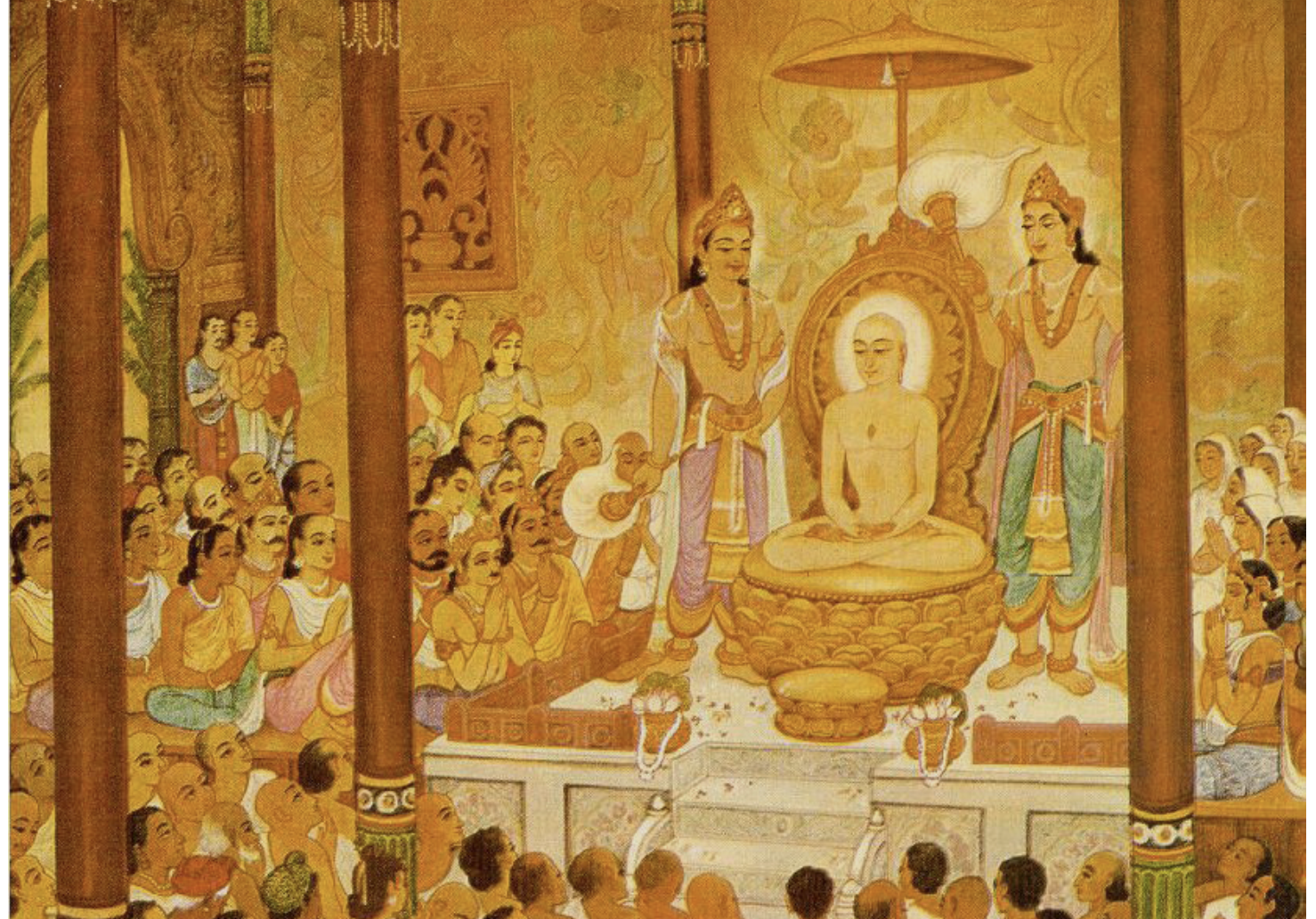
Uttaradhyayana Sutra · Chapter 19

Hermit's Son (मृगापुत्रीय)

Chapter 19 — The Story of Mṛgaputra and the Memory of the Great Cycle

Mṛgaputra gazes at the monk

जया य से सुही होइ, तया गच्छइ गोयरं

“When the deer recovers, it returns to its pasture — naturally, without medicine, relying on its own nature.”

About This Chapter

Mṛgaputrīya

Mṛgaputrīya — the nineteenth chapter — is a monumental dialogue between a son and his parents. It captures the exact moment of spiritual awakening when Prince Mṛgaputra, seeing a monk from his palace window, suddenly recalls his countless previous existences.

The chapter is famous for its thirty-verse description of the sufferings of hell (naraka), delivered as first-person testimony. It then transitions into the beautiful "deer-conduct" (mṛgacārī) analogy, where Mṛgaputra argues that the monk's life is as natural and self-reliant as that of a deer in the forest. It concludes with his total renunciation and ultimate attainment of the Siddha state.

Chapter Structure

I The Encounter and Awakening
II The Prince's Decision
III The Parents' Warning
IV The Testimony of the Great Cycle
V The Deer-Conduct (Mṛgacārī)
VI Renunciation and Practice
VII Final Liberation
99 Sutras
Jātismaraṇa Awakening
Mṛgacārī The Deer-Path
Adhyayana 19

The 99 Sutras

Each sutra is presented with the original Prakrit, English translation, and a simplified commentary.

Part I — The Encounter and Awakening
19.1

सुग्गीवे णयरे रम्मे, काणणुज्जाण सोहिए ।
राया बलभद्दित्ति, मिया तस्सऽग्गमाहिसी ॥१९.१॥

In the pleasant city of Sugrīva, adorned with forests and gardens, there ruled a king named Balabhadra, whose foremost queen was named Mṛgāvatī.

The chapter opens with precise geographical and dynastic anchoring: the city of Sugrīva, abundant with forests and gardens, ruled by the righteous king Balabhadra with his chief queen Mṛgāvatī. The name Mṛgāvatī ("she who has deer-like qualities") foreshadows the chapter's title Mṛgaputrīya — the son of the deer-queen. Jain narrative literature always places the soul's birth within a specific, identifiable context, affirming that liberation is achieved not in abstract space but within the concrete reality of a particular life.

The simple version: This chapter begins in the beautiful city of Sugrīva, where King Balabhadra ruled with his queen Mṛgāvatī.

Sugrīva City Balabhadra Mṛgāvatī
19.2

तेसिं पुत्ते बलसिरी, मियापुत्ते ति विस्सुए ।
अम्मापिऊण दइए, जुवराया दमीसरे ॥१९.२॥

Their son was Balashrī, famous as Mṛgaputra — deeply loved by his mother and father, and a crown prince who subdued enemies.

The epithet Mṛgaputra — "son of the deer" — carries layered meaning: born of Mṛgāvatī, and possessing the gentle yet fleet nature of the deer. The word damīsara typically means "subduer of enemies" in the royal context, but in the Jain reading carries the secondary sense of one who will subdue the inner enemies — the passions. Beloved by his parents and invested with the crown-prince's role, he has every worldly advantage — which makes his renunciation all the more significant.

The simple version: King Balabhadra and Queen Mṛgāvatī had a son named Balashrī, also known as Mṛgaputra — their beloved crown prince.

Mṛgaputra Crown Prince Damīsara
19.3

णंदणे सो उ पासाए, कीलए सह इत्थिहिं ।
देवो दोगुंदगो चेव, णिच्चं मुइयमाणसो ॥१९.३॥

He played in the pleasure-garden palace with women — like a dohundaga deity, ever joyful of mind.

CautionSamsara · Worldly Existence

Involvement in worldly activities generates binding karma.

The comparison to the dohundaga (Trāyastriṃśa) devas places Mṛgaputra at the peak of worldly enjoyment — these devas are known in the Jain cosmology for living in perpetual sensory delight. The palace pleasure-garden becomes the world in miniature: beautiful, insulated, and apparently inexhaustible in its pleasures. This is the life the chapter will subvert entirely when one unexpected sight shatters the illusion.

The simple version: Mṛgaputra lived like a pleasure-deity — always joyful, playing in the palace garden with women, with every desire satisfied.

Pleasure Doguṃdaga Deva Sensory Delight
19.4

मणिरयण कोट्टिमतले, पासायालोयणट्ठिओ ।
आलोएइ णगरस्स, चउक्क-तिय-चच्चरे ॥१९.४॥

Seated in the palace lattice-window, on a floor inlaid with precious gems, he was looking out at the crossroads, triple-roads, and many thoroughfares of the city.

The setting of the palace lattice-window is a recurring motif in Jain narrative: it represents the liminal space between the inner world of royal comfort and the outer world where renunciants walk. Mṛgaputra looks out — not as a casual observer but with the alert curiosity of a soul on the edge of transformation. The gem-inlaid floor beneath him and the busy streets below him represent the two worlds between which he is about to choose.

The simple version: One day Mṛgaputra sat at his palace window — on a beautiful jeweled floor — and looked out at the busy city streets below.

Liminal Space Observation Royal Pomp
19.5

अह तत्थ अइच्छंतं, पासइ समणसंजयं ।
तव–णियम–संजमधरं, सीलडुं गुण आगरं ॥१९.५॥

Then, unexpectedly passing there, he saw a restrained śramaṇa — a bearer of austerity, rules, and saṃyama, holding thousands of precepts, a treasury of virtues.

The word aicchantaṃ — "passing unexpectedly" — captures the unplanned nature of the encounter. Neither Mṛgaputra sought out the monk, nor did the monk seek him. This is the Jain understanding of nimittakāraṇa — the instrumental cause of awakening arrives uninvited. The monk is described with three qualities: tapa (austerity), niyama (rules of conduct), and saṃyama (restraint) — the complete external expression of the liberated path — plus thousands of śīlāṅgas (virtue-disciplines) that constitute the internal structure of the monastic life.

The simple version: Unexpectedly, Mṛgaputra saw a Jain monk passing below — a man who practiced austerity, followed all rules, and was filled with countless virtues.

Nimittakāraṇa Śramaṇa Virtue-Treasury
19.6

तं देहइ मियापुत्ते, दिट्टीए अणिमिसाए उ ।
काहिं मण्णेरिसं रूवं, दिट्टपुव्वं मए पुरा ॥१९.६॥

Mṛgaputra gazed at him with unblinking eyes, thinking: "Where have I seen such a form as this before — at some time in the past?"

The unblinking gaze — animiṣa — is significant: it mirrors the monk's own quality of sustained, unwavering focus. Mṛgaputra cannot look away. Something in the sight of the monk triggers a recognition that goes deeper than ordinary memory — he feels he has seen this before, but he cannot locate it in his current life's experience. The soul's deeper memory is beginning to stir. This is the first sign that jātismaraṇa is approaching.

The simple version: Mṛgaputra stared at the monk with wide, unblinking eyes, thinking: "I've seen someone like this before — but where?"

Animiṣa Stirring Memory Recognition
19.7

साहुस्स दरिसणे तस्स, अञ्झवसाणम्मि सोहणे ।
मोह गयस्स संतस्स, जाईसरणं समुप्पणं ॥१९.७॥

Upon seeing that monk, with moha gone and inner resolution purified and tranquil, jātismaraṇa knowledge arose in him.

The technical Jain term here is significant: moha-gaya — "with moha having departed." The obscuring force of the mohanīya karma momentarily lifts, the inner resolve (adhyavasāya) is purified, and jātismaraṇa jñāna — the extraordinary knowledge of past births — arises spontaneously. This is not visualization or imagination but actual knowledge. The sight of the monk, himself free of moha, resonates with Mṛgaputra's own deeper nature and catalyzes the lifting of karmic fog.

The simple version: The moment Mṛgaputra saw the monk, the veil of delusion momentarily lifted from his mind and he suddenly gained the ability to remember his past lives.

Jātismaraṇa Moha-Gaya Inner Clarity
19.8

देवलोग–चुओ संतो, माणुसं भवमागओ ।
सिणिणाणे समुप्पण्णे, जाई सरइ पुराणयं ॥१९.८॥

Having descended from the deva-world and come into the human existence — when saṃjñā-jñāna (jātismaraṇa) arose — he remembered his ancient births.

Jain PrincipleMoksha · Liberation

Freedom from karma and rebirth is the soul's eternal home.

The narrative reveals that Mṛgaputra's immediately previous birth was as a deva — a celestial being in one of the heavenly realms. This is the classic Jain trajectory of a soul approaching liberation: descending from a deva birth into a human birth, where the conditions for final liberation are available. The recall is complete — purāṇayaṃ means "ancient, long-past" — his memory reaches not just to the previous life but to many previous existences.

The simple version: Mṛgaputra remembered that he had been born in a heavenly realm before this human life, and his past-life memory was now revealing all his previous existences.

Human Birth Cosmic Memory Deva-Loka
19.9

जाईसरणे समुप्पणे, मियापुत्ते महिड्डिए ।
सरइ पोराणियं जाइं, सामण्णं च पुराकयं ॥१९.९॥

When jātismaraṇa arose in the great-powered Mṛgaputra, he remembered his ancient births and also the śramaṇa-dharma he had practiced in previous lives.

CautionDukha · Suffering

Suffering arises from identifying with the perishable body and desires.

The remembrance includes not only the births and their suffering but specifically the śramaṇa-dharma practiced previously. This is a soul with prior karmic credit in the renunciant path — the practice of saṃyama from a previous birth has left impressions (saṃskāras) that resurface now. The epithet mahiḍḍia — "great-powered" — acknowledges the soul's accumulated spiritual energy, which enables this extraordinary recall.

The simple version: When past-life memory arose in the great Mṛgaputra, he remembered not only his old births but also the spiritual discipline he had practiced in those past lives.

Previous Practice Saṃskāra Mahiḍḍia
Part II — The Prince's Decision
19.10

विसएसु अरज्जंतो, रज्जंतो संजमम्मि य ।
अम्मा–पियरमुवागम्म, इमं वयणमब्बवी ॥१९.१०॥

Becoming dispassionate toward sense-objects and developing love for saṃyama, he approached his mother and father and spoke these words.

The transition from rāga-in-the-world to rāga-in-saṃyama is the inner pivot of the chapter. Mṛgaputra does not become cold or empty — he becomes redirected. The same capacity for love that once moved toward sense-objects now moves toward liberation. He goes first to his parents: not to escape them but to engage them, to ask for their blessing. This act of filial reverence is the foundation of the renunciation that follows.

The simple version: Having lost his taste for sensory pleasures and feeling drawn toward the monk's life of discipline, Mṛgaputra respectfully approached his parents to speak.

Dispassion Redirection Filial Reverence
19.11

सुयाणि मे पंच महव्वयाणि, णरएसु दुक्खं च तिरिक्खजोणिसु ।
णिच्छिवणकामो मि महण्णवाओ, अणुजाणह पव्वइस्सामि अम्मो ॥१९.११॥

"I know the five great vows; I know the suffering in the hells and in animal wombs — I am desirous of crossing this great ocean (of saṃsāra); give me permission, O Mother: I will take dīkṣā."

CautionDukha · Suffering

Suffering arises from identifying with the perishable body and desires.

This is Mṛgaputra's single, comprehensive opening statement to his parents: three pillars of his readiness — (1) knowledge of the vows, (2) knowledge of the suffering that awaits without them, and (3) the desire to cross saṃsāra. The word aṇujāṇaha — "give permission" — reflects the Jain value of seeking blessing before renunciation. He does not flee; he asks. And his knowledge is not secondhand theology but the direct recall of jātismaraṇa.

The simple version: Mṛgaputra told his parents: "I know the five great vows, I know the suffering of hell and animal life — please give me permission to become a monk and cross this ocean of rebirth."

Seeking Permission Saṃsāra-Ocean Vows
19.12

अम्मताय मए भोगा, भुत्ता विसफलोवमा ।
पच्छा कडुयविवागा, अणुबंध दुहावहा ॥१९.१२॥

"O Mother and Father! The pleasures I have enjoyed are comparable to poisonous fruit — after-ripening bitterly, they bring continuous suffering."

CautionImpermanence and Death

All worldly things are temporary—clinging to them brings suffering.

Mṛgaputra's vairāgya speech to his parents occupies sutras 12–24. He begins with the poisonous fruit analogy — the kimpāka fruit of the forest looks beautiful and tastes sweet but causes death. Pleasures appear attractive in anticipation, are pleasant momentarily, and then leave behind suffering, bondage, and karmic accumulation. This is the empirical observation of a soul who has lived many lives and has felt the full cycle from pleasure to suffering.

The simple version: Mṛgaputra told his parents that the pleasures he had enjoyed were like poisonous fruit — sweet at first, but bringing bitter pain and continuing suffering in the end.

Kimpāka Fruit Karmic Ripening Vairāgya
19.13

इमं सरीरं अणिच्चं, असुइं असुइसंभवं ।
असासया वासिमणं, दुक्ख केसाण भायणं ॥१९.१३॥

"This body is impermanent, impure, born of impurity; its residence is temporary — it is a vessel of sufferings and afflictions."

CautionDukha · Suffering

Suffering arises from identifying with the perishable body and desires.

The body is analyzed through four lenses: (1) anicca — impermanent; (2) aśuci — impure; (3) born of impurity — arising from blood, semen, and the processes of digestion; (4) a temporary residence — we stay in it for a while and must leave it. Against these four realities, the practice of body-beautification and body-worship appears misguided. The body is not the enemy but it is not the self — and building one's happiness on it is structurally flawed.

The simple version: Mṛgaputra told his parents that the body is impermanent, impure, born from impure substances, only a temporary home — and ultimately a container of suffering.

Anicca Aśuci Body-Realism
19.14

असासए सरीरम्मि, रइं णोवलभामहं ।
पच्छा पुरा व चइयव्वे, फेणबुब्बुय–सणिभे ॥१९.१४॥

"In this impermanent body — comparable to a water-bubble of foam — I find no joy; whether sooner or later, this body must certainly be abandoned."

The foam-bubble image (pheṇabubbuya) is one of the most ancient and universal metaphors for bodily impermanence — a bubble appears and dissolves within moments, leaving no trace. Mṛgaputra extends the logic: if the body is bubble-like in its permanence, and if genuine joy requires a stable foundation, then the body cannot be that foundation. Whether the bubble lasts a moment or a century, it will burst. The rational response is to invest in what endures.

The simple version: The body is like a bubble of foam — it must be left behind sooner or later — so Mṛgaputra found no real joy in it.

Bubble Metaphor Inevitability Non-Attachment
19.15

माणुसते असारम्मि, वाही रोगाण आलए ।
जरा मरणचत्थम्मि, खणं पि ण रमामहं ॥१९.१५॥

"In the human life — which is insubstantial, a house of diseases and afflictions, subject to old age and death — I find not even a moment of true joy."

CautionImpermanence and Death

All worldly things are temporary—clinging to them brings suffering.

In the human life — which is insubstantial, a house of diseases and afflictions, subject to old age and death — I find not even a moment of true joy.

The simple version: This human life is full of disease, suffering, old age and death — Mṛgaputra said he found not even a single moment of genuine joy in it.

Insubstantiality House of Disease Realism
19.16

जम्मं दुक्खं जरा दुक्खं, रोगाणि मरणाणि य ।
अहो दुक्खो हु संसारो, जत्थ कीसंति जंतवो ॥१९.१६॥

"Birth is suffering, old age is suffering, diseases and deaths also — alas! how full of suffering is saṃsāra, wherein all beings are perpetually tormented."

CautionImpermanence and Death

All worldly things are temporary—clinging to them brings suffering.

This sutra is one of the most quoted summaries of the Jain view of cyclic existence — echoing the First Noble Truth of Buddhism and the core Jain teaching on the nature of saṃsāra. Birth itself involves pain; growing old is a progressive loss; disease is suffering; death is certain. And this cycle repeats endlessly for all beings. The exclamation "aho!" — "alas!" — is not despair but wonder: how extraordinary that beings continue to choose this cycle over liberation.

The simple version: Birth hurts, aging hurts, sickness hurts, death hurts — Mṛgaputra said: how full of suffering is this world where every being is constantly tormented.

Four Sufferings Saṃsāra Aho!
19.17

खेतं वत्थुं हिरण्णं च, पुत्त दारं च बंधवा ।
चइत्ताण इमं देहं, गंतव्वमवसस्स मे ॥१९.१७॥

"Fields, property, gold, sons, wife, and relatives — leaving all these and this very body, I must inevitably go."

Mṛgaputra lists everything one typically clings to — real estate, precious metals, children, spouse, relatives, and finally the body itself. All of it must be left. This is not pessimism but a straightforward accounting: death is the great equalizer that strips away every possession, every relationship, every identity. The question the sutra implicitly poses: if you must leave all of it anyway, why not practice leaving it now — while you can do so voluntarily and with full awareness?

The simple version: Fields, gold, family, even the body itself — all of it must be left behind when we die. Mṛgaputra saw no point in clinging to any of it.

Inevitability Stripping Away Death
19.18

जहा किम्पागफलाणं, परिणामो ण सुंदरो ।
एवं भुत्ताण भोगाणं, परिणामो ण सुंदरो ॥१९.१८॥

"Just as the result of eating kimpāka (poisonous) fruit is not beautiful — so the result of the pleasures that have been enjoyed is not beautiful."

The kimpāka fruit — known in ancient Indian literature as the most beautiful-looking but lethally poisonous of fruits — is the perfect analogy for sensory pleasure. Its fragrance is inviting, its appearance is perfect, but eating it destroys. Mṛgaputra has experienced enough cycles of pleasure-followed-by-suffering to know that the pariṇāma (final result/ripening) of bhoga (pleasure) is always unfavorable. The Jain term pariṇāma here carries both its ordinary meaning (result) and its karma-theory meaning (the ripening of karmic consequences).

The simple version: Just like the kimpāka fruit that looks beautiful but is deadly, the pleasures of the world look attractive but their final result is suffering.

Pariṇāma Pleasure Trap Deceptive Beauty
19.19

अद्धाणं जो महंतं तु, अपाहेओ पवज्जइ ।
गच्छंतो सो दुही होइ, छुहा तण्हाए पीडिओ ॥१९.१९॥

"One who travels a long road without provisions suffers as he goes, tormented by hunger and thirst."

Sutras 19–22 form a compact parallel pair of similes: the traveler without provisions vs. the traveler with provisions, applied to the journey through existences with and without dharma. This is practical wisdom: the road of cyclic existence is long — countless births ahead — and those who travel it without the provisions of dharma (the five vows, right conduct, meditation) will suffer at every stage, unprepared and exhausted.

The simple version: A person who travels a long road without food and water suffers terribly from hunger and thirst — this is what happens to souls who cross saṃsāra without dharma.

Traveler Simile Spiritual Provisions Unpreparedness
19.20

एवं धम्मं अकाऊणं, जो गच्छइ परं भवं ।
गच्छंतो सो दुही होइ, वाहीरोगेहिं पीडिओ ॥१९.२०॥

"Similarly, one who goes to the next existence without having practiced dharma suffers as he goes, tormented by diseases and afflictions."

Just as the unprepared traveler suffers — one who passes to the next life without practicing dharma suffers there, tormented by various afflictions.

The simple version: Just as the unprepared traveler suffers — one who passes to the next life without practicing dharma suffers there, tormented by various afflictions.

Karmic Consequences Next Birth Affliction
19.21

अद्धाणं जो महंतं तु, सपाहेओ पवज्जइ ।
गच्छंतो सो सुही होइ, छुहा तण्हा विवज्जिओ ॥१९.२१॥

"But one who travels a long road with provisions goes happily, free from hunger and thirst."

But the traveler who carries provisions travels happily, free from hunger and thirst — the contrast with the unprepared traveler is total.

The simple version: But the traveler who carries provisions travels happily, free from hunger and thirst — the contrast with the unprepared traveler is total.

Dharma-Provisions Ease Preparedness
19.22

एवं धम्मं पि काऊणं, जो गच्छइ परं भवं ।
गच्छंतो सो सुही होइ, अप्पकम्मे अवेयणे ॥१९.२२॥

"Similarly, one who practices dharma and goes to the next existence travels happily — with fewer karmas and free from pain."

CautionDukha · Suffering

Suffering arises from identifying with the perishable body and desires.

One who practices dharma passes to the next existence happily — with less karma and without the pain of karmic suffering.

The simple version: One who practices dharma passes to the next existence happily — with less karma and without the pain of karmic suffering.

Appakamma Freedom from Pain Joyful Journey
19.23

जहा गेहे पलत्तम्मि, तस्स गेहस्स जो पहू ।
सारभंडाणि णीणेइ, असारं अवउज्झइ ॥१९.२३॥

"Just as when a house is on fire, its owner takes out the valuable goods and leaves behind the worthless things."

The burning-house analogy is one of the great similes of Indian spiritual literature. The world is the burning house; the soul is the owner; the valuables are the spiritual qualities (knowledge, equanimity, the vows) that can be carried beyond death; the worthless things are the possessions, attachments, and relationships that burn away at death and cannot be taken along. Mṛgaputra is making the rational calculation of a soul who knows it must exit the house.

The simple version: When a house is burning, a wise owner grabs the valuables and leaves the worthless things behind — Mṛgaputra was making that same choice with his life.

Burning House Sāra-Bhāṇḍa Valuables
19.24

एवं लोए पलित्तम्मि, जराए मरणेण य ।
अप्पाणं तारइस्सामि, तुब्भेहिं अणुमणिओ ॥१९.२४॥

"Similarly, with this world ablaze with old age and death — with your permission — I will save my own soul."

CautionImpermanence and Death

All worldly things are temporary—clinging to them brings suffering.

Mṛgaputra applies the burning-house simile directly to his own situation: the world is ablaze with jarā (old age) and maraṇa (death) — there is no safety inside it. His soul is the valuable he must save. And he says explicitly: "with your permission" — the liberation-seeking is not an act of abandonment but one requested with love and respect. The parents are the first ones he must convince, and the most important.

The simple version: Just as the world is on fire with old age and death, Mṛgaputra said: "With your blessing, I will save my own soul from this burning."

Spiritual Urgency Self-Rescue Ablaze
Part III — The Parents' Warning
19.25

तं बितंअम्मा पियरो, सामण्ण पुत्त दुच्चरं ।
गुणाणं तु सहस्साइं, धारेयव्वाइं भिक्खुणो ॥१९.२५॥

Then his mother and father said to him: "O Son, the śramaṇa-life is very difficult — a monk must bear thousands of virtues."

The parents now respond — not with refusal but with education. From sutra 25 through 44, they lay out a comprehensive portrait of what genuine monkhood demands. Their opening point is quantitative: the monk must maintain sahassāiṃ guṇāṇaṃ — literally thousands of virtues — referring to the 18,000 śīlāṅgas (virtue-disciplines) of the Jain monastic code. This is not hyperbole; the Jain tradition is highly specific about the enumeration of monastic requirements. Their love for their son expresses itself as complete, unflinching honesty.

The simple version: His parents said, "Son, the monk's life is very difficult — a monk must maintain thousands of virtues and disciplines."

Ducciraṃ Thousands of Virtues Honesty
19.26

समया सव्वभूएसु, सतु मित्तेसु वा जगे ।
पाणाइवायविरइ, जावज्जीवाए दुक्करं ॥१९.२६॥

"To maintain equanimity toward all beings — enemy or friend — in the world, and to abstain from violence toward living beings for one's entire life: this is extremely difficult."

Jain PrincipleSamata · Equanimity

Equal-mindedness in pleasure and pain reveals the soul's true nature.

The first mahāvrata — ahiṃsā — is presented here in its full scope: equanimity toward all beings (samabhāva) combined with life-long abstention from violence of any kind. This is not merely not killing large animals; Jain ahiṃsā extends to every life-form, every act of mind, speech, and body. "Enemies and friends alike" points to the internal challenge: it is relatively easy to be kind to friends, but maintaining genuine equanimity toward those who harm you requires a completely different inner architecture.

The simple version: To have equal feelings toward enemies and friends, and to never harm any living being for your entire life — this is extremely difficult, the parents said.

Equanimity Ahiṃsā Dukkaraṃ
19.27

णिच्चकालऽप्पमत्तेणं, मुसावाय विवज्जणं ।
भासियव्वं हियं सच्चं, णिच्चाउत्तेण दुक्करं ॥१९.२७॥

"To give up falsehood always, without a moment's laxness — to speak only beneficial truth, ever-attentive: this is very difficult."

The satya mahāvrata goes beyond merely "not lying" — it requires that every word spoken be simultaneously true AND beneficial (hiya). A statement may be true but harmful; Jain ethics requires both. And this vigilance must be maintained without any lapse, at all times. The standard is total: no convenient half-truths, no omissions, no misleading framing. In a world where language is constantly deployed for self-interest, this standard of speech is genuinely extraordinary.

The simple version: Never speaking even a small falsehood, always speaking only what is true and beneficial, remaining vigilant every moment — this is very difficult.

Satya Beneficial Truth Vigilance
19.28

दंतसोहण–माइस्स, अदत्तस्स विवज्जणं ।
अणवज्जेसिणज्जस्स, गेण्हणाडिव य दुक्करं ॥१९.२८॥

"Not to take even a toothpick without it being given — and to accept only what is blameless and proper: this is extremely difficult."

The asteya (non-stealing) mahāvrata is expressed here in its most granular form: a toothpick without permission cannot be taken. This hyper-precision is characteristic of Jain monastic ethics — nothing is too small to be subject to the rule of not-taking-without-giving. But equally, what IS received must be received through the proper eṣaṇā-samiti — the discipline of careful examination to ensure what one accepts is truly blameless (no living beings harmed, obtained properly).

The simple version: A monk cannot take even a toothpick without being given it, and must only accept things that are completely blameless — the level of care required is extreme.

Asteya Eṣaṇā-Samiti Precision
19.29

विरई अबंभचेरस्स, कामभोगरसण्णुणा ।
उग्गं महव्वयं बंभं, धारेयव्वं सुदुक्करं ॥१९.२९॥

"For one who has tasted the pleasures of sensual enjoyment, to give up non-celibacy and bear the fierce great vow of brahmacarya: this is supremely difficult."

The brahmacarya mahāvrata is described as ugga — fierce, intense, demanding. For someone who has lived in the palace and enjoyed the full range of sensory pleasure as Mṛgaputra has, the shift to complete celibacy is not merely a rule but a fundamental reorientation of the entire being. The parents are not being prurient; they are acknowledging the physiological and psychological reality of someone who has been conditioned for pleasure being asked to sustain complete inner and outer celibacy for life.

The simple version: For someone who has enjoyed the pleasures of life, giving all of that up and maintaining complete celibacy forever is supremely difficult, the parents said.

Brahmacarya Ugga Reorientation
19.30

धण धण्ण–पेसवग्गेसु, परिग्गह विवज्जणं ।
सव्वारंभ परिच्चाओ, णिम्ममत्तं सुदुक्करं ॥१९.३०॥

"To give up possessiveness of wealth, grain, and servants — to abandon all enterprises and to be free of 'mine-ness': this is supremely difficult."

The aparigraha mahāvrata asks not just for the physical giving-up of possessions but for the inner dissolution of mamakāra — the "mine" sense. A prince who owns a kingdom does not simply walk away from property; he must uproot the very psychological structure through which he related to the world as "mine." The word sabbāraṃbha — "all enterprises" — means the abandonment of every activity that generates karmic bondage, which is almost everything that constitutes ordinary worldly life.

The simple version: Giving up wealth, food, servants, all worldly activities, and every sense of "this is mine" — completely — is supremely difficult.

Aparigraha Mamakāra Sudukkaraṃ
19.31

चउव्विहे वि आहारे, राइभोयण वज्जणा ।
सिणही संचओ चेव, वज्जेयव्वो सुदुक्करं ॥१९.३१॥

"From all four types of food, to give up night-eating — and also not to hoard or store oily/snigdha items: this is supremely difficult."

The four types of food (āhāra) in Jain classification: aśana (solid food), pāna (liquid), khādya (snacks), and svādya (condiments/savories). The night-eating prohibition (rātribhojana-virati) requires that all eating be completed during daylight hours — motivated by the protection of microscopic life-forms that are more active at night and that would be destroyed in the preparation and eating of food in darkness. Not hoarding snigdha (oily, sticky) items prevents the attachment to pleasurable foods.

The simple version: A monk must not eat after sunset and must never store or hoard any food — even these seemingly small disciplines are supremely difficult to maintain.

Rātribhojana-Virati Non-Hoarding Care
19.32

छुहा तण्हा य सीउण्हं, दंस मसग वेयणा ।
अक्कोसा दुक्खसेज्जा य, तणफासा जल्लमेव य ॥१९.३२॥

"Hunger and thirst, cold and heat, the pain of biting insects and mosquitoes, harsh words, painful sleeping places, the prickle of grass, and dirt — all these must be endured."

This sutra lists a cluster of the twenty-two parīṣahas — the classical hardships the Jain monk must endure without inner disturbance. The progression moves from physical (hunger, cold, insect bites) to social (harsh words) to environmental (hard ground, grass, dirt). None of these are catastrophic in isolation, but their cumulative, daily, unrelenting presence across years of monastic life demands a sustained equanimity that is genuinely rare. The prince who has known only comfort is being invited to envision the exact opposite of his current existence.

The simple version: A monk must bear hunger, thirst, heat, cold, insect bites, insults, sleeping on hard ground, grass-pricks, and being covered in grime — all without complaint.

Parīṣaha Endurance Equanimity
19.33

तालणा तज्जणा चेव, वह बंध परीसहा ।
दुक्खं भिक्खायरिया, जायणा य अलाभया ॥१९.३३॥

"Beatings, threats, the hardships of violence and bondage — the difficulty of going on almsround, travel on foot, and the experience of receiving no alms: all these must be borne."

The social dimension of monastic hardship is foregrounded here: physical assault, verbal threats, being bound — these are the risks of a wandering mendicant in ancient India who had no social or legal protection. Bhikṣācarya (almsround) is not dignified walking; it is hours of walking door to door in heat or cold, with no guarantee of receiving anything. Alābha — receiving nothing — is itself a hardship the monk must endure without distress. The monk has no fallback; he must be genuinely content with whatever the day brings.

The simple version: A monk must endure being beaten, threatened, harmed, bound — plus go house to house begging for food, walk long distances, and sometimes receive absolutely nothing.

Social Hardship Bhikṣācarya Alābha
19.34

कावोया जा इमा वित्ती, केसलोओ य दारुणो ।
दुक्खं बंभवयं घोरं, धारेडुं अमहप्पणो ॥१९.३४॥

"The pigeon-like livelihood, the painful and terrible kesha-locha (pulling out hair), and the extremely difficult and terrifying brahmacarya vow — for one who is not great-souled, these are torturous to bear."

Kesha-locha — the practice of pulling out head hair by the roots, performed at initiation and periodically throughout monastic life — is unique to the Jain tradition. Unlike shaving, which is painless, kesha-locha causes genuine physical pain and is performed without anesthetic of any kind. It is both a practical austerity (no grooming) and a symbol of indifference to body-image. Combined with the pigeon-like livelihood (accepting whatever is given without complaint) and lifelong brahmacarya, these three together constitute the outer face of renunciation at its most demanding.

The simple version: A monk must live like a pigeon (taking only what comes), pull out his own hair by the roots at initiation, and maintain complete celibacy for life — all of which ordinary people cannot bear.

Kesha-Locha Kapotavṛtti Mahātman
19.35

सुहोइओ तुमं पुत्ता, सुकुमालो सुमज्जिओ ।
ण हुसि पभू तुमं पुत्ता, सामण्णमणुपालिउं ॥१९.३५॥

"O Son, you are accustomed to pleasure, you are delicate and always adorned with baths, ointments, and fine garments — O Son, you are not capable of maintaining the śramaṇa-life."

This is the parents' concluding verdict in their opening round: you are too delicate. The word sukumāla — delicate, soft — is not a criticism but a factual description of someone raised in palace luxury, bathed in fragrant oils, clothed in silk, never exposed to physical hardship. They love him and they are afraid for him. Their fear is real: they have enumerated what the path demands, and they cannot see their tender son bearing it. What they cannot see is what jātismaraṇa has built into his soul.

The simple version: The parents concluded: "Son, you have been raised in comfort, you are delicate and always pampered — you are simply not capable of living the monk's hard life."

Sukumāla Parental Concern Capability
Similes of Monastic Difficulty
19.36

जावज्जीव–मविस्सामो, गुणाणं तु महब्भरो ।
गुरुओ लोहभारुव्व, जो पुत्ता होइ दुव्वहो ॥१९.३६॥

"Throughout life, the immense weight of the many virtues (required by a monk) is difficult to carry — like a heavy load of iron, O Son, it is very hard to bear."

The first of nine similes the parents offer for the difficulty of saṃyama. Iron is the heaviest of ordinary materials — bearing a load of it is grueling work with no relief. The monk's life must be sustained jāvajjīva — for one's entire remaining life, not for a retreat or a trial period. There is no vacation from the vows. The weight of guṇāṇaṃ — the virtue-disciplines — is not crushing intellectually but cumulatively, across decades of sustained practice without a break.

The simple version: Bearing all the virtues of monkhood throughout your entire life is like carrying a load of iron — very heavy, with no rest allowed.

Iron Weight Jāvajjīva Duvvaho
19.37

आगासे गंगसोऽव्व, पडिसोऽव्व दुत्तरो ।
बाहाहिं सागरो चेव, तरियव्वो गुणोदही ॥१९.३७॥

"Like crossing the Gaṅgā flowing down from the sky (against its current), or swimming across the ocean with one's arms — such is the ocean of virtues (of saṃyama) that must be crossed."

The second simile: the Gaṅgā flowing from the sky — a reference to the intense, high-pressure current of the great river as it descends from the Himalayas — is crossed against its current; and the ocean is crossed with bare arms. Both images convey the superhuman effort required to sustain monastic virtue. The guṇodadhi — "ocean of virtues" — must be crossed in its entirety: not waded, not skirted around, but fully traversed.

The simple version: The discipline required of a monk is like swimming against the Gaṅgā in full flood or crossing the ocean with your bare arms — an almost superhuman effort.

Sky-Gaṅgā Ocean of Virtue Effort
19.38

वालुया कवलो चेव, णिरस्साए उ संजमे ।
असिधारा गमणं चेव, दुक्करं चिरेउं तवो ॥१९.३८॥

"Just as a mouthful of sand is tasteless, so saṃyama is tasteless — and just as walking on the edge of a sword is difficult, so is practicing austerity for long."

The third and fourth similes. Sand has no flavor — saṃyama, compared to the rich sensory life the prince has known, will feel similarly barren to his pleasure-conditioned senses. This is not a condemnation of saṃyama but an honest acknowledgment that one trained for pleasure will experience its absence as deprivation. The sword-edge simile evokes the extreme precision required: one step wrong on the sword's edge ends everything. Sustained austerity requires similar precision, moment after moment, year after year.

The simple version: Saṃyama is as tasteless as a mouthful of sand compared to palace pleasures — and sustaining it for years is as difficult as walking on the edge of a sword.

Sword's Edge Sand-Mouthful Flavorless
19.39

अहीवेगंत दिट्टीए, चिरत्ते पुत्त दुच्चरे ।
जवा लोहमया चेव, चावेयव्वा सुदुक्करं ॥१९.३९॥

"To walk the path of right conduct with the snake's steady, single-pointed gaze, O Son, for a long time is very difficult — and to shoot iron chains with a bow is supremely difficult."

The fifth and sixth similes. The snake's gaze (ahīveganta diṭṭhī) is completely steady and one-directional — the snake looks precisely where it moves and does not waver. The monk's conduct requires this same precision: every step watched (to avoid harming life-forms), every word weighed, every action deliberate. The iron-chain-in-a-bow image conveys that some things resist being forced into a shape they are not suited for — just as one cannot fire iron chains from a normal bow, a personality not prepared for saṃyama cannot sustain it by force alone.

The simple version: Moving through life with the constant focused attention of a snake, never losing concentration, for years — is very difficult. And some things simply cannot be forced, like shooting iron with a bow.

Snake's Gaze Iron-Chain Bow Focus
19.40

जहा अग्गिसिहा दित्ता, पाउं होइ सुदुक्करं ।
तहा दुक्करं करेउं जे, तारुण्णे समणत्तणं ॥१९.४०॥

"Just as it is supremely difficult to drink a blazing flame — so it is difficult to practice śramaṇa-life in youth."

The seventh simile. Youth — tāruṇṇa — is the time of maximum bodily energy, sexual drive, social ambition, and sensory intensity. The parents are pointing out that this is precisely the most difficult time to sustain the vows — the pull of everything saṃyama prohibits is at its strongest in youth. Drinking a blazing flame is impossible; they are suggesting that for their young, pleasure-trained son, monkhood at this stage of life approaches the impossible.

The simple version: Just as no one can drink fire, it is extremely difficult to live as a monk during the full surge of youth.

Drinking Fire Youth Sudukkaraṃ
19.41

जहा दुक्खं भरेउं जे, होइ वायस्स कोत्थलो ।
तहा दुक्खं करेउं जे, कीवेणं समणत्तणं ॥१९.४१॥

"Just as it is difficult to fill a bellows with wind — so it is difficult to practice śramaṇa-life for a coward and the weak-spirited."

The eighth simile. A bellows must be pumped with force; if you pump it without strength, no air moves. Śramaṇa-life requires inner courage — kīva (coward) specifically refers to one who lacks the inner fortitude to face difficulty. The parents may be gently suggesting that despite his intelligence and spiritual sensitivity, their son has been raised in an environment that has not built the quality of courageous endurance that sustained monkhood requires.

The simple version: Just as you cannot fill a bellows with air if you pump it weakly, you cannot sustain the monk's life if you are inwardly weak or cowardly.

Bellows Fortitude Kīva
19.42

जहा तुलाए तोलेउं, दुक्करं मंदरो गिरी ।
तहा णिहुयं णीसंकं, दुक्करं समणत्तणं ॥१९.४२॥

"Just as it is difficult to weigh Mount Mandara in scales — so it is difficult to practice śramaṇa-life with quietude and fearlessness."

The ninth and final simile. Mandara — the cosmic mountain churned at the mythic creation of the universe — is so vast it cannot be measured. The monk's life practiced with complete inner stillness (nimbuta) and complete fearlessness (niśśaṅka) represents a similar enormity. These two inner qualities — tranquility and freedom from doubt — are the subtlest and most difficult achievements. They cannot be commanded or performed; they emerge only from sustained practice and genuine realization.

The simple version: Just as no scale can weigh a cosmic mountain, the level of inner calm and fearlessness required for true monkhood is beyond ordinary human capacity.

Mount Mandara Quietude Niśśaṅka
19.43

जहा भुयाहिं तिरेउं, दुक्करं रयणायरो ।
तहा अणुवसंतेणं, दुक्करं दमसायरो ॥१९.४३॥

"Just as it is difficult to cross the ocean of jewels (the sea) with one's arms — so it is difficult to cross the ocean of sense-control for one who is not inwardly pacified."

This bonus simile (following the nine formal ones) drives home the central point: dama — sense-control — is itself an ocean whose crossing requires far more than external effort. The word aṇuvasanta — "not pacified" — refers to someone whose inner passions (kaṣāyas) are still active. Swimming an ocean with bare arms without inner pacification is the monk's life attempted from the outside alone, without the inner transformation. The parents are identifying precisely what they fear their son lacks.

The simple version: Just as you cannot swim across an ocean with your bare arms, you cannot sustain sense-control without first calming your inner passions.

Ocean-Crossing Damasāyara Inner Peace
19.44

भुंज माणुस्सए भोए, पंचलक्खणए तुमं ।
भुत्तभोगी तओ जाया, पच्छा धम्मं चिरस्सिसि ॥१९.४४॥

"O Son, first enjoy the five-fold human sensory pleasures — then, after becoming one who has enjoyed enough, in old age you will willingly practice dharma."

The parents' final argument is the most human: not yet. Enjoy first; practice dharma later. This is the classic householder's prescription — kāma in youth, artha in middle age, dharma in old age, and mokṣa at the end. The parents are not enemies of dharma; they are proposing a sequence they believe to be safer and more realistic for their beloved son. What they do not account for is that jātismaraṇa has already collapsed this sequence: Mṛgaputra has no "later" — he knows what later looks like from past lives.

The simple version: The parents' final plea — "Son, enjoy your youth first; become a monk later in old age when you have had your fill of pleasures."

"Later" Trap Enjoyment Sequence
Part IV — The Testimony of the Great Cycle
19.45

सो बितंअम्मा पियरो, एवमेयं जहा फुडं ।
इह लोए णिप्पिवासस्स, णत्थि किंचि वि दुक्करं ॥१९.४५॥

He said to his mother and father: "What you say is clearly and exactly true — but for one who is desireless in this world, there is nothing at all that is difficult."

This is the great turning-point of the chapter — one of the most powerful single lines in the Uttaradhyayana. Mṛgaputra does not dispute a single point. He grants every word as true. But he reframes the entire question: difficulty is a function of desire, not of external circumstance. For the desireless (niḥspṛha — literally "free of thirst"), cold is not cold in the usual sense; hunger is not suffering in the usual sense; beatings are not humiliation in the usual sense. They are simply conditions — neutral, passing, survivable. Everything the parents listed becomes irrelevant the moment desire is dissolved.

The simple version: Mṛgaputra replied, "Everything you said is true — but for someone who has no more desires, nothing in the world is actually difficult."

Niḥspṛha Desireless Freedom
19.46

सारीर माणसा चेव, वेयणाओ अणंतसो ।
मए सोढाओ भीमाओ, असई दुक्खभयाणि य ॥१९.४६॥

"Infinite times I have endured dreadful physical and mental sufferings, and countless fearful pains."

CautionDukha · Suffering

Suffering arises from identifying with the perishable body and desires.

From sutra 46 through 75, Mṛgaputra delivers a first-person account of his naraka experiences — thirty sustained sutras of visceral, direct testimony. He is not recounting scripture or philosophy; he is speaking from lived past-life memory. This is the chapter's most extraordinary section, and its power comes from its specificity and first-person authority. He begins with the summary statement — infinite physical and mental suffering — and then descends into the details.

The simple version: Mṛgaputra said: "I have personally experienced, countless times across my past lives, dreadful physical and mental suffering that I can still remember."

Direct Memory Infinite Sufferings Authority
19.47

जरा मरण कंतारे चाउरंते भयागरे ।
मए सोढाणि भीमाणि, जम्माणि मरणाणि य ॥१९.४७॥

"In this terrifying jungle of old age and death, with its four realms (four gatis) — I have endured dreadful births and deaths."

CautionImpermanence and Death

All worldly things are temporary—clinging to them brings suffering.

Saṃsāra as a jungle is a compelling image: dense, disorienting, no clear path forward, full of dangers, and offering no permanent shelter. The cāturanta (four-gated) qualifier refers to the four primary states of existence the soul cycles through: deva (celestial), manuṣya (human), tiryañc (animal/plant), and nāraka (hell). Mṛgaputra has been through all four, many times, and the memory of the naraka stays with him most vividly.

The simple version: Mṛgaputra said he had lived through terrifying births and deaths, across all four kinds of existence — heaven, human, animal, and hell — countless times.

Four Gatis Jungle Simile Endless Cycle
19.48

जहा इहं अगणी उण्हो, एत्तोऽडणंतगुणे तहिं ।
णरएसु वेयणा उण्हा, अस्साया वेइया मए ॥१९.४८॥

"Just as fire here is hot — in the hells the heat is infinitely more intense than this; such unbearable burning pain I have endured there."

CautionDukha · Suffering

Suffering arises from identifying with the perishable body and desires.

Mṛgaputra now uses comparative scale to convey the quality of naraka suffering. The fire we know here — the most extreme heat available in the human world — is infinitely less intense than naraka's heat. The word aṇaṃtaguṇa — "infinite times greater" — is not hyperbole in the Jain cosmological sense but a technical description: naraka suffering exceeds human suffering by a factor that cannot be finitely expressed. This is not intended to terrify but to give the listener genuine perspective on the stakes of their karmic choices.

The simple version: The hottest fire we know here is infinitely less burning than the heat in hell — and Mṛgaputra said he personally endured that unbearable heat there.

Naraka Heat Scale Unbearable
19.49

जहा इमं इहं सीयं, एत्तोऽडणंतगुणं तहिं ।
णरएसु वेयणा सीया, अस्साया वेइया मए ॥१९.४९॥

"Just as cold here is cold — in the hells the cold is infinitely more intense than this; such unbearable icy pain I have endured there."

Paired with the previous sutra on heat, this verse addresses the hell of extreme cold — the lower narakas in Jain cosmology alternate between heat-narakas and cold-narakas. Just as no earthly cold can approach naraka's cold, no earthly heat approaches naraka's heat. Mṛgaputra presents both as equally endured, equally unbearable, equally personal memory. The effect on the listener is a double revelation: the full extremes of what karmic accumulation leads to.

The simple version: Just as the coldest cold here is infinitely less than the cold of hell — Mṛgaputra said he had endured that unbearable icy suffering there too.

Naraka Cold Extremes First-Hand
19.50

कंदंतो कंदुकुंभीसु, उड्डुपाओ अहोसिरो ।
हुयासणे जलंतम्मि, पक्कपुव्वो अणंतसो ॥१९.५०॥

"Crying out, upside-down in the iron cauldrons of hell — head below, feet above — in blazing fire, I have been boiled infinite times."

CautionDukha · Suffering

Suffering arises from identifying with the perishable body and desires.

The naraka testimony becomes viscerally specific from here. The kaṃdukuṃbhī — the iron cooking-vessel of hell — is one of the standard instruments of naraka suffering in the Jain tradition. Being plunged into it upside-down (a detail that emphasizes total loss of dignity and orientation) and cooked in fire: this is not symbolic but the actual experience of the soul bound by karma in the lower realms, as Mṛgaputra remembers it. The word aṇaṃtaso — infinite times — is devastating in its matter-of-fact delivery.

The simple version: Mṛgaputra said he remembered being thrown upside-down into burning iron cauldrons and cooked — not once, but infinite times across his past lives.

Kaṃdukuṃbhī Boiling Loss of Dignity
19.51

महादविग्गसंकासे, मरुम्मि वइरवालुए ।
कलंब वालुयाए य, दड्डुपुव्वो अणंतसो ॥१९.५१॥

"Like a vast blazing forest fire, in the diamond-sand desert and in the sands of the Kalaṃba river — I have been scorched infinite times."

After the cauldron's boiling (50), Mṛgaputra shifts to the scorching desert landscapes of naraka conjured by demonic tormentors. The mahādavigga — the terrifying great forest-fire — evokes total engulfing flame with no shelter. The vairavāluyā — diamond-grit sand — is sand so sharp and burning it tears the body as it scorches. The Kalaṃba river's sands compound this: no cool water, only abrasive fire-hot sand. The soul has endured all of this, across infinite past lives, as first-person memory.

The simple version: Mṛgaputra said he had been scorched like a figure caught in a raging forest fire, thrown into blazing diamond-sand deserts and burning riverbeds — infinite times.

Diamond Sand Scorching River of Fire
19.52

रसंतो कंदुकुंभीसु, उड्डुं बद्धो अबंधवो ।
करवत्त-करकयाईहिं, छिण्णपुव्वो अणंतसो ॥१९.५२॥

"Weeping while being pulled from the iron cauldrons and bound helplessly above — without any kinfolk — I have been cut by saws and karakā weapons infinite times."

After the cauldron comes a new instrument: the karavatta (saw) and karaka (iron cutting instrument). The soul is drawn from the cauldron, bound above on branches like meat strung up, and then sawed apart. "Abaṃdhavo" — without any kinfolk — is the devastation at the center of this verse: in naraka, no one comes to help. The soul accumulated karma thinking it had family and support; now it discovers absolute solitude in its suffering. The person who sacrificed dharma for the sake of family and social bonds discovers those bonds dissolve entirely at the boundary of naraka.

The simple version: After being boiled in cauldrons, Mṛgaputra was pulled out, bound helplessly, and sawed apart by naraka's iron instruments — infinite times, with no one there to help him.

Solitude Cutting Abaṃdhavo
19.53

अइतिक्ख कंटगाइण्णे, तुंगे सिंबलि पायवे ।
खेवियं पासबद्धेण, कड्डोकड्डाहिं दुक्करं ॥१९.५३॥

"Bound by ropes and flung onto the tall Śalmali tree — filled with extremely sharp thorns — I was dragged back and forth across the thorns, enduring extreme suffering."

CautionDukha · Suffering

Suffering arises from identifying with the perishable body and desires.

The Śalmali tree is one of the most vivid images in Jain naraka cosmology — a towering tree with every branch bristling with razor-sharp thorns. The soul is lassoed, flung onto its heights, then dragged back and forth across the thorns by demonic tormentors. "Kaḍḍokaḍḍāhiṃ" — forwards and backwards — emphasizes that the suffering is systematic, not random. Each pass across the thorns reopens what the previous pass tore. No position on the tree offers rest. The Śalmali is naraka's answer to the beautiful garden tree whose shade offers comfort: here, the tree itself is the weapon.

The simple version: Mṛgaputra recalled being tied with ropes, thrown onto a towering tree covered with razor-sharp thorns, and then dragged back and forth across those thorns — suffering beyond what words can hold.

Śalmali Tree Thorns Systematic Pain
19.54

महाजंतेसु उच्छू वा, आरसंतो सुभेरवं ।
पीलिओ मि सकम्मेहिं, पावकम्मो अणंतसो ॥१९.५४॥

"Screaming in extreme terror, like sugarcane in the great presses of naraka — I, the evil-karma doer, have been crushed by my own karmas infinite times."

The mahājantra — the great press — is naraka's equivalent of the sugarcane crusher: a massive machine that squeezes the naraka-being as sugarcane is pressed to extract juice. Mṛgaputra uses the simile directly: "ucchū vā" — like sugarcane. The key phrase is "sakammehi" — by one's own karmas. The machines of naraka are not external punishment inflicted by an angry god; they are the direct expression of the soul's own accumulated karma. No one else put the soul into the press. The karma did. This is perhaps the most philosophically important word in this entire naraka account.

The simple version: Just as sugarcane is crushed in a press, Mṛgaputra said he was crushed by naraka's giant machines — and that what was doing the crushing was not a demon but his own past evil actions.

Sugarcane Press Self-Created Mahājantra
19.55

कूवंतो कोलसुणएहिं, सामेहिं सबलेहि य ।
पाडिओ फालिओ छिण्णो, विप्फुरंतो अणेगसो ॥१९.५५॥

"Screaming, attacked by the boar- and dog-formed Śyāma and Śabala demonic beings — I was flung down, split open, and cut apart, writhing in pain, innumerable times."

The paramādhārmika devas — the demonic beings who govern naraka — take the forms of wild animals like boars and dogs to attack naraka beings. "Śyāma and Śabala" are specific named classes of these demonic administrators. The triple action — pāḍio, phālio, chiṇṇo (flung, split, cut) — mirrors the methodical nature of naraka suffering. The soul who indulged its animal desires is now attacked by beings wearing animal forms. Mṛgaputra's first-person account — "I was screaming" — makes this not an abstract doctrine but a lived memory, rendered as testimony for his parents.

The simple version: Mṛgaputra said he had been attacked by demonic beings in the forms of boars and dogs — thrown down, torn apart, and cut into pieces while screaming and writhing — countless times.

Animal Forms Paramādhārmika Devouring
19.56

असीहिं अयसिवण्णाहिं, भल्लीहिं पट्टिसेहि य ।
छिण्णो भिण्णो विभिण्णो य, ओइण्णो पावकम्मुणा ॥१९.५६॥

"By swords the color of flax-flowers, by lances and battle-axes — cut, split, and shattered — I descended into naraka, born there by evil karma."

This sutra adds a phrase absent from the others: "oiṇṇo pāvakammuṇā" — I descended into naraka because of evil karma. Mṛgaputra links cause to effect explicitly: the sword, the lance, the battle-axe — these are not random tortures but the precise expression of evil karma. The vivid detail of swords "the color of flax-flowers" (dark blue-purple, gleaming) is a striking poetic image extracted directly from the Prakrit text, giving this abstract suffering a startlingly specific visual quality. The soul did not fall into naraka by accident or by a god's judgment — it descended there by its own karma.

The simple version: Mṛgaputra said he was cut apart by gleaming dark swords, lances, and battle-axes — and that he ended up in naraka not by anyone's decision but because of his own evil past actions.

Blue Swords Karmic Descent Oiṇṇo
19.57

अवसो लोहरहे जुत्तो, जलंते सिमलाजुए ।
चोइओ तोत्तजुत्तेहिं, रोज्झो वा जह पाडिओ ॥१९.५७॥

"Yoked helplessly to a blazing iron chariot with burning shaft and yoke — goaded by those armed with whips and prods — I was flung to the ground like a bull."

In life, the soul may have driven vehicles, commanded armies, enjoyed the prestige of a chariot. In naraka, the soul becomes the draft animal — yoked to a burning iron chariot, driven by whips, and thrown to the ground like a spent bull. The reversal is total. "Avaso" (helpless, without will) captures the soul's condition precisely: in naraka there is no autonomy, no dignity, no escape from the role karma has assigned. The proud charioteer becomes the beast of burden. This is not punishment but consequence — the exact form of the soul's attachment to power now expressed as its opposite.

The simple version: Mṛgaputra said he was forced to pull a flaming iron chariot like a bull — whipped and goaded — and then thrown to the ground when he collapsed. The cause was his own karma.

Iron Chariot Reversal Avaso
19.58

हुयासणे जलंतम्मि, चियासु महिसो विव ।
दड्डो पक्को य अवसो, पावकम्मेहिं पाविओ ॥१९.५८॥

"In blazing fire on the funeral pyres, like a buffalo — I was burned and cooked, helpless, brought to this condition by evil karmas."

CautionDukha · Suffering

Suffering arises from identifying with the perishable body and desires.

The funeral pyre in this context is deeply ironic: in human life, cremation marks the end of the body's suffering. In naraka, the pyre is an instrument of suffering without end — fire that consumes but does not release. The soul is likened to a buffalo being roasted: heavy, helpless, unable to resist the flames. "Pāvakammehi pāvio" — brought here by evil karma — again closes with the causal reminder. Even this, the most viscerally physical image, ends with a philosophical anchor: the body suffers what the karma ordained.

The simple version: Mṛgaputra said he had been thrown onto blazing funeral pyres and roasted like a buffalo — helplessly burned again and again — because of his own evil actions from past lives.

Funeral Pyre Roasting Cause-Effect
19.59

बला संडासतुंडेहिं, लोहतुंडेहिं पक्खिहिं ।
विलुत्तो विलवंतोऽहं, ढंकगिद्धेहिं अणंतसो ॥१९.५९॥

"By force — by birds with pincer-beaks, by birds with iron-hard beaks, by Ḍhaṃka birds and vultures — I was pecked apart and devoured, wailing in anguish — infinite times."

The Ḍhaṃka is a large bird in Jain cosmology with a powerful sharp beak. Combined with the vulture (giddha), these birds are naraka's scavengers, assigned by demonic administrators to tear apart naraka-beings. Their beaks are described as pincer-like and iron-hard — these are no ordinary birds but instruments of karma made manifest. The soul wails (vilavanto) — it is not numb to the suffering. In naraka, the capacity to feel pain is not diminished; if anything, it is heightened. The consciousness remains fully intact while the body is torn apart, which is what makes naraka naraka.

The simple version: In naraka, Mṛgaputra said he was attacked by giant birds with sharp iron-like beaks that pecked and tore at him while he screamed in agony — and this happened infinite times.

Iron-Beaked Birds Devoured Wailing
19.60

तण्हा किलंतो धावंतो, पत्तो वेयरिणिं णई ।
जलं पाहिति चिंतंतो, खुरधाराहिं विवाइओ ॥१९.६०॥

"Overcome with thirst and exhausted, I ran and reached the Vaitaraṇī river — thinking 'I will drink this water' — and was destroyed by its razor-sharp currents."

The Vaitaraṇī is one of the most famous elements of naraka cosmology across multiple Indian traditions — a river not of water but of razor-sharp liquid, designed to destroy anyone who approaches it for relief. Mṛgaputra's account is devastating in its psychological precision: the soul runs to the river hoping for water (jalaṃ pāhiti ciṃtaṃto — "thinking I will drink this water") and is destroyed instead. In naraka, even the hope for relief becomes the instrument of suffering. This is the deepest teaching of this section: craving (taṇhā) drives the soul toward the very thing that destroys it. The thirsty soul runs toward water — and finds a blade.

The simple version: Burning with thirst in naraka, Mṛgaputra ran to a river hoping for water — but the river's currents were sharp as razors, and instead of being refreshed, he was cut apart.

Vaitaraṇī River Craving Trap Razor-Water
19.61

उण्हाभितत्तो संपत्तो, असिपत्तं महावणं ।
असिपत्तेहिं पडंतेहिं, छिण्णपुव्वो अणेगसो ॥१९.६१॥

"Scorched by the heat and arriving at the Asipattra forest — I have been cut apart innumerable times by the sword-sharp leaves that fall from its trees."

After the Vaitaraṇī river, the soul — still driven by the agony of heat — seeks shade in the great forest. But the Asipattra forest is the Jain (and broader Indic) naraka image of the forest whose leaves are sword-blades. The soul seeks shelter from the sun under the canopy, and the falling leaves cut it apart. Seeking refuge from naraka's heat leads only to naraka's cutting. Every act of seeking comfort or relief in naraka becomes a new form of suffering — because the entire environment of naraka is structured by karma as an apparatus of consequence.

The simple version: Seeking shade from the unbearable heat of naraka, Mṛgaputra entered a great forest — but the leaves of the trees were sharp as swords, and as they fell they cut him apart, again and again.

Asipattra Forest False Shelter Sword-Leaves
19.62

मुग्गरेहिं मुसंढीहिं, सूलेहिं मुसलेहि य ।
गयासं भग्ggगतेहिं, पत्तं दुक्खं अणंतसो ॥१९.६२॥

"By maces, by the muṣaṇḍhī club, by tridents, and by pestles — my body crushed to pieces without hope of survival — such suffering has been attained infinite times."

CautionDukha · Suffering

Suffering arises from identifying with the perishable body and desires.

This verse returns to weapons but names them with specificity: the muggar (iron mace), the muṣaṇḍhī (a spiked club unique to naraka traditions), the sūla (trident), and the musala (pestle). "Gayāsaṃ" — "with life-hope abandoned" — captures the psychological dimension: the naraka being loses not just bodily integrity but the very hope of survival, again and again. The suffering is not only physical; it is the repeated experience of total hopelessness. Mṛgaputra presents this as past memory, but the gravity of "pattaṃ dukkhaṃ aṇaṃtaso" — such suffering attained infinite times — lands with accumulative weight.

The simple version: Mṛgaputra recalled being beaten with maces, tridents, and iron clubs until his body was crushed to pieces — with no hope of survival — infinite times over.

Iron Mace Hopelessness Shattered
19.63

खुरेहिं तिक्खधारेहिं, छुरियाहिं कप्पणीहि य ।
कप्पिओ फालिओ छिण्णो, उक्कित्तो य अणेगसो ॥१९.६३॥

"By sharp-edged razors, by knives, and by scissors — I was trimmed like cloth, split open, cut apart, and my skin peeled off — innumerable times."

Where the previous verse used heavy blunt weapons (maces, clubs), this verse moves to the precision instruments of cutting: the razor, the knife, the scissors. The verb "kappio" — from kappa, to cut cloth — is significant: it compares the naraka-being's body to fabric being tailored. There is something particularly chilling about this domesticity: the ordinary act of cutting cloth transformed into the instrument of naraka suffering. "Ukkitto" — peeling off the skin — adds a final layer of refinement to the horror. Mṛgaputra's testimony uses these specific, concrete images to make abstract karmic consequence viscerally real to his parents.

The simple version: Mṛgaputra said he had been sliced with sharp razors, knives, and scissors — cut like fabric being trimmed — split open, and his skin stripped away — countless times.

Precision Instruments Skinning Tailoring-Suffering
19.64

पासेहिं कूडजालेहिं, मिओ वा अवसो अहं ।
वाहिओ बद्धरुद्धो य, बहुसो चेव विवाइओ ॥१९.६४॥

"Caught helplessly like a deer in snares and trap-nets — I was driven, bound and restrained, and destroyed many times."

The deer simile appears here for the first time in the naraka account — significant because the chapter itself is named Mṛgaputrīya (the son of the deer-queen). In naraka, the soul is the deer: driven into traps, caught in nets, helplessly bound and destroyed. Later in the chapter (sutras 76–86), Mṛgaputra will return to the deer image in its positive form — the free-ranging deer as the model for the monk's life. The same creature that is a victim in naraka becomes the archetype of freedom in saṃyama. The deer is his own self-symbol across both domains.

The simple version: Mṛgaputra said he had been caught in snares and nets like a helpless deer — driven, bound, and killed — many times in past lives in naraka.

Deer Trap Self-Symbol Nets
19.65

गलेहिं मगरजालेहिं, मच्छो वा अवसो अहं ।
उल्लिओ फालिओ गहिओ, मारिओ य अणंतसो ॥१९.६५॥

"By fishhook instruments and crocodile-nets, like a helpless fish — I was hauled out, split open, caught, and killed — infinite times."

From the deer (64) to the fish: Mṛgaputra moves through the animal kingdom as a catalogue of the soul's vulnerability in naraka. The fish is drawn out of water — its natural element — then split and killed. The fishhook's deception is perfect: it offers something (bait) and delivers destruction. The crocodile-net adds the dimension of the hunter using one dangerous creature as a metaphor for trapping another. In naraka, one is caught by the most effective instruments of one's own karma — precisely calibrated to what the soul was most susceptible to.

The simple version: Like a fish caught on a hook or in a net, Mṛgaputra said he had been snagged, dragged out, split open, and killed by naraka's instruments — infinite times.

Fishhook Bait Trap Vulnerability
19.66

विदंसएहि जालेहिं, लेप्पाहिं सउणा विव ।
गहिओ लग्गो बद्धो य, मारिओ य अणंतसो ॥१९.६६॥

"Like a bird caught in nets and snares and in sticky birdlime — I was seized, stuck, bound, and killed — infinite times."

The birdlime (leppa) is a distinctive image: a substance that appears harmless — just a sticky coating on a branch — but that immobilizes the bird the moment it lands. The bird is not trapped by force but by the subtle adhesion of something it did not see as dangerous. This is a perfect symbol for saṃsāric attachment: the soul is not seized violently by worldly things; it sticks to them, one barely noticed attachment at a time, until it cannot move. The bird's singing branches become its cage. In naraka, the soul revisits the consequence of every such sticking, every such landing on what seemed pleasant.

The simple version: Like a bird that gets stuck in birdlime or caught in nets, Mṛgaputra said he had been trapped, bound, and killed in naraka — infinite times — because of the invisible stickiness of attachment.

Birdlime Adhesion Subtle Trap
19.67

कुहाड फरसुमाईहिं, वडुईहिं दुमो विव ।
कुटिओ फालिओ छिण्णो, तच्छिओ य अणंतसो ॥१९.६७॥

"By axes, hatchets and such instruments — by carpenters in demon form — like a tree I was chopped up, split open, cut apart, and stripped — infinite times."

The carpenter-demons wield their tools precisely as human carpenters do: the axe to fell, the hatchet to shape, the adze to strip bark. The soul is the tree. "Dumo viva" — like a tree — is vivid: the tree stands rooted, unable to run, as the carpenter systematically reduces it from living form to lumber. The śabdārtha is explicit that the demonic beings take the form of carpenters (vaḍuī = sūthār). This narrative detail makes the torture more unnerving than if monstrous beings were responsible: it is the familiar, skilled, methodical act of carpentry applied to the soul's body.

The simple version: Mṛgaputra said that in naraka, demonic beings took the form of carpenters and hacked at him with axes and hatchets like a tree being felled — chopped, split, stripped — infinite times.

Carpenter Demon Tree Simile Hacking
19.68

चवेड मुट्टिमाईहिं, कुमारेहिं अयं विव ।
ताडिओ कुटिओ भिण्णो, चुणिओ य अणंतसो ॥१९.६८॥

"By slaps and blows of the fist and similar actions — by demonic blacksmiths who beat iron on an anvil — I was beaten, broken, shattered, and ground to powder — infinite times."

From the carpenter (67) to the blacksmith: the demonic being now takes the form of a metalworker who beats iron on an anvil. The soul is the iron — subjected to the hammer again and again until it is first shaped, then broken, then ground to dust. "Cuṇio" — ground fine as powder — completes the progression: after all the cutting and splitting of earlier verses, here the final stage of disintegration arrives. The smithing metaphor is precise: the blacksmith's work purifies and shapes metal. In naraka, the same process applied to the soul has only destruction as its outcome, because the karma has not been worked off — it is being endured, not dissolved.

The simple version: Mṛgaputra said demonic beings in the form of blacksmiths beat him like iron on an anvil — slapped, punched, shattered, and ground to powder — infinite times.

Blacksmith Demon Iron Simile Pounding
19.69

तत्ताइं तंबलोहाइं, तउयाइं सीसगाणि य ।
पाइओ कलकलंताइं, आरसंतो सुभेरवं ॥१९.६९॥

"Screaming in extreme terror, I was forced to drink the bubbling, boiling red-hot copper, lead, tin, and other molten metals."

The verse describes being forced to drink molten metals — copper, iron, lead — while they bubble and boil. "Kalakalaṃtāiṃ" is an onomatopoetic word: the "kala-kala" sound of boiling liquid, now applied to metal. The śabdārtha notes that the drinking was forced despite the screaming: the soul cried out in terror (ārasaṃto subheravāṃ) but was made to consume the metals regardless. This is naraka's answer to the soul that spent its human lives consuming sensory pleasures indiscriminately — now forced to consume what destroys rather than nourishes.

The simple version: Mṛgaputra described being forced to drink bubbling molten copper, iron, and lead in naraka — screaming in terror the entire time — unable to stop or escape.

Molten Metal Forced Drinking Kalakalaṃtāiṃ
19.70

तुहं पियाइं मंसाइं, खंडाइं सोल्लगाणि य ।
खाविओ मि समंसाइं, अग्गिगवण्णाइं अणेगसो ॥१९.७०॥

"Reminding me that meat was dear to you — my own flesh was cut into pieces, roasted, made fire-red like live coals, and I was made to eat it — innumerable times."

This verse is among the most philosophically striking in the naraka account. The demonic tormentors taunt the soul by echoing its past desires: "this meat was dear to you." They then cut the soul's own flesh, roast it, make it glow red like burning coals, and force the soul to eat it. The soul is made to consume itself — its own craving turned against it with perfect precision. What one desired is now what one is forced to swallow, in its most degraded and agonizing form. This is not punitive torture; it is the direct, logical fruition of the soul's own attachment to meat and sensory pleasure.

The simple version: In naraka, tormentors reminded Mṛgaputra of his past love of meat — then cut his own flesh, roasted it glowing red, and forced him to eat it. This is what attachment to sensory pleasure becomes.

Self-Consumption Karmic Echo Meat Desire
19.71

तुहं पिया सुरा सीहू, मेरओ य महुण य ।
पाइओ मि जलंतीओ, वसाओ रुहिराणि य ॥१९.७१॥

"Reminding me that wine, sīdhu liquor, maireya, and mead were dear to you — I was made to drink my own blazing fat and blood."

This verse parallels 70 precisely: as meat was answered with one's own flesh, intoxicating drink is answered with one's own burning blood and fat. The four types of liquor named — surā, sīdhu, maireya, madhu — are the specific categories recognized in Jain dietary ethics as forbidden intoxicants. The taunting formula "tuhaṃ piyā" — "this was dear to you" — appears again: the demonic tormentors function as the karma's own voice, reminding the soul of what it chose. What was sweet is now scorching; what refreshed now burns.

The simple version: Just as Mṛgaputra was forced to eat his own flesh (70), here he was reminded of the intoxicating drinks he once craved — and then forced to drink his own burning blood and fat instead.

Intoxicants Burning Fluid Karmic Voice
19.72

णिच्चं भीएण तत्थेण, दुहिएण वहिएण य ।
परमा दुहसंबद्धा, वेयणा वेइया मए ॥१९.७२॥

"Always frightened, troubled, grief-stricken, and agitated in body — I have endured the supreme suffering, bound in extreme pain."

CautionDukha · Suffering

Suffering arises from identifying with the perishable body and desires.

After cataloguing the specific physical instruments of naraka (sutras 46–71), this verse steps back and names the total psychological condition of the naraka-being: niccaṃ bhīeṇa — constantly frightened. Not occasionally frightened, not frightened until one adjusts, but niccaṃ — always, without interruption. The naraka-being is permanently in the state of terror, grief, and physical agitation. "Paramā duhasaṃbaddhā" — supremely bound in suffering — is the summary of the entire account. The suffering is not just intense; it is binding: it holds the soul in place, prevents liberation, prevents even the beginning of spiritual effort.

The simple version: Mṛgaputra described not just the individual tortures of naraka but the total state of being there: constantly afraid, troubled, grief-stricken, shaking — supremely bound in suffering with no relief.

Constant Terror Agitation Supreme Bondage
19.73

तिव्वचंडप्पगाढाओ, चोराओ अइदुस्सहा ।
महब्भयाओ भीमाओ, णरएसु वेइया मए ॥१९.७३॥

"Intense, violent, profound, severe, extremely unbearable, supremely terrifying, and frightful — such sufferings have been experienced by me in the narakas."

CautionDukha · Suffering

Suffering arises from identifying with the perishable body and desires.

This verse is a concentrated list of seven qualifiers for naraka suffering — tivva, caṃḍa, ppagāḍhā, corā, aidussahā, mahabbhayā, bhīmā — each an independent adjective meaning something slightly different: acute, violent, deep-seated, harsh, unbearable, hugely terrifying, and frightful. The Gujarati commentary explains these distinctions carefully: tīvra = beyond normal painful experience; caṃḍa = extreme; pragāḍha = long-lasting; ghora = severe; ati duḥsaha = absolutely unbearable; mahābhaya = causing immense fear; bhīma = frightening to even contemplate. Mṛgaputra is not repeating himself — each word names a distinct dimension of the suffering.

The simple version: Mṛgaputra used seven different words to describe naraka suffering — each capturing a different aspect of it: piercing, violent, deep, harsh, impossible to bear, terrifying, and dreadful.

Qualities of Pain Intensity Seven Marks
19.74

जारिसा माणुसे लोए, ताया दीसंति वेयणा ।
एत्तो अणंतगुणिया, णरएसु दुक्खवेयणा ॥१९.७४॥

"O parents! Whatever sufferings appear in the human world — the painful suffering in the narakas is infinitely greater than those."

CautionDukha · Suffering

Suffering arises from identifying with the perishable body and desires.

This verse is the comparative pivot of the entire naraka account. Mṛgaputra addresses his parents directly ("tāyā" — beloved parents) and makes the comparison explicit: all the suffering you see in the human world — disease, grief, loss, injury, death — is nothing compared to naraka. The word "aṇaṃtaguṇiyā" — infinitely multiplied — is precise in Jain thought: not merely "much greater" but literally infinite in magnitude. The purpose of this comparison is not to terrify but to reason: if you understand the scale of naraka suffering even partially, what effort would you not make to avoid the karma that leads there?

The simple version: Mṛgaputra told his parents directly — every suffering you see in the human world is infinite times less than what is experienced in naraka. That is how serious this is.

Human vs. Naraka Comparison Aṇaṃtaguṇiyā
19.75

सव्वभवेसु अस्साया, वेयणा वेइया मए ।
णिमेसंतरिमत्तं पि, जं साया णत्थि वेयणा ॥१९.७५॥

"In all existences — only painful, unpleasant suffering has been experienced by me; not even for the blink of an eye has there been a pleasant, soothing sensation in that suffering."

CautionDukha · Suffering

Suffering arises from identifying with the perishable body and desires.

This verse is the conclusion of Mṛgaputra's naraka account (sutras 46–75). He makes the final, total statement: across all existences, across all narakas, not even for the duration of a blink of an eye was there a pleasant sensation — not the briefest respite, not the faintest comfort. The contrast with human life is implicit: even in the worst human suffering, there are moments of relief, sleep, distraction, kindness. In naraka, the continuity of suffering is absolute and unbroken. This is both the closing argument of Mṛgaputra's testimony and his personal invitation to his parents: I have remembered all of this. Now will you still ask me to stay?

The simple version: After describing every form of naraka suffering, Mṛgaputra made the final point: not even for the blink of an eye, across all those infinite past lives, was there a single moment of relief.

No Relief Continuity Final Word
Part V — The Deer-Conduct (Mṛgacārī)
19.76

तं बिंतऽम्मापियरो, छंदेणं पुत्त पव्वया ।
णवरं पुण सामण्णे, दुक्खं णिप्पडिकम्मया ॥१९.७६॥

The parents said to him: "O son, take initiation according to your own wish — but know that in the monastic life the special hardship is: there is no medical treatment for illness."

Having heard Mṛgaputra's full naraka testimony (sutras 46–75), the parents relent. Their permission is genuine but accompanied by a real concern: in monastic life, when illness comes, a monk does not seek or receive medical treatment. This is the principle of niṣpratikarmitā — non-recourse to remedies. The Daśavaikālika Sūtra makes this explicit, as does the Uttaradhyayana itself. The parents' concern is not an attempt to stop Mṛgaputra; it is a parent's honest worry, framed as a teaching about what he is undertaking. Their love is expressed precisely in this honesty.

The simple version: After hearing everything, Mṛgaputra's parents said: "Take initiation if you wish, son — but know that monks do not receive medical treatment when they fall ill. That is the great hardship of this path."

Relenting Niṣpratikarmitā Parental Release
19.77

सो बिंतऽम्मापियरो, एवमेयं जहाफुडं ।
पडिकम्मं को कुणइ, अरण्णे मियपिक्खणं ॥१९.७७॥

He said to his parents: "What you say is true exactly — but who gives medical treatment to the deer and birds in the forest?"

Mṛgaputra's response to his parents' concern is the beginning of the mṛgacārī (deer-conduct) analogy that runs through sutras 77–86. His answer is precise and logical: yes, the monk does not receive treatment — but who treats the deer and birds in the forest? They live, roam, fall ill, recover or perish — entirely without medical care. And yet they live fully. This question turns the parents' concern into the setup for a philosophical teaching about what self-reliance in spiritual life actually looks like.

The simple version: Mṛgaputra said to his parents: "You are right that monks don't get treatment when ill — but tell me, who treats the deer and birds in the forest? And yet they live."

Deer Analogy Forest Medicine Self-Reliance
19.78

एगभूओ अरण्णे वा, जहा उ चरइ मिगो ।
एवं धम्मं चरिस्सामि, संजमेण तणेव य ॥१९.७८॥

"Just as a deer roams alone, freely, in the forest — so shall I practice the Dharma, through restraint, like the blades of grass."

The mṛgacārī analogy reaches its positive formulation here: the deer roaming alone in the forest becomes the explicit model for Mṛgaputra's monastic resolve. "Egabhūo" — alone — is the key word: the monk, like the deer, does not seek a companion to manage its needs. The final phrase "taṇeva ya" — like a blade of grass — adds another layer: the monk does not even have the deer's mobility of preference but accepts the simplest, most undemanding existence. The blade of grass takes what comes — sun, rain, drought — without complaint or arrangement. This is the positive vision that the naraka account has been building toward: not just fear of suffering, but love of freedom.

The simple version: Mṛgaputra said: "Just as a deer wanders freely and alone in the forest, I will practice the spiritual path through discipline — simply, without fuss, like a blade of grass."

Egabhūo Blade of Grass Natural Living
19.79

जया मिगस्स आयंको, महारण्णम्मि जायइ ।
अच्छंतं रुक्खमूलम्मि, को णं ताहे तिगिच्छइ ॥१९.७९॥

"When illness comes to a deer in the great forest, seated under a tree — who then treats that deer?"

Mṛgaputra develops the analogy with surgical precision. When the forest deer falls ill and rests under a tree, there is no healer — no physician, no medicine, no one even to ask after its welfare. And yet the deer recovers (when it recovers) through its own nature, without anxiety about its lack of care. The question "who treats it?" is rhetorical: the answer is, no one. This is not tragedy; it is the natural order of self-reliant life. The monk's situation is identical: when illness comes during the wandering life, there is no treatment. But the illness is not the problem — it is the attachment to wellness, the anxiety about its absence, that constitutes the real suffering.

The simple version: Mṛgaputra asks: when a deer in the deep forest gets sick and sits under a tree — who takes care of it? No one. And yet the deer lives its life fully.

Healerless Nature's Way Inner Strength
19.80

को वा से ओसहं देइ, को वा से पुच्छइ सुहं ।
को से भत्तं च पाणं च, आहिरत्तु पणामए ॥१९.८०॥

"Who gives it medicine? Who asks after its welfare? Who brings it food and water and offers it?"

Three rhetorical questions complete the deer analogy: Who brings medicine? Who inquires about its health? Who brings it food and water? The answer to all three is: no one. No one does these things for the forest deer. And this, Mṛgaputra argues, is not a deficiency but a condition of freedom. The monk who undertakes mṛgacārī — deer-conduct — does not require these things either, because the monk's inner wellbeing is not contingent on external care. This is a radical restatement of what it means to be "cared for": not by another's service, but by one's own undisturbed equanimity.

The simple version: Mṛgaputra asks three simple questions about the sick deer in the forest: Who gives it medicine? Who asks how it is? Who brings it food and water? No one. And yet it lives.

Absence of Service Self-Caring Radical Freedom
19.81

जया य से सुही होइ, तया गच्छइ गोयरं ।
भत्तपाणस्स अट्टाए, वल्लराणि सराणि य ॥१९.८१॥

"And when the deer recovers its health, it goes to its pasture — seeking food and water among the forest thickets and ponds."

When the deer recovers — without having had any medicine or care — it simply returns to its natural activity: grazing. It goes to the forest thickets (vallarā) and the ponds (sara), seeking what it needs without urgency, without hoarding, without anxiety about tomorrow. "Suhī hoi" — it becomes well — not because of treatment but because of its own constitution and resilience. The monk similarly: when the illness passes (as illness does, even untreated, unless karma makes it terminal), the monk resumes the wandering life without drama, without complaint about what was not provided.

The simple version: When the deer gets better on its own, it simply goes back to grazing in the forest and drinking from ponds — naturally, without making a fuss about having been sick.

Goyaraṃ Recovery Pasture
19.82

खाइत्ता पाणियं पाउं, वल्लरेहिं सरेहि य ।
मिगचारियं चरित्ताणं, गच्छइ मिगचारियं ॥१९.८२॥

"Having eaten grass and drunk water at the forest thickets and ponds — practicing the deer-conduct — it proceeds on its deer-way."

The deer's daily pattern is simple: eat what the forest offers, drink from the ponds, and move. "Migacāriyaṃ carittāṇaṃ, gacchai migacāriyaṃ" — practicing deer-conduct, it goes the deer-way — has a meditative repetition: the deer is the deer. It does not aspire to be something else, does not compare itself to others, does not accumulate beyond what the day requires. The monk who follows mṛgacārī embodies this: accepting what comes in terms of food and water (alms received), not seeking better or lamenting less, and continuing the spiritual movement — the wandering forward.

The simple version: The deer eats what the forest offers, drinks from ponds, and moves on — living simply and naturally. Mṛgaputra says: this is how I will live as a monk.

Mṛgacārī Simplicity Deer-Way
19.83

एवं समुट्टिओ भिक्खू, एवमेव अणेगओ ।
मिगचारियं चरित्ताणं, उड्डुं पक्कमइ दिसं ॥१९.८३॥

"Likewise the monk who arises with this resolve — roaming many places just like the deer — practicing deer-conduct — proceeds toward the upward direction: liberation."

Jain PrincipleMoksha · Liberation

Freedom from karma and rebirth is the soul's eternal home.

The deer analogy now comes full circle: the monk who practices mṛgacārī — living simply without medical treatment, without fixed residence, without accumulation — moves "upward" (uḍḍuṃ). In Jain cosmology, the upward direction (ūrdhvagati) is the direction of liberation: the liberated soul rises to Siddha-śilā at the apex of the universe. The deer's wandering in the forest, though horizontal in the physical world, is for the monk a vertical movement toward freedom. The mṛgacārī, practiced with equanimity and restraint, leads not in circles but upward.

The simple version: In the same way the deer lives freely in the forest, the monk who practices that same simple, unattached way of living rises upward — toward liberation.

Upward Direction Uḍḍuṃ Liberation-Bound
19.84

जहा मिगे एग अणेगचारी, अणेगवासे धुवगोयरे य ।
एवं मुणी गोयरियं पविट्टे, णो हीलए णो वि य खिंसएज्जा ॥१९.८४॥

"Just as the deer wanders many places alone, dwells in many locations, and always grazes wherever it is — so too the monk who has entered on the path of alms-wandering should neither feel contempt for it, nor be angry about it."

This verse expands the mṛgacārī teaching into its full ethical and psychological dimension. The deer, wherever it roams, does not feel contempt for the grass available, nor does it grow angry when only poor grass is found. The monk, similarly, should not feel contempt for the alms received (whether abundant or meager) and should not grow angry or resentful when the wandering life offers less than expected. "Dhuvagoyare" — always finding its pasture — implies that wherever the monk goes, nourishment for the soul is available: in every situation, the opportunity for equanimity and practice exists.

The simple version: Just as the deer roams freely and eats whatever grass it finds — never looking down on what's available or getting angry about it — the monk should practice the same contentment on the alms-wandering path.

Contentment No Contempt Dhuvagoyare
Part VI — Renunciation and Practice
19.85

मिगचारियं चरिस्सामि, एवं पुत्त जहासुहं ।
अम्मापिउहिं अणुण्णाओ, जहाइ उवहिं तओ ॥१९.८५॥

"'I will practice the deer-conduct' — thus Mṛgaputra spoke; and the parents said: 'Do as it brings you well-being, son.' Having received his parents' permission, he then abandoned all household possessions."

This verse marks the formal exchange of permission. Mṛgaputra declares his intent in the language of the analogy he has built: "I will practice mṛgacārī." The parents, hearing the full deer-conduct argument, respond with "jahāsuhaṃ" — do as brings you happiness, do as your welfare dictates. The permission is unconditional and loving. Then, having received it, Mṛgaputra immediately abandons all household possessions ("uvahaṃ tao" — then the possessions). There is no delay, no lingering. The permission received is the trigger for action.

The simple version: Mṛgaputra said "I will live like the deer," and his parents replied "Do what brings you well-being, son." With their blessing, he immediately gave up all his worldly belongings.

Jahāsuhaṃ Abandonment Permission
19.86

मिगचारियं चरिस्सामि, सव्वदुक्खविमोक्खिणिं ।
तुभेहिं अऽभणुण्णाओ, गच्छ पुत्त जहासुहं ॥१९.८६॥

Mṛgaputra: "I will practice the deer-conduct — which liberates from all suffering." Parents: "Having received your permission, go, son — as it brings you well-being."

CautionDukha · Suffering

Suffering arises from identifying with the perishable body and desires.

This sutra is a couplet of departing words. Mṛgaputra adds the crucial qualifier to his mṛgacārī declaration: "savvadukkha-vimokkhiṇiṃ" — which liberates from all suffering. He is not merely saying he will live like a deer; he is saying this conduct, followed with complete commitment, leads to total liberation. The parents respond with "gaccha putta" — "go, son" — the formal blessing of departure. The Gujarati commentary notes that this is the moment of complete renunciation of household life: not just of possessions but of the parental claim itself. The parents release him.

The simple version: Mṛgaputra said "I will follow the path that frees from all suffering" — and his parents said "Go, son, as it brings you well-being." With those words, he was truly released.

Final Release Liberation Gaccha Putta
19.87

एवं सो अम्मापियरो, अणुमाणित्ताण बहुविहं ।
ममत्तं छिंदइ ताहे, महाणागो व्व कंचुयं ॥१९.८७॥

"In this way, having convinced his parents in many ways, he then cuts off all attachment — as a great serpent sheds its skin."

Jain PrincipleTyaga · Renunciation

Voluntarily releasing worldly attachments leads to spiritual freedom.

CautionSanga · Attachment

Emotional bonds to people and things perpetuate suffering.

The snake-shedding-its-skin simile is one of the most celebrated images for renunciation in the Indic traditions. The great serpent (mahānāga) sheds its old skin not with struggle or regret but with ease and completeness — it moves forward, and the old skin is simply left behind. Mṛgaputra, having done the work of persuasion through the long naraka account and the mṛgacārī argument, now cuts his mamatta — his sense of "mine" toward family, possessions, status, and even his parents themselves — cleanly and completely. The mamatta is the skin. The self that emerges is new.

The simple version: After convincing his parents with all his arguments, Mṛgaputra cut away every trace of attachment — like a great snake that simply sheds its old skin and moves forward.

Shedding Skin Mahānāga Cutting Mamata
19.88

इड्डुं वित्तं च मित्ते य, पुत्त-दारं च णायओ ।
रेणुयं व पडे लग्गं, णिद्धुणित्ताण णिग्गओ ॥१८.८८॥

"His prosperity, wealth, friends, sons, wife, and kinfolk — as one shakes off dust settled on a garment — shaking all these off, he went forth."

CautionSanga · Attachment

Emotional bonds to people and things perpetuate suffering.

The snake simile (87) described the cutting of internal attachment (mamatta — the sense of "mine"). This verse describes the external reality: the actual objects of that attachment — wealth, friends, sons, wife, relatives. And the simile is the dust shaken from a garment: just as one brushes dust from a cloth with a light shake — without effort, without grief, without looking back at the dust — Mṛgaputra brushes away these relationships and goes forth. The dust is not the cloth. The garment of the soul continues without the accumulated dust of worldly identity.

The simple version: Just as you shake dust from a piece of cloth, Mṛgaputra shook off all his wealth, friends, family, and possessions — and walked away into the homeless life.

Dust Simile Niggao Shaking Off
19.89

पंचमहव्वयजुत्तो, पंचसिमिओ तिगुत्तिगुत्तो य ।
सऽभिंतर बाहिरओ, तवोकम्मंसि उज्जुओ ॥१९.८९॥

"Endowed with the five great vows, with the five careful observances, protected by the three guards — engaged in inner and outer austerity, he was diligent in the practice of tapa."

Jain PrincipleTapa · Austerity

Deliberate practice that weakens karma and strengthens the soul.

The text now shifts from narrative to description of Mṛgaputra's actual monastic practice. The 5 + 5 + 3 framework is the structural backbone of Jain monastic life: five great vows (mahāvrata), five careful observances (samiti), and three guards (gupti). Together these constitute the full armature of the monk's conduct. "Inward and outward" (sa'bhinṃtara bāhirao) indicates that both the external actions (what is done) and the internal states (what is thought and felt) are brought under discipline. Tapa — austerity — encompasses both the body's discipline and the mind's refinement.

The simple version: As a monk, Mṛgaputra followed the five great vows, five rules of carefulness, and three types of inner restraint — working at austerity both on the inside and the outside.

5+5+3 Tapa Diligence
19.90

णिम्ममो णिरहंकारो, णिस्संगो चत्तगारवो ।
समो य सव्वभूएसु, तसेसु थावरेसु य ॥१९.९०॥

"Free of attachment, free of ego, free of all bonds, having abandoned the three types of pride — equanimous toward all beings, mobile and immobile."

Jain PrincipleTyaga · Renunciation

Voluntarily releasing worldly attachments leads to spiritual freedom.

CautionMana · Pride

Arrogance blocks the humility needed for genuine learning.

This verse describes the inner qualities of Mṛgaputra's renunciation: no "mine-ness," no ego, no attachments, no pride. The three gāravas abandoned — pride of body, pride of knowledge, pride of gain/status — are the three subtle forms of ego that persist in even advanced practitioners. "Samo ya savvabhūesu" — equanimous toward all beings — extends this inner freedom outward: the monk who has no ego has no preference, no favoritism, no prejudice toward any of the six types of beings, from the subtlest immobile organism to the human being.

The simple version: As a monk, Mṛgaputra had no sense of "mine," no ego, no attachments, no pride — and he treated every single living being, plant or animal, with complete equality.

Nimmamo Nirahṃkāro Universal Equality
19.91

लाभालाभे सुहे दुक्खे, जीविए मरणे तहा ।
समो णिंदा पसंसासु, तहा माणावमाणओ ॥१९.९१॥

"Equanimous in gain and loss, in pleasure and pain, in life and death — equally disposed toward blame and praise, toward honor and dishonor."

Jain PrincipleSamata · Equanimity

Equal-mindedness in pleasure and pain reveals the soul's true nature.

CautionImpermanence and Death

All worldly things are temporary—clinging to them brings suffering.

This verse catalogues six pairs of opposites across which Mṛgaputra maintains perfect equanimity: gain/loss, pleasure/pain, life/death, blame/praise, honor/dishonor. The spiritual ideal is not indifference to experience but freedom from being moved by the poles — neither pulled toward one nor repelled by the other. "Samo" — equal-natured — is the technical Jain term for this state: samabhāva. The soul that rests in samabhāva is not tossed between the opposites because it has found the ground that holds regardless of what the surface brings.

The simple version: Mṛgaputra was the same person whether he received gain or loss, pleasure or pain, praise or blame, honor or insult. None of these moved him. That is what equanimity means.

Samabhāva Opposites Center
19.92

गारवेसु कसाएसु, दंड सल्ल भएसु य ।
णियत्तो हास सोगाओ, अणियाणो अबंधणो ॥१९.९२॥

"Turned away from pride, from the passions, from the three rods of punishment and the seven fears — withdrawn from laughter and sorrow — without nidāna (worldly seeking) and without bondage."

CautionMana · Pride

Arrogance blocks the humility needed for genuine learning.

This verse maps the complete interior freedom Mṛgaputra attained: turned away from the gāravas, kaṣāyas, daṇḍas, śalyas, and bhaya — these are the entire catalogue of the soul's inner enemies in Jain soteriology. "Aṇiyāṇo" — without nidāna — is critical: the monk does not practice tapa or dharma with any ulterior motive (whether wealth, rebirth in heaven, or even liberation sought as a reward). The practice is pure. "Abaṃdhaṇo" — without bondage — is the result: no new karma is being generated because there is no ego, no passion, no motive.

The simple version: Mṛgaputra was free of pride, passion, the punishments of uncontrolled mind/speech/body, and all the inner "thorns" of wrong seeking — neither frivolously joyful nor sorrowful — practicing with no ulterior motive.

No Nidāna Inner Freedom Abaṃdhaṇo
19.93

अणिस्सिओ इहं लोए, परलोए अणिस्सिओ ।
वासीचंदणकप्पो य, असणे अणसणे तहा ॥१९.९३॥

"Without dependence on this world, without dependence on the next world — equanimous like the chisel and the sandalwood — the same whether receiving food or going without."

The vāsī-candana simile — the adze and sandalwood — is one of the most celebrated in Jain ethics. The sandalwood does not distinguish between the adze that cuts it and the person who applies it as perfume: it gives its fragrance equally to both. The monk who has reached this state does not prefer food over fasting, praise over blame, this world over the next. "Aṇissio ihaṃ loe, paraloe aṇissio" — not dependent on this world, not dependent on the next — captures the totality of the monk's freedom: nothing in either world exerts a pull.

The simple version: Mṛgaputra was equally at peace whether he ate a full meal or fasted completely — like sandalwood that releases its fragrance equally to the adze that cuts it and the hand that applies it.

Vāsī-Candana Independence Non-Dependence
19.94

अप्पसत्थेहिं दारेहिं, सव्वओ पिहियासवे ।
अञ्झप्पझाणजोगेहिं, पसत्थ दमसासणे ॥१९.९४॥

"With all inauspicious gates closed, all āsravas blocked from all directions — through the yoga of inner, auspicious meditation — he was steady in the praised discipline of self-restraint."

Jain PrincipleVinaya · Discipline

Self-imposed order of thought, word, and deed transforms the soul.

This verse describes the technical achievement of Mṛgaputra's practice: the blocking of all āsravas (sources of karma inflow) through the power of inner meditation. "Savvao pihiyāsave" — blocked from all directions — implies completeness: no single gate remains through which karma can enter. This is the state of saṃvara (stoppage of karma inflow), the penultimate stage before nirjarā (shedding of existing karma) and ultimately mokṣa. The instrument of this achievement is adhyātma-dhyāna — deep inner meditation that is not merely focused thought but a qualitative transformation of the soul's orientation.

The simple version: Through deep inner meditation, Mṛgaputra blocked every pathway through which new karma could enter his soul — settling firmly into the highest discipline of self-restraint.

Saṃvara Āsrava-Block Adhyātma-Dhyāna
19.95

एवं णाणेण चरणेण, दंसणेण तवेण य ।
भावणाहिं य सुद्धाहिं, सम्मं भावेत्तु अप्पयं ॥१९.९५॥

"In this way — through knowledge, through conduct, through insight, through austerity, and through pure contemplations — he thoroughly cultivated his own soul."

Jain PrincipleTapa · Austerity

Deliberate practice that weakens karma and strengthens the soul.

This verse is the structural summary of Mṛgaputra's spiritual path, naming its five pillars: jñāna (knowledge), cāritra (conduct), darśana (insight), tapa (austerity), and śuddha-bhāvanā (pure contemplation). The combination of these five, applied "sammam" — rightly, in the proper way — constitutes the complete Jain path of liberation. "Bhāvettu appayaṃ" — cultivated his own soul — is the goal: the soul that cultivates itself through these instruments transforms from within. No external force accomplishes this. The soul transforms itself.

The simple version: Through right knowledge, right conduct, right insight, austerity, and pure meditation — Mṛgaputra cultivated and transformed his own soul from within.

Five Pillars Soul-Cultivation Sammaṃ
Part VII — Final Liberation
19.96

बहुयाणि उ वासाणि, सामण्णमणुपालिया ।
मासिएण उ भत्तेण, सिद्धिं पत्तो अणुत्तरं ॥१९.९६॥

"Having observed the monastic life for many years — and at the end, through a one-month santhārā (fast unto death) — he attained the supreme, unsurpassed Siddhi."

CautionImpermanence and Death

All worldly things are temporary—clinging to them brings suffering.

The Gujarati commentary notes that the exact number of years is not specified in the text, and that since Mṛgaputra was a soul from the time of Ajitanātha Bhagavān, his practice may have extended across crores or arba (billions) of years. The concluding act is the santhārā — a voluntary, conscious, one-month fast unto physical death, fully accepted with equanimity. This is not suicide but the Jain ideal of death in meditation: the final expression of complete non-attachment to the body. Through this, Mṛgaputra attains "aṇuttaraṃ siddhi" — the unsurpassed liberation, the Siddha state.

The simple version: After many years of perfect monastic practice, Mṛgaputra fasted completely for a full month — and at the end of that fast, reached liberation: the supreme, undying state of the Siddha.

Santhārā Siddhi Aṇuttaraṃ
19.97

एवं करंति संबुद्धा, पंडिया पविवक्खणा ।
विणियट्टंति भोगेसु, मियपुत्ते जहा रिसी ॥१९.९७॥

"Thus do the awakened, the wise, the discerning ones act — they turn away from pleasures — just as Mṛgaputra, the sage, did."

Jain PrinciplePrajna · Wisdom

Direct insight into reality transcends mere intellectual knowledge.

This verse universalizes the lesson: what Mṛgaputra did is what all the awakened do. The chapter is not the story of one exceptional young prince — it is the pattern of how wisdom operates in any soul. "Saṃbuddhā, paṃḍiyā, pavivakkhaṇā" — the fully awakened, the wise, the discerning — these three terms together form a comprehensive portrait of the spiritually mature soul: one who has woken up, one who has understood, one who sees clearly. All three "viṇiyaṭṭaṃti bhogesu" — turn away from pleasures. Not by force, not by fear, but by clarity.

The simple version: This is what truly wise and awake people do — they turn away from sensory pleasures, just as Mṛgaputra the sage did. His path is the path of all genuine seekers.

The Awakened Universality Discerning
19.98

महापभावस्स महाजसस्स, मियाइ पुत्तस्स णिसम्म भासियं ।
तवप्पहाणं चरियं च उत्तमं, गइप्पहाणं च तिलोगविस्सुयं ॥१९.९८॥

"Having heard the words of Mṛgaputra — who is of great radiance and great fame — his supreme conduct that is foremost in austerity, his ultimate destination that is renowned throughout the three worlds — practice the supreme path."

This verse is the narrator's direct address to the listener — having heard Mṛgaputra's story, now practice. The three characteristics of Mṛgaputra named here — great radiance (mahāprabhu), great fame (mahāyaśas), and a destination renowned throughout the three worlds — elevate his story from personal biography to cosmic exemplar. His teaching resonates across all three realms of existence. The listener is invited not merely to admire but to emulate: "gavappahāṇaṃ ca tiloga-vissuyaṃ" — his destination, the supreme Siddha-gati, is the goal that all three worlds recognize as the highest.

The simple version: Having heard the story of Mṛgaputra — his great radiance, his supreme austerity, his liberation famous throughout all three worlds — now go and practice that same supreme path.

Cosmic Renown Radiance Foremost Path
19.99

वियाणिया दुक्खविवद्धणं धणं, ममत्तबंधं च महाभयावहं ।
सुहावहं धम्मधुर अणुत्तर, धारेज्ज णिव्वाण गुणावहं महं ॥१९.९९॥
— ति बेमि ।

"Knowing that wealth increases suffering, that the bond of attachment brings supreme fear — bear the supreme dharma-burden, which brings happiness and confers the qualities of Nirvāṇa." Thus I speak.

CautionDukha · Suffering

Suffering arises from identifying with the perishable body and desires.

This is the final sutra and iti bemi — the seal of Mahāvīra. The closing teaching synthesizes the entire chapter: wealth, understood clearly, increases suffering; attachment, understood clearly, is the source of the greatest fear. The counter to both is the "dharma-dhura" — the dharma-burden — which sounds like a weight but is described as "suhāvahaṃ" — happiness-bringing — and as "nirvāṇa-guṇāvahaṃ" — conferring the qualities of liberation. The iti bemi — "Thus I speak" — is Mahāvīra's voice directly: this is not anonymous scripture but his personal declaration. The chapter opened with a story. It closes with a command.

The simple version: Knowing that wealth multiplies suffering and that attachment is the root of the greatest fear — pick up the yoke of spiritual practice willingly. It is the one thing that brings real happiness and leads to liberation. Thus speaks Mahāvīra.

Dharma-Dhura Nirvāṇa-Guṇa Iti Bemi
॥ अध्ययन-१९ सम्पूर्ण ॥

End of Chapter 19 — Mṛgaputrīya

← Ch 18 Ch 20 →