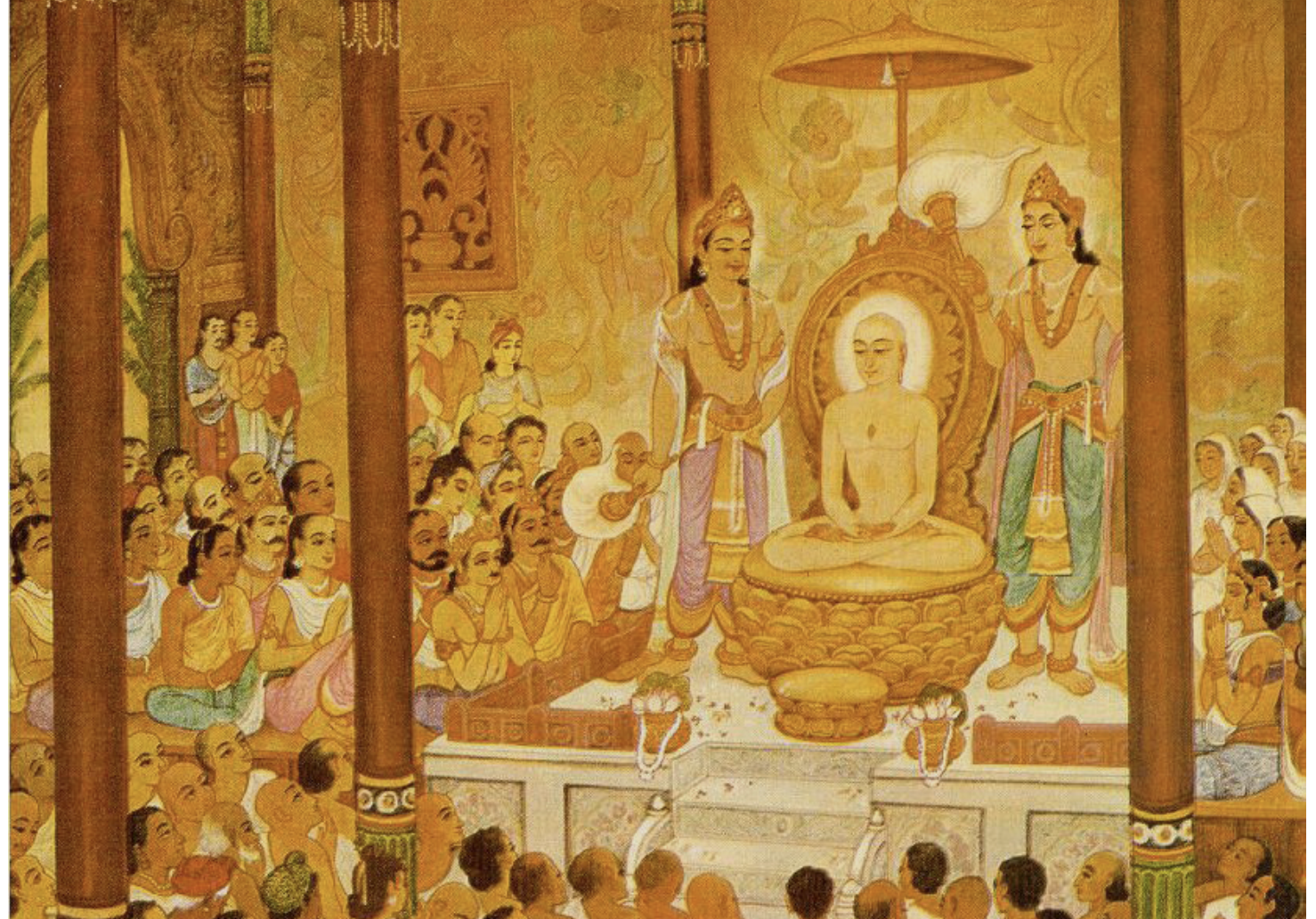
चंपाए पालिए णाम, सावए आसि वाणिए ।
महावीरस्स भगवओ, सीसे सो उ महप्पणो ॥२१.१॥
In Champa city there lived a lay follower (shrāvaka) named Pālita, a merchant. He was a disciple — a great-souled one — of the Blessed Lord Mahāvīra.
The chapter opens by anchoring the story in Champa city — one of the great ancient cities of the Jain spiritual world — and the person of Pālita, a merchant and devoted shrāvaka. A shrāvaka is a lay disciple — a Jain householder — who takes specific ethical vows while remaining in ordinary life, without full monastic renunciation. Think of it like this: a shrāvaka follows the same five rules a monk does (non-violence, truth, non-stealing, celibacy, non-possession) but in a softer, more flexible form called anuvratas (minor vows), adapted for someone who still has a family, a business, and everyday responsibilities. Pālita moved in the world of trade, buying and selling across sea routes, yet his inner life was structured by Jain ethical formation and the living teachings of Mahāvīra. That he is described as a direct disciple of Mahāvīra himself — the 24th and final Tīrthaṃkara of this cosmic cycle — is enormously significant: it grounds the whole chapter in the most direct possible spiritual lineage. A Tīrthaṃkara is a soul who has achieved infinite knowledge and then teaches others the path to liberation; Mahāvīra is the last such teacher in our current cosmic era. This is not a story that happens in some abstract past; it happens within living memory of the source of the tradition itself. The child who will emerge from this household will carry that formation all the way to its ultimate conclusion — complete liberation from the cycle of rebirth. Every detail of Pālita's life — his faith, his discipline, his courage to live ethically in a world of commerce — is the soil from which his son's extraordinary destiny will grow.
The simple version: In the city of Champa there was a merchant named Pālita, who was a devoted lay disciple of Lord Mahāvīra.