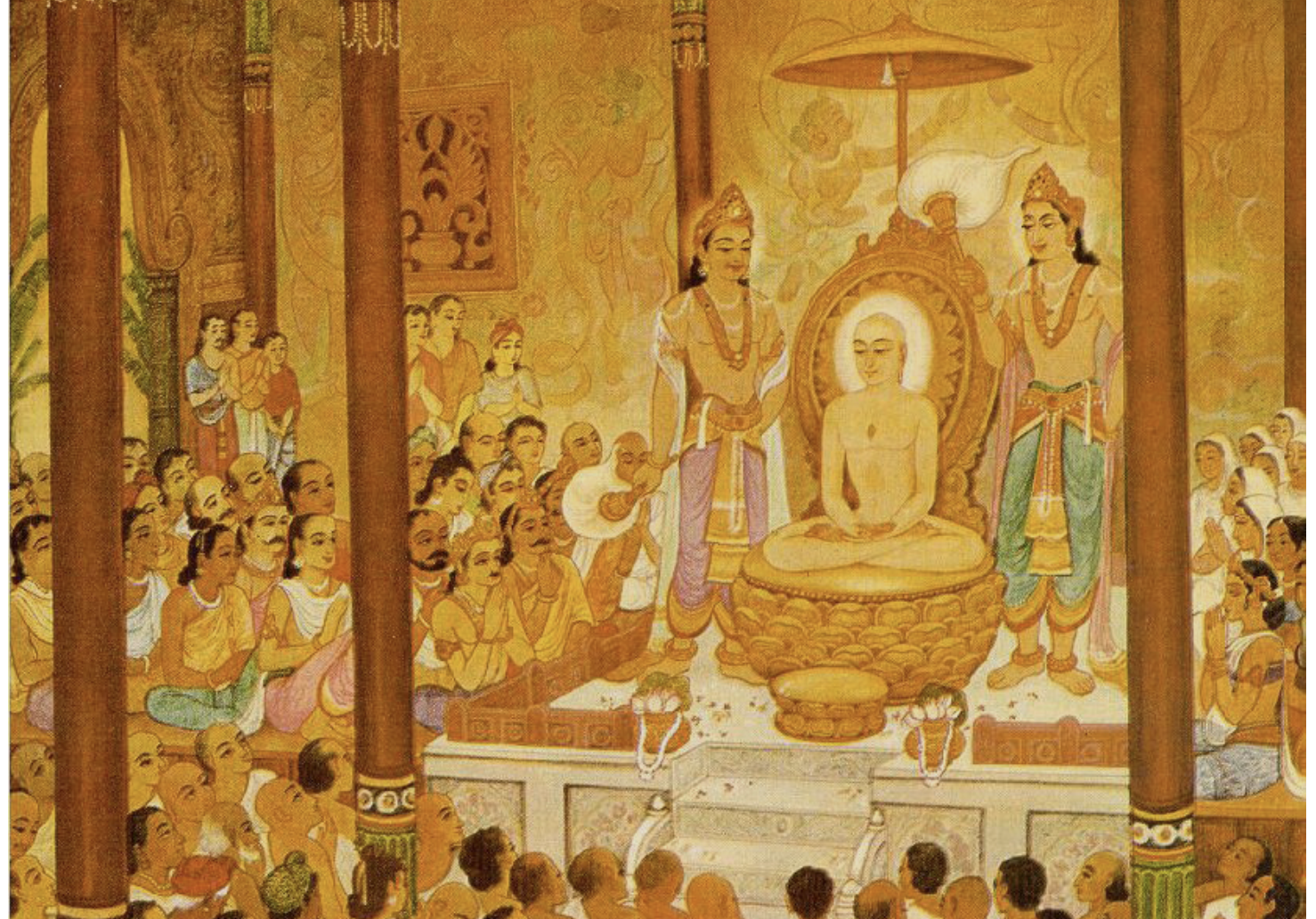
Uttaradhyayana Sutra · Chapter 25

Sacrifice (यज्ञीय)

Chapter 25 — On the True Brahmin, the Inner Yajna, and the Power of Action over Birth

Varanasi and the Sacred Sacrifice

कम्मुणा बंभणो होइ, कम्मुणा होइ खत्तिओ । वइस्सो कम्मुणा होइ, सुद्दो हवइ कम्मुणा ॥२५.३३॥

“By karma one becomes a Brahmin; by karma one becomes a Kṣatriya; by karma one becomes a Vaiśya; by karma one becomes a Śūdra.”

About This Chapter

The Sacrifice

Yajñiya — the twenty-fifth chapter — records a decisive meeting in Varanasi between the monk Jayaghosha and his brother Vijayaghosha. It reclaims the sacred vocabulary of the Vedic tradition — yajna, Brahmin, Veda, Agnihotra — and infuses it with the Śramaṇa values of non-violence, equanimity, and self-discipline.

Jayaghosha, a Brahmin by birth but a Jain monk by inner realization, challenges the ritualistic worldview of his brother. He defines the true Brahmin not by the thread he wears or the family he is born into, but by the "inner sacrifice" of the passions and the cultivation of a soul that is like a dry clay ball — unable to be smeared by the mud of worldly attachment.

Chapter Structure

I The Meeting in Varanasi: Two Brothers, Two Paths
II The Criteria of Worthiness: Who Deserves the Offering?
III The Inner Core: Sacred Knowledge Defined
IV The True Brahmin: Eleven Qualities of a Pure Soul
V The Power of Karma: Actions over Rituals
VI The Great Departure: Conversion and Liberation
45 Sutras
Varanasi Setting
6 Sections
Adhyayana 25

The 45 Sutras

Each sutra is presented with the original Prakrit, English translation, and a simplified commentary.

Part I — The Meeting in Varanasi: Two Brothers, Two Paths
25.1

माहण कुल संभूओ, आसी विप्पो महाजसो । जायाई जम्मजण्णिमि, जयघोसिति णामओ ॥२५.१॥

Born of Brahmin lineage, there was a greatly renowned Brahmin named Jayaghosha, who performed yama-niyama as his yajna (sacrifice).

The chapter opens by introducing Jayaghosha: a Brahmin by birth but a Jain monk by inner realization. The key phrase is jammajāṇṇimi — one for whom the ethical restraints (yama-niyama: ahiṃsā, satya, asteya, brahmacarya, aparigraha) constitute the real yajna. This immediately sets the philosophical axis of the chapter: the Śramaṇa tradition's inner sacrifice vs. the Brahmanical tradition's outer fire-ritual.

The simple version: Jayaghosha was a famous Brahmin who had become a Jain monk — and his "sacrifice" was not a fire ritual but the daily practice of non-violence and self-control.

Inner Sacrifice Yama-Niyama Brahmin Monks
25.2

इंदियग्गाम णिग्गाही, मग्गगामी महामुणी । गामाणुगामं रीयंतो, पत्तो वाणारसिं पुरिं ॥२५.२॥

That great muni, who had conquered the group of senses and was walking the path of liberation, traveling from village to village, arrived one day at the city of Varanasi.

Jain PrincipleMoksha · Liberation

Freedom from karma and rebirth is the soul's eternal home.

Jayaghosha is described with two of the most concentrated epithets in the Jain vocabulary of spiritual achievement: indriya-grāma-niggāhī (conqueror of the entire cluster of senses) and mārga-gāmī (one traveling the path of liberation). Varanasi (Banaras) is chosen with intent: it was the supreme center of Vedic Brahmanical learning and sacrifice, the city of ritual fire.

The simple version: Jayaghosha, the disciplined Jain monk who had mastered his senses, was traveling on foot from village to village when he arrived at the great city of Varanasi.

Self-Mastery Varanasi Moksha-Marga
25.3

वाणारसीए बहिया, उज्जाणम्मि मणोरमे । फासुए सेज्जसंथारे, तत्थ वासमुवागए ॥२५.३॥

Outside the city of Varanasi, in a delightful garden where there was a prāsuka (pure, fit) bed and seating, he took up his residence there.

Jain PrincipleAhimsa · Non-Violence

Harmlessness toward all beings is the foundation of all virtues.

A Jain monk's residence must be prāsuka — free of living organisms, acceptable under the vows of non-violence. Jayaghosha does not enter the busy city to rest; he stays on its outskirts in a garden. The contrast with Vijayaghosha's yajna-śālā (sacrifice hall) inside the city will be sharp: the monk, unattached, outside; the householder-priest, attached, inside.

The simple version: Jayaghosha set up his simple resting place in a garden on the outskirts of Varanasi — the kind of quiet, clean spot a monk needs.

Ahimsa Simplicity Monastic Life
25.4

अह तेणेव कालेणं, पुरीए तत्थ माहणे । विजयघोसिति णामेणं, जण्णं जयइ वेयवी ॥२५.४॥

At that very time, in that city, a Brahmin named Vijayaghosha — learned in the Vedas — was performing a yajna (sacrifice).

The narrative brings the two brothers into the same city at the same moment. Vijayaghosha is Jayaghosha's younger brother — the two are flesh and blood, same family — and yet they represent two entirely different orientations of life. Vijayaghosha represents orthodox Brahmanical life at its most learned and earnest: he performs yajna, he knows the Vedas.

The simple version: At that same time in Varanasi, Jayaghosha's own younger brother Vijayaghosha — a learned Vedic priest — was conducting a fire sacrifice.

Vedic Ritual Brahminhood Worldly Life
25.5

अह से तत्थ अणगारे, मासक्खमण पारणे । विजयघोसस्स जण्णम्मि, भिक्खमट्टा उवट्टिए ॥२५.५॥

Then that homeless monk (Jayaghosha), on the day of breaking his month-long fast (māsākṣamaṇa pāraṇā), arrived at Vijayaghosha's sacrifice hall to seek alms.

The detail of māsākṣamaṇa (a one-month continuous fast) is significant: this is one of the highest forms of Jain austerity. Jayaghosha is not casually wandering; he has completed thirty days without food. He comes to end this fast at his own brother's home. The scene carries enormous emotional weight — a man who has fasted for a month approaches his brother for a simple meal.

The simple version: Jayaghosha had been fasting for an entire month and went to his brother's sacrifice hall to receive a simple meal — as a monk, he could only eat what was freely given.

Austerity Fasting Alms
25.6

समुवट्टियं तहिं संतं, जायगो पडिसेहए । ण हु दाहामि ते भिक्खं, भिक्खु जायाहि अण्णओ ॥२५.६॥

The yajñika (Vijayaghosha), seeing him arrived there, refused him, saying: "O monk! I will not give you alms. Go and seek alms elsewhere."

Vijayaghosha's refusal is not personal cruelty — it is ideological. He will articulate in the next sutras exactly why he refuses: only learned Brahmin yajñikas deserve food. From his worldview, a wandering Jain monk — even his own elder brother — does not qualify. The chapter now becomes a philosophical debate encoded in a family drama.

The simple version: Vijayaghosha turned his fasting monk-brother away: "I won't give you food. Go ask someone else."

Rejection Ideological Conflict Worthiness
Part II — The Criteria of Worthiness: Who Deserves the Offering?
25.7

जे य वेयविउ विप्पा, जण्णट्टा य जे दिया । जोइसंगविउ जे य, जे य धम्माण पारगा ॥२५.७॥

Those Brahmins who are knowers of the Vedas, those twice-born who are accomplished in yajna, those who know jyotiṣa (astrology/astronomy) and its limbs, and those who have crossed to the other shore of dharma —

This sutra begins Vijayaghosha's criterion for receiving food at a yajna: the food is for the best — those who know Vedas, know sacrifice, know the astronomical sciences, and are masters of dharmaśāstra. This is the Brahmanical hierarchy of worthiness. Vijayaghosha is following his tradition's rules of dāna (giving) faithfully.

The simple version: Vijayaghosha explains who deserves food at his sacrifice: Brahmin scholars of the Vedas, experts in sacrificial ritual, astronomers, and masters of religious law.

Vedic Scholarship Hierarchy Dharma-Shastra
25.8

जे समत्था समुद्धतुं, परमप्पाणमेव य । तेसिं अण्णिमण देयं, भो भिक्खू सव्वकामियं ॥२५.८॥

Those who are capable of lifting up their own self and others to the highest — to them, O monk, this complete and all-satisfying food is to be given.

Vijayaghosha's condition is philosophically rich: the food at a yajna is for those who can liberate themselves and others. He is saying the food belongs to those who are both self-realizing and redemptive. This is precisely the criterion that Jayaghosha will turn back on him: you cannot answer who fits this description, and I can.

The simple version: Vijayaghosha says: only those who can save themselves and others deserve this best-quality food — not wandering monks.

Liberation Salvation Worthiness
25.9

सो तत्थ एवं पडिसिद्धो, जायगेण महामुणी । ण वि रुट्टो ण वि तुट्टो, उत्तमट्टु गवेसओ ॥२५.९॥

The great muni, having been thus refused by the yajñika, was neither angered nor pleased — he remained the seeker of the highest purpose (liberation).

Jain PrincipleSamata · Equanimity

Equal-mindedness in pleasure and pain reveals the soul's true nature.

CautionKrodha · Anger

Anger destroys equanimity and generates the most intense karma.

This sutra is a model of equanimity (samatā). A monk who has fasted for a month is turned away from his own brother's door — yet he is neither angry nor dejected. The phrase uttamaṭṭhu gaveṃsao ("seeker of the highest purpose") explains why: Jayaghosha's purpose is ātman, not alms.

The simple version: Being turned away didn't make Jayaghosha angry or sad — his goal was liberation, not a meal.

Equanimity Samata Inner Focus
25.10

जण्णटुं पाणहेउं वा, ण वि णिव्वाहणाय वा । तेसिं विमोक्खणट्टाए, इमं वयणमब्बवी ॥२५.१०॥

Not for the sake of yajna, not for water, not even for sustaining life — but to liberate them from ignorance and false knowledge, he spoke these words:

Jain PrincipleMoksha · Liberation

Freedom from karma and rebirth is the soul's eternal home.

CautionAvijja · Ignorance

Lack of spiritual vision perpetuates the cycle of rebirth.

Jayaghosha clarifies his own motivation for speaking: it is not the food, not even life — it is liberation of the other. This is the Jain definition of the highest compassion: dharmopadēśa (teaching of truth) for the liberation of another soul. He is not arguing to win; he is speaking to free his brother from misconception.

The simple version: Jayaghosha wasn't speaking to get food or make a point — he spoke only to free his brother from false beliefs.

Compassion True Teaching Liberation of Others
25.11

ण वि जाणासि वेयमुहं, ण वि जण्णाण जं मुहं । णक्खत्ताण मुहं जं च, जं च धम्माण वा मुहं ॥२५.११॥

You do not know the chief (mukha) of the Vedas, nor do you know what is the chief of the yajnas; you do not know the chief of the nakshatras, nor the chief of the dharmas.

Jayaghosha goes to the root. He asks: "You said the food is for one who knows Vedas, yajna, jyotiṣa, and dharma — tell me then: what is the principal (mukha) of each of these?" This exposes the gap between ritual competence and the deepest inner truth of the traditions Vijayaghosha claims to uphold.

The simple version: "You don't actually know the most important thing about Vedas, sacrifice, astronomy, or dharma," Jayaghosha tells him.

Core Knowledge Inquiry Inner Meaning
25.12

जे समत्था समुद्धतुं, परमप्पाणमेव य । ण ते तुमं वियाणासि, अह जाणासि तो भण ॥२५.१२॥

You do not know those who are capable of lifting up their own self and others to the highest. If you do know, then tell me.

Jayaghosha picks up Vijayaghosha's own criterion — "the food is for those who can liberate self and others" — and turns it into a question. The challenge is elegant: Vijayaghosha, expert in Vedic learning, cannot name who genuinely has the power to liberate.

The simple version: "You said the best food goes to those who can liberate themselves and others — but do you actually know who that is? Tell me if you do."

Liberation Hidden Knowledge Self-Realization
25.13

तस्सक्खेव पमोक्खं च, अचयंतो तहिं दिओ । सपरिसो पंजली होउं, पुच्छइ तं महामुणिं ॥२५.१३॥

Unable to give answers to the monk's sharp questions, the Brahmin (Vijayaghosha), together with his entire assembly, joined his palms and asked the great muni:

A transformation has occurred. The man who just refused alms is now standing with folded hands before his brother, asking him to teach. Jayaghosha did not argue or shame — he simply asked what the Brahmin could not answer. The folded hands (paṃjalī) represent the hierarchy inverting.

The simple version: Vijayaghosha couldn't answer, and the whole assembly joined him in bowing to Jayaghosha and asking him to explain.

Humility Learning Reverence
25.14

वेयाणं च मुहं बूहि, बूहि जण्णाण जं मुहं । णक्खत्ताण मुहं बूहि, बूहि धम्माण वा मुहं ॥२५.१४॥

Tell us the chief of the Vedas; tell us what is the chief of the yajnas; tell us the chief of the nakshatras; tell us the chief of the dharmas.

Vijayaghosha asks the same four questions back — formally and reverently. Sutra 11 was the challenge; sutra 14 is the submission. The teacher creates the question, then the student discovers the need to ask it.

The simple version: Vijayaghosha now humbly asks Jayaghosha the exact same four questions — with respect instead of dismissal.

Seeking Truth Formality Submission
25.15

जे समत्था समुद्धतुं, परमप्पाणमेव य । एयं मे संसयं सव्वं, साहू कहसु पुच्छिओ ॥२५.१५॥

Who is truly capable of lifting up their own self and others to the highest? I have doubt about all of this — O sādhu! kindly tell me, for I am asking you.

Vijayaghosha admits to saṃsaya (doubt), the most significant admission in Jain epistemology. Doubt is the beginning of right knowledge. The transformation of doubt into faith through a teacher's wisdom is the arc of the chapter.

The simple version: Vijayaghosha confesses: "I have genuine doubts about all of this — please teach me, holy monk."

Doubt Honesty Initiation
Part III — The Inner Core: Sacred Knowledge Defined
25.16

अग्गिहुत्तमुहा वेया, जण्णट्टी वेयसां मुहं । णक्खत्ताण मुहं चंदो, धम्माणं कासवो मुहं ॥२५.१६॥

Agnihotra is the chief of the Vedas; the yajñārthī (the one performing yajna for liberation) is the chief among those who know the Vedas; the Moon is the chief of the nakshatras; and Kāśyapa (Mahavira) is the chief of the dharmas.

Jain PrincipleMoksha · Liberation

Freedom from karma and rebirth is the soul's eternal home.

Jayaghosha answers with precision. Agnihotra is the core of Vedic religion. The yajñārthī — one seeking liberation, not rewards — is the best of scholars. The Moon leads the stars. Most significantly: Kashyap-gotriya Mahavira is the chief of dharmas. Jayaghosha names his own teacher, bridging two worlds through their shared lineage.

The simple version: The heart of the Vedas is the fire-sacrifice; the best Vedic scholar is the one who performs yajna for liberation; the Moon leads the stars; and Mahavira — of your own Kashyap lineage — is the highest among all paths.

Mahavira Agnihotra True Scholar
25.17

जहा चंदं गहाईया, चिट्टुंति पंजलीउडा । वंदमाणा णमंसता, उत्तमं मणहारिणो ॥२५.१७॥

Just as the grahas (planets) and nakshatras stand with folded hands before the utterly captivating Moon, bowing and saluting it —

This simile introduces the Tīrthaṃkara's spiritual radiance, which is beyond even the Moon's celestial splendor. The image of planets standing with folded palms — as Vijayaghosha and his assembly just did — creates a resonance: the whole cosmos bows to the highest truth.

The simple version: Just as all the planets and stars stand with reverence before the beautiful Moon — so too the highest is naturally honored by all.

Reverence Cosmic Order Splendor
25.18

अजाणगा जण्णवाई, विज्जा माहणसंपया । मूढा सज्झायतवसा, भासच्छणा इवग्िणो ॥२५.१८॥

The yajna-vādis (those who advocate external sacrifice) are ignorant of liberation-knowledge; they are like fire covered with ash: appearing calm outside, but burning within.

Jain PrincipleMoksha · Liberation

Freedom from karma and rebirth is the soul's eternal home.

The simile is precise: fire covered with ash appears extinguished but still burns inside. External ritualists appear serene, but their inner passions (kaṣāya) are unsubdued. Their practice stirs rather than settles the inner flame.

The simple version: Those who only know outer sacrifice are like fire covered in ash — they look calm on the outside but are still burning with desire within.

False Calm Inner Passions Ritualism
Part IV — The True Brahmin: Eleven Qualities of a Pure Soul
25.19

जे लोए बंभणो वुत्तो, अग्गी व महिओ जहा । सया कुसल संदिट्टुं, तं वयं बूम माहणं ॥२५.१९॥

One who in this world is called a Brahmin, who is honored like fire, whom the wise constantly behold (as worthy) — that one we call a true Brahmin (māhaṇa).

Sutras 19–29 form the reclamation of what "Brahmin" truly means. The true Brahmin is the one whom the spiritually wise (kusala) point to and recognize as worthy. This is not birth-based recognition, but recognition of spiritual competence.

The simple version: The true Brahmin is someone the wise recognize as truly worthy — honored by all like fire, which is always pure.

Purity Recognition Brahminhood
25.20

जो ण सज्जइ आगंतुं, पव्वयंतो ण सोयइ । रमए अज्जवयणम्मि, तं वयं बूम माहणं ॥२५.२०॥

One who does not become attached to those who come to him, who does not grieve when leaving, who delights in the words of the āryas — that one we call a true Brahmin.

Jain PrincipleVairāgya · Detachment

Release from desire is the gateway to spiritual awakening.

CautionSanga · Attachment

Emotional bonds to people and things perpetuate suffering.

The true Brahmin is defined by non-attachment in both directions: neither grasping when something arrives, nor lamenting when it departs. This is vairāgya (detachment) as a lived quality, coupled with a genuine inner delight in truth.

The simple version: A true Brahmin doesn't cling to those who come into his life and doesn't cry when they leave — instead he finds his joy in the teachings of the wise.

Non-attachment Detachment Vairagya
25.21

जायरूवं जहामट्टुं, णिढुंतमल पावगं । रागदोसभयाईयं, तं वयं बूम माहणं ॥२५.२१॥

One like pure gold refined by fire — purified of all impurities — who has transcended rāga (attachment), dveṣa (aversion), and fear — that one we call a true Brahmin.

CautionSanga · Attachment

Emotional bonds to people and things perpetuate suffering.

When gold is rubbed on a touchstone and exposed to fire, its purity is revealed. The monk — through restraint and austerity — undergoes precisely this process. Raga, dvesha, and bhaya (fear) are the fundamental impurities of the soul.

The simple version: A true Brahmin is like gold tested by a touchstone and refined by fire — all impurities of desire, hatred, and fear have been burned away.

Refinement Purity Transcending Fear
25.22

तवस्सियं किसं दंतं, अविचय मंस सोणियं । सुव्वयं पत्तणिव्वाणं, तं वयं बूम माहणं ॥२५.२२॥

One who is a practitioner of tapas, emaciated, controlled, whose flesh and blood have dried, who observes beautiful vows, who has reached nirvāṇa — that one we call a true Brahmin.

Jain PrincipleTapa · Austerity

Deliberate practice that weakens karma and strengthens the soul.

This sutra gives a physical description of the monk's body as evidence of inner transformation. The body is lean from fasting, the senses are mastered — this is the body of one who has "offered" their physical self in the inner yajna.

The simple version: The true Brahmin is someone whose body shows the marks of serious practice — lean, controlled, vow-keeping, and heading toward liberation.

Tapas Nirvana Self-Control
25.23

तसे पाणे वियाणेत्ता, संगहेण य थावरे । जो ण हिंसइ तिविहेणं, तं वयं बूम माहणं ॥२५.२३॥

One who, knowing in detail the mobile and stationary living beings, does not harm them in any of the three ways — that one we call a true Brahmin.

This sutra specifically condemns the yajna's core act: the killing of animals. Ahiṃsā must arise from knowledge (viyāṇettā). Knowing that all beings are conscious and feeling is the foundation of true Brahminhood.

The simple version: The true Brahmin knows that all creatures — moving and still — have life, and never harms any of them in thought, word, or deed.

Ahimsa Non-violence Knowledge
25.24

कोहा वा जइ वा हासा, लोहा वा जइ वा भया । मुसं ण वयइ जो उ, तं वयं बूम माहणं ॥२५.२४॥

One who does not speak falsehood — whether out of anger, or jesting, or greed, or fear — that one we call a true Brahmin.

CautionLobha · Greed

Craving for possessions generates binding karma without ceasing.

Truth-telling (satya) is tested in difficult moments. Anger, humor, greed, and fear are the full spectrum of human falsehood. A true Brahmin maintains satya even under these pressures.

The simple version: A true Brahmin never lies — not when angry, not when joking around, not for money, not out of fear.

Truth Satya Integrity
25.25

चित्तमंतमचित्तं वा, अप्पं वा जइ वा बहुं । ण गिण्हइ अदत्तं जे, तं वयं बूम माहणं ॥२५.२५॥

One who does not take what has not been given — whether the thing is sentient or insentient, small or large — that one we call a true Brahmin.

Asteya (non-stealing) is the third great vow. The true Brahmin respects the property and life of others, taking only what is freely offered, regardless of the value or nature of the object.

The simple version: A true Brahmin never takes anything that hasn't been freely given — whether it's small or large, alive or not.

Asteya Non-stealing Respect
25.26

दिव्वमाणुस्सतेरिच्छं, जो ण सेवइ मेहुणं । मणसा कायवक्केणं, तं वयं बूम माहणं ॥२५.२६॥

One who does not engage in sexual activity — with divine, human, or animal beings — through mind, body, or speech — that one we call a true Brahmin.

Complete brahmacarya is the standard. It is not just a physical restraint but a mental and verbal one as well, encompassing all realms of existence.

The simple version: A true Brahmin observes complete brahmacarya — no sexual activity in thought, word, or deed, with any being anywhere.

Brahmacarya Purity Celibacy
25.27

जहा पोमं जले जायं, णोविलिप्पइ वारिणा । एवं अलित्त कामेहिं, तं वयं बूम माहणं ॥२५.२७॥

Just as a lotus born in water is not wetted by the water — so one who lives in the world untouched by sense-pleasures — that one we call a true Brahmin.

The lotus simile represents the condition of being present but unattached. The lotus does not flee the pond; the monk does not flee the world. Both are simply alitta — unstained by their surroundings.

The simple version: Like a lotus that grows in water but never gets wet, the true Brahmin lives among worldly pleasures without being touched by them.

Lotus Unstained Worldly Existence
25.28

अलोलुयं मुहाजीवी, अणगारं अकिंचणं । असंसत्तं गिहत्थेसु, तं वयं बूम माहणं ॥२५.२८॥

One who is free of greed, who lives by mere alms, who is homeless, who possesses nothing, who is not entangled with householders — that one we call a true Brahmin.

CautionLobha · Greed

Craving for possessions generates binding karma without ceasing.

Mudhajivi means one who receives alms without calculation of return. A monk who is completely without possessions (akinchana) and stays unentangled from householder affairs lives non-attachment in the body.

The simple version: The true Brahmin owns nothing, lives off what is freely given, has no home, and stays unentangled from the business of householders.

Poverty Freedom Alms
25.29

जहित्ता पुव्वसंजोगं, णाइसंगे य बंधवे । जो ण सज्जइ भोगेसु, तं वयं बूम माहणं ॥२५.२९॥

One who has abandoned all previous bonds, who has released attachment to relatives, who does not cling to pleasures — that one we call a true Brahmin.

CautionSanga · Attachment

Emotional bonds to people and things perpetuate suffering.

This completes the eleven-quality portrait. Releasing attachment to relatives is precisely what Jayaghosha has done. He speaks to his brother not from ego but from a state of total freedom.

The simple version: The true Brahmin has cut through every bond — family ties, past relationships, sense pleasures — and clings to none of them.

Family Bonds Freedom Renunciation
Part V — The Power of Karma: Actions over Rituals
25.30

पसुबंधा सव्ववेया, जट्टुं च पावकम्मुणा । ण त तायंति दुस्सीलं, कर्माणि बलवंति हि ॥२५.३०॥

All the Vedas, with their animal sacrifices and evil-action-producing yajnas, cannot protect the immoral person — for karmas are powerful and must bear their fruit.

This is the decisive argument against external sacrifice. Violence (himsa) is karma, and karma must bear fruit. No amount of chanting can shield the soul from the consequences of its actions. Karma is the most powerful force.

The simple version: No amount of Vedic chanting or fire sacrifice can protect an immoral person from the consequences of their actions — karma is more powerful than ritual.

Karma Cause and Effect Ritual Critique
25.31

ण वि मुंडिएण समणो, ण ओंकारेण बंभणो । ण मुणी रणवासेणं, कुसचीरेण ण तावसो ॥२५.३१॥

One does not become a śramaṇa merely by shaving one's head; one does not become a Brahmin merely by chanting Oṃ; one does not become a muni by living in forests.

Jayaghosha targets the external marks of both traditions. A shaved head, an Om-chant, a forest hermitage — none of these make a person what they claim. Form without substance is hollow on both sides.

The simple version: Shaving your head doesn't make you a monk, chanting Oṃ doesn't make you a Brahmin, living in a forest doesn't make you a sage, and wearing bark clothes doesn't make you an ascetic.

Substance Outer Marks Reality
25.32

समयाए समणो होइ, बंभचेरेण बंभणो । णाणेण य मुणी होइ, तवेण होइ तावसो ॥२५.३२॥

One becomes a śramaṇa by equanimity (samatā); one becomes a Brahmin by brahmacarya; one becomes a muni by knowledge (jñāna); one becomes a tapasvin by tapas.

Jain PrincipleTapa · Austerity

Deliberate practice that weakens karma and strengthens the soul.

The inner definition of each title: samatā makes a śramaṇa; brahmacarya (abiding in the self) makes a Brahmin; jñāna makes a muni; and tapas makes a tapasvin. This is the true meaning of spiritual attainment.

The simple version: True titles are earned by inner qualities — equanimity makes a monk, celibacy makes a Brahmin, wisdom makes a sage, and austerity makes an ascetic.

Inner Qualities Samata Knowledge
25.33

कम्मुणा बंभणो होइ, कम्मुणा होइ खत्तिओ । वइस्सो कम्मुणा होइ, सुद्दो हवइ कम्मुणा ॥२५.३३॥

By karma one becomes a Brahmin; by karma one becomes a Kṣatriya; by karma one becomes a Vaiśya; by karma one becomes a Śūdra.

The most explicit statement on caste: it is determined entirely by karma (action), not by birth or bloodline. Originally humanity was one; the division arose through action over time. Jayaghosha is Brahmin by birth but monk by karma.

The simple version: You become a Brahmin, warrior, merchant, or servant by what you do — not by which family you were born into.

Equality Action over Birth Karma
25.34

एए पाउकरे बुद्धे, जेहिं होइ सिणायओ । सव्वकम्म विणिमुक्कं, तं वयं बूम माहणं ॥२५.३४॥

These are the virtues taught by the Tīrthaṃkaras: by practicing them, one becomes a snātaka (a fully purified soul) — freed from all karma. That one we call a true Brahmin.

Snātaka (snātaka) is reclaimed to mean the one who has "bathed" in the river of jñāna and saṃyama. These virtues lead to the total shedding of karma, and they were revealed by the Tīrthaṃkaras themselves.

The simple version: The Tīrthaṃkaras revealed these qualities — the one who lives them is truly "bathed clean" of all karma. That is the true Brahmin.

Tirthankara Purification Snataka
25.35

एवं गुण समाउत्ता, जे भवंति दिउत्तमा । ते समत्था समुद्धतुं, परमप्पाणमेव य ॥२५.३५॥

Those who are endowed with these qualities and are the best among the twice-born — they are truly capable of lifting up their own self and others to the highest.

Jain PrincipleMoksha · Liberation

Freedom from karma and rebirth is the soul's eternal home.

Jayaghosha completes his answer: those endowed with the eleven qualities are the ones truly capable of liberation. They, and only they, deserve the name "best of the twice-born." The argument is closed with precision.

The simple version: Those who actually have these qualities ARE the ones capable of liberating themselves and others — they are the true "best Brahmins."

Final Answer Liberation Capability
Part VI — The Great Departure: Conversion and Liberation
25.36

एवं तु संसए छिण्णे, विजयघोसे य माहणे । समुदाय तयं तं तु, जयघोसं महामुणिं ॥२५.३६॥

In this way, as the doubt of Vijayaghosha the Brahmin was completely dispelled, he took the teaching of the great muni Jayaghosha fully into his heart.

CautionAvijja · Ignorance

Lack of spiritual vision perpetuates the cycle of rebirth.

Doubt (saṃśaya) has been cut away. Vijayaghosha's recognition is complete: the muni he dismissed is his elder brother and teacher. Truth does not force; it patiently dispels the mist of ignorance.

The simple version: Vijayaghosha's doubts were completely cut away — he took Jayaghosha's teaching fully to heart.

Clarity Conversion Heart
25.37

तुट्टे य विजयघोसे, इणमुदाहु कयंजली । माहणत्तं जहाभूयं, सुट्टु मे उवदंसियं ॥२५.३७॥

The delighted Vijayaghosha, with joined palms, said: "You have shown me the true and complete nature of Brahminhood — excellently, exactly as it is."

Jahābhūyaṃ means seeing reality exactly as it is. Vijayaghosha is delighted to have seen the truth. The genuine seeker welcomes correction because it brings them closer to what they truly sought.

The simple version: Vijayaghosha bowed with joy: "You have shown me what Brahminhood truly is — exactly as it is."

Joy Reality Discovery
25.38

तुभे जइया जण्णाणं, तुभे वेयविउ विउ । जोइसंगिवउ तुभे, तुभे धम्माण पारगा ॥२५.३८॥

"You are indeed the true yajñārthī; you are the true knower of the Vedas; you are the knower of jyotiṣa; you have truly crossed to the other shore of dharma."

Vijayaghosha affirms that Jayaghosha meets every criterion he once set for worthiness. The man who was refused alms is now recognized as the most worthy recipient of the entire yajna.

The simple version: Vijayaghosha now recognizes: "You are the true Vedic scholar, the true sacrificer, the true sage — you are everything I said I was looking for."

Acknowedgement Fulfilment Wisdom
25.39

तुभे समत्था समुद्धतुं, परमप्पाणमेव य । तमणुग्गहं करेहम्ह, भिक्खेण भिक्खु उत्तमा ॥२५.३९॥

"You are truly capable of lifting up your own self and others to the highest. Therefore, O best of monks! please do us the grace of accepting alms from us."

The narrative comes full circle. Vijayaghosha asks Jayaghosha to please accept alms — as a grace (anugraha) to the giver. The giver now recognizes that the presence of the monk is the true gift.

The simple version: "You are truly the one who can lift us to liberation — please honor us by accepting our alms, O greatest of monks."

Anugraha Grace Receiving
25.40

ण कज्जं मज्झ भिक्खेण, खिप्पं णिक्खमसू दिया । मा भमिहिसि भयावट्टे, घोरे संसारसागरे ॥२५.४०॥

"I have no need for your alms. O Brahmin! Quickly take the initiation of renunciation. Do not wander in the terrifying ocean of saṃsāra."

Jain PrincipleTyaga · Renunciation

Voluntarily releasing worldly attachments leads to spiritual freedom.

CautionImpermanence and Death

All worldly things are temporary—clinging to them brings suffering.

Jayaghosha declines the alms and instead urges immediate renunciation. He has seen the ripeness of his brother's soul. Samsara is a terrifying ocean with whirlpools (bhayavatte) of birth and death.

The simple version: "I don't need your food — what I need is for you to renounce right now. Don't keep spinning in the terrifying ocean of rebirth."

Urgency Renunciation Samsara
25.41

उवलेवो होइ भोगेसु, अभोगी णोविलिप्पइ । भोगी भमइ संसारे, अभोगी विप्पमुच्चइ ॥२५.४१॥

Karmic bondage arises from sense-enjoyments; one who does not enjoy is not smeared. The enjoyer wanders in saṃsāra; the non-enjoyer is swiftly liberated.

Lepa (smearing) occurs through sense-enjoyment (bhoga), which makes the soul "wet" and adhesive to karma. The abhogī — who is dried by restraint — cannot be stained. This is the path to freedom.

The simple version: Sense-pleasures stick to the soul like paint — the one who indulges keeps reincarnating, the one who doesn't is quickly freed.

Karmic Bondage Lepa Sense Enjoyment
25.42

उल्लो सुक्को य दो छूढा, गोलया मट्टियामया । दो वि आविडिया कुड्डे, जो उल्लो सोत्थ लग्गइ ॥२५.४२॥

A wet ball and a dry ball both hit the wall, but only the wet ball sticks to it.

The soul is the clay ball; the world is the wall; karma is the moisture. The dry ball (the soul cleansed by restraint) strikes the same wall but bounces free. The metaphor makes karma-bandha viscerally comprehensible.

The simple version: Throw a wet mud ball and a dry mud ball at a wall — only the wet one sticks. The soul wet with desire gets stuck in the world; the dry, detached soul bounces free.

Metaphor Detachment Karma-Bandha
25.43

एवं लग्गंति दुम्मेहा, जे णरा कामलालसा । विरत्ता उ ण लग्गंति, जहा से सुक्कगोलए ॥२५.४३॥

The foolish who are enamored of sense-pleasures get stuck. But the detached do not stick — just like the dry clay ball.

Jain PrincipleVairāgya · Non-Attachment

Detachment from worldly desires allows the soul to perceive its true nature.

Ritual activity, if performed with desire and passion, keeps the ball wet. Only the genuine inner withdrawal (vairagya) dries the ball. The detached do not stick to the cycle of rebirth.

The simple version: Foolish people who crave pleasures get stuck in rebirth — but the truly detached, like the dry ball, don't cling to anything and go free.

Vairagya Attachment Release
25.44

एवं से विजयघोसे, जयघोसस्स अंतिए । अणगारस्स णिक्खंतो, धम्मं सोच्चा अणुत्तरं ॥२५.४४॥

In this way, Vijayaghosha, having heard the unsurpassed dharma from Jayaghosha, took initiation into homelessness.

Socca (having heard) is the operative word. It is genuine listening with an open heart that converts. Vijayaghosha heard the unsurpassed (anuttara) dharma and took the "great departure."

The simple version: Having listened deeply to the highest teaching from his monk-brother, Vijayaghosha renounced everything and took monastic initiation on the spot.

Initiation Listening Dharma
25.45

खवित्ता पुव्वकम्माइं, संजमेण तवेण य । जयघोस-विजयघोसा, सिद्धिं पत्ता अणुत्तरं ॥२५.४५॥
— ति बेमि ।

Having destroyed all past karmas through saṃyama and tapas, both Jayaghosha and Vijayaghosha attained the unsurpassed siddhi. — Thus I speak.

Jain PrincipleTapa · Austerity

Deliberate practice that weakens karma and strengthens the soul.

The chapter closes with the brothers exhausting all karma (nirjarā) and attaining the Siddha state. Restraint (samyama) and austerity (tapas) are the twin pillars of liberation. Ti bemi is Mahavira's closing seal.

The simple version: Through restraint and deep austerity, both brothers burned away all their past karma and reached the ultimate liberation — the state of the Siddhas. Thus it is taught.

Liberation Siddha Finality Thus I Say
॥ अध्ययन-२५ सम्पूर्ण ॥

End of Chapter 25 — The Sacrifice

← Ch 24 Ch 26 →